





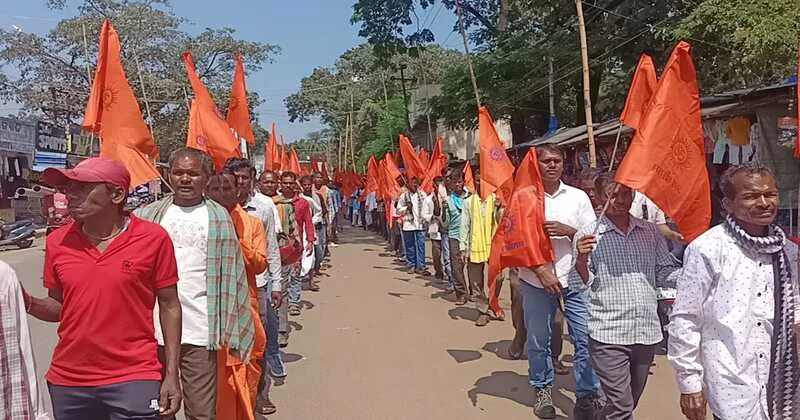
Bhubaneswar: The Jati Janajati Surakshya Manch, Koraput district, staged a protest rally in Jeypore demanding a complete ban on religious conversions across the country and calling for strict action against those attempting conversions. The Surakshya Manch also submitted a memorandum to the administration highlighting their concerns.
The rally, organized by The Jati Janajati Surakshya Manch, began at the old government bus stand in Jeypore , a predominantly tribal area of Koraput district, and proceeded along the main road, culminating at Surya Mahal. At Surya Mahal, a protest demonstration and public meeting were held, drawing participation from several prominent leaders and community members.
During the meeting, speakers stated that religious conversion is an anti-national activity. They noted that even before India’s independence, Christian missionaries across the country had been enticing simple and innocent tribal, forest-dwelling, and Scheduled Caste populations into conversion through various forms of inducements. Mahatma Gandhi had referred to conversion as a “grave sin” and stated that, had he been in power, he would have completely stot the conversion activity . Speakers described it as shameful that conversions continue in Bharat today with little or no action from the administration.
The speakers also highlighted that conversions are being orchestrated with foreign funding, indicating a large-scale conspiracy behind these efforts. They demanded a complete ban to all such conversions. While laws exist in the state to prevent religious conversions, the speakers lamented that these are not being implemented effectively. They urged that the existing legal provisions be strictly enforced.
Further, the forum called for the enactment of stricter laws to curb illegal conversions and protect religious and cultural rights. They expressed opposition to ongoing efforts in the Supreme Court aimed at diluting or removing Article 25 of the Constitution, which guarantees the freedom of religion, emphasizing the need to safeguard the autonomy and rights of tribal and Scheduled Caste communities.
The rally and protest reflected growing concern among local communities about the preservation of tribal culture and identity. Organizers stressed that the movement aims not to restrict religious freedom but to prevent forced or inducement-based conversions that threaten the social and cultural fabric of vulnerable communities.
Speakers stated that Article 25 of our Constitution guarantees every person the freedom to practice and propagate his or her religion, but this right is subject to public order, morality, and health. They clarified that ‘propagation’ does not equate to ‘conversion,’ as the Judiciary has ruled in numerous cases. After independence, eminent personalities in the country called for a central law to prevent illegal religious conversions. The issue was discussed in the Constituent Assembly, but the ruling party at the time believed that only state governments had the authority to enact such laws. As a result, several states, including Madhya Pradesh, Uttar Pradesh, Uttarakhand, Himachal Pradesh, Gujarat, Odisha, Chhattisgarh, and Rajasthan, enacted Religious Freedom Acts. The aim of these laws is not to suppress faith, but to prevent religious conversions carried out through force, fraud, and allurement. Currently, the forces involved in illegal religious conversions and their supporters have challenged these constitutional laws in their respective High Courts. Unfortunately, the Hon’ble Supreme Court has ordered a combined hearing of all these cases.
Speakers emphasised that since these matters fall under state jurisdiction, the Supreme Court should consider these cases only after the respective High Courts have made their decisions. They noted that the circumstances of each state are different, as are the nature of their laws and the grounds for opposing them. It is perplexing how all these matters can be heard together.
The Jati Janajati Surakshya Manch demanded a complete ban on illegal religious conversions and called for stricter enforcement of anti-conversion laws. The forum also urged that the anti-conversion laws enacted in various states be implemented rigorously. Additionally, they called for Odisha to introduce provisions similar to those in Rajasthan, which prescribe up to eight years of imprisonment and fines of up to two lakh rupees for individuals engaging in illegal conversions.
Speakers highlighted that in Koraput district, several individuals who have adopted Christianity continue to receive Scheduled Caste recognition and access to government benefits. They urged for the identification of such individuals and strict action against them.
The program, organized by the Jati Janajati Surakshya Manch in collaboration with the Vishva Hindu Parishad, was attended by several prominent leaders, including Babu Bhai Bajrangi, Bunu Rath, Tejeshwar Panda, and Ganga Nayak.
















Comments