





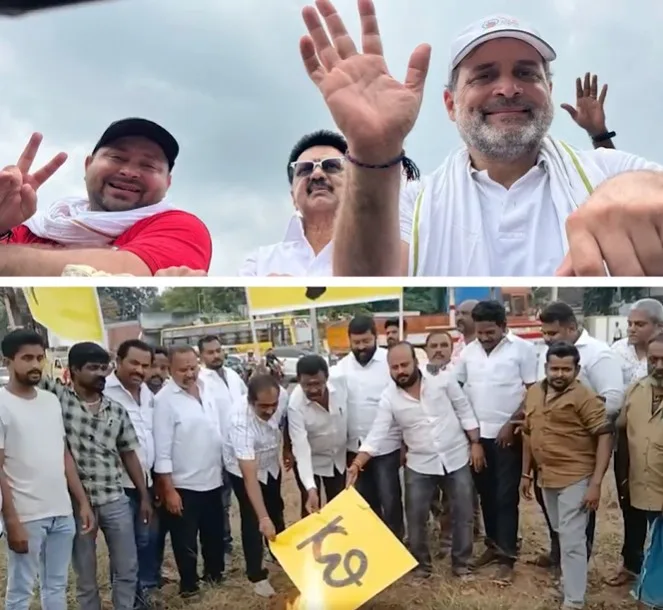
Another faux pas by the Dravidian Model government has once again revealed its deep-rooted anti-Hindi sentiment. Following strong public outrage and objections from its I.N.D.I Alliance allies, the Tamil Nadu government has reportedly backtracked on its alleged proposal to move a Bill in the current Assembly session.
It is reliably learnt from multiple sources that the Stalin government was all set to introduce legislation in the Tamil Nadu Assembly seeking to ban Hindi hoardings, boards, movies, and songs across the State. Former Rajya Sabha MP T.K.S. Elangovan had explicitly stated, “We won’t do anything against the Constitution. We are against the imposition of Hindi,” providing what many interpreted as official confirmation of the party’s intent.
The news went viral on social media, with many condemning the move as unconstitutional, pointing out that Hindi is the official language of India and one of the 22 scheduled languages. Critics argued that if Tamil Nadu bans Hindi today, tomorrow other States might ban Tamil or other recognised languages. They called it sheer fanaticism and an example of the DMK’s long-standing aversion to Hindi, which it has opposed since the 1960s under the pretext of fighting “Hindi imposition.” Many said it was a time-tested DMK ploy to divert attention from major issues such as the Supreme Court handing over the Karur Stampede probe to the CBI.
Diversion Model. pic.twitter.com/hyPTXzx8vu
— MR.Anil (@Saffron_Anil_) October 16, 2025
Like Deputy CM Udhayanidhi Stalin’s controversial “eradication of Sanatana Dharma” remark, the proposed ban on Hindi songs, films, and hoardings has the potential to create a political dent in Bihar, where election campaigning is in full swing. The I.N.D.I Alliance reportedly advised Stalin against this ill-timed move, warning it could harm their poll prospects in the Hindi heartland.
Critics pointed out, “DMK often raises issues like Hindi imposition, North–South divide, self-rule, or imaginary delimitation only to divert public attention. Yet, during elections, it freely uses Hindi banners and campaigns in Hindi in North Indian-dominated areas. Would it dare ban Hindi in CBSE schools or the Hindi Prachar Sabha? For DMK, the two-language formula applies only to government schools—not to the CBSE institutions run by politicians. All DMK family members know Hindi and study in their own schools and colleges. The party continues to fool the public with rhetoric while pretending to champion the Tamil language.”
After facing heavy backlash, the alleged “fact-checking” unit of the DMK government dismissed the report as a rumour, saying no such proposal for a Bill had been received.
Rumor about Hindi language ban bill in Tamil Nadu Assembly
Fake News:
It is being claimed that the Tamil Nadu government, led by the Honorable Chief Minister, is planning to introduce a bill in the Legislative Assembly to ban the Hindi language in all forms.
Truth:
This claim…
— TN Fact Check (@tn_factcheck) October 15, 2025
The Chief Minister warned the public not to spread rumours and unfounded news. However, it was the DMK family-controlled Sun News and Dinakaran that first broke the story. Observers suggest the DMK was “testing the waters” to gauge public reaction, and when it received widespread criticism, it quickly labelled the story as a rumour.
Former TN BJP chief K. Annamalai sarcastically commented, “AP CM signed a landmark agreement with Google to set up a $15 billion AI data centre in Visakhapatnam. TN CM lets table a Bill to ban Hindi in our State. Yo! DMK and their pathetic politics and misplaced priorities, sigh!”
Taking to social media platform X, Annamalai added, “The DMK government’s plan to table a Bill to ban Hindi wasn’t a rumour; it was premeditated. Their cadres, as usual, began their trademark theatrics of blackening and burning Hindi letters. DMK functionaries in Pollachi yesterday burned Hindi letters in celebration after learning about the Bill that was to be tabled in the Assembly. Joblessness at its peak! I.N.D.I Alliance – Divisive by nature, united by corruption!”
The DMK government’s plan to table a bill to ban Hindi wasn't a rumour; it was premeditated, and their cadres, as usual, started their trademark theatrics of blackening & burning Hindi letters.
DMK functionaries in Pollachi yesterday burned Hindi letters in celebration after… pic.twitter.com/StdPc7lRBj
— K.Annamalai (@annamalai_k) October 16, 2025
Critics further asked, “If there was no such proposal, how come DMK cadres were burning Hindi alphabets and staging protests in Pollachi and other places? There’s no smoke without fire.”
Dear @INCIndia ,
People of BiHar , take note .
I feel it’s an arm twisting tactic to keep congress in its place before the Bihar polls !
Poor congress and poorer Raga! https://t.co/YtJIzRQjVQ— karthik gopinath (@karthikgnath) October 15, 2025
Delhi-based senior journalist Rajagopalan, in a tweet, detailed the timeline of the proposed Bill and its subsequent withdrawal. He wrote, *“The anti-Hindi Bill was initially set to be tabled in the Tamil Nadu Assembly, sparking immediate attention from television channels. However, the government abruptly dropped the proposal following two critical phone calls—one from Patna and another from New Delhi to Chennai.
11:00 am – Anti-Hindi Bill in Tamil Nadu Assembly likely; breaking story on all television channels.
12:30 pm – Phone calls from Patna and New Delhi to Chennai: ‘We will lose Bihar,’ say @INCIndia @yadavtejashwi. Alarm bells!
12:45 pm – @arivalayam Govt drops anti-Hindi Bill after two calls. Scared DMK? I.N.D.I Bloc in panic.”*
Critics say the DMK is not serious about issues faced by the public. They accuse it of wasting time on self-publicity, waging war with constitutional heads, and raking up old topics merely to corner the NDA government and the opposition.
They cited today’s proceedings in the State Assembly as an example. Chief Minister M.K. Stalin moved a resolution before the House to reject certain remarks contained in the Governor’s message regarding the Tamil Nadu Siddha Medical University Bill, 2025, particularly a portion that, he said, “undermined the dignity of the House.”
The resolution was adopted unanimously. Stalin stated that the Governor does not have powers to offer views on a Bill before it is passed by the House. He added, “What does the term ‘appropriate’ mean? It means ‘proper’ or ‘suitable’ consideration. By adding such a word, it appears as though this Assembly examines Bills in an improper or unsuitable manner. This expression, therefore, undermines the dignity of this august House and is unacceptable. The Governor has thus violated the Constitution.”











Comments