





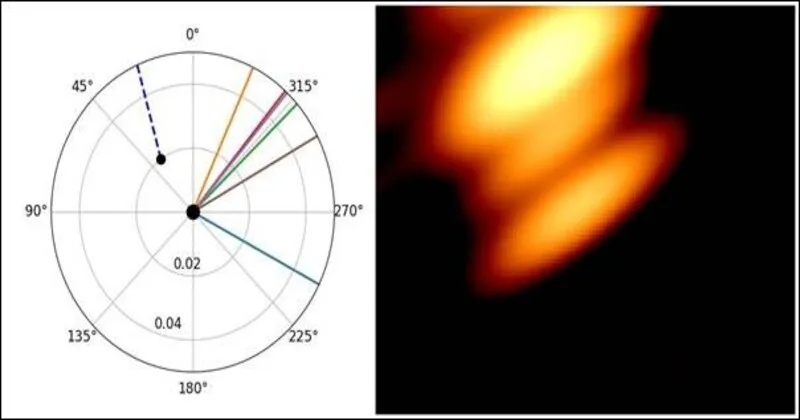
For the first time in the history of humankind, scientists have directly observed two black holes engaged in a cosmic dance, orbiting around each other in a galaxy far away. This groundbreaking discovery not only verifies decades of scientific theory but also puts Indian scientists at the center of astronomy for this finding.
Black holes by nature are invisible. They reveal themselves only through the glowing material swirling around them as matter falls inward. Till date scientists had managed to image only two of them directly the supermassive black holes at the center of galaxy Messier 87 and our own galaxy Milky Way’s Sagittarius A. Both appeared as shadowy circles surrounded by a halo of light. But the latest discovery went beyond mere imaging. Using an advance network of telescopes including one orbiting halfway to the Moon, astronomers have captured radio images showing not one but two black holes circling each other in a system known as OJ287.
The Century-Long Mystery of OJ287
The quasar OJ287, a bright and distant galaxy has long amazed astronomers with its rhythmic flickering. Its brightness seemed to rise and fall in a regular pattern, a phenomenon first noticed in photographs dating back to the 19th century. Czech astronomer Rene Hudec of the Czech Technical University in Prague extensively studied these historical records, helping to trace the light variations over a century.
Scientists in 1982 found that the periodic activity followed a definite pattern indicating that OJ287 contained, but two black holes which were orbiting each other approximately in every 12 years. Thousands of astronomers followed the trail in subsequent decades, gathering data to build a complete picture of its orbital motion.
The puzzle of OJ287 orbit was finally solved through detailed studies published in 2018 in the Astrophysical Journal and in 2021 in the Monthly Notices of the Royal Astronomical Society. These groundbreaking papers were led by Lankeswar Dey from the Tata Institute of Fundamental Research (TIFR), Mumbai, under the supervision of Prof. Achamveedu Gopakumar of TIFR and Mauri Valtonen from the University of Turku, Finland. Their work produced a precise orbital model predicting where the two black holes should appear at any point in time.
Proving the Binary Black Hole Model
The next challenge was to confirm whether both black holes were actually bright enough to be seen separately, requiring unprecedented imaging resolution. This proof came through a collaboration led by Shubham Kishore and Alok C. Gupta from the Aryabhatta Research Institute of Observational Sciences (ARIES) Nainital, an autonomous institute under the Department of Science and Technology (DST), Government of India along with Paul Wiita from the College of New Jersey, USA.
Using NASA’s TESS satellite in late 2021, the team monitored OJ287 and observed a sudden surge in brightness that lasted just 12 hours equivalent to the combined luminosity of hundreds of galaxies. The flare faded rapidly and follow-up observations from ground-based telescopes coordinated by Staszek Zola of Jagiellonian University of Cracow, Poland, confirmed the event. These results offered compelling evidence that astronomers had, for the first time, seen the smaller black hole of the OJ287 system in action.
Telescope Beyond Earth: RadioAstron’s Breakthrough
Around the same time, an international team achieved a major imaging milestone. Using the RadioAstron space telescope a powerful radio antenna orbiting the Earth at great distances in combination with an array of ground-based observatories, astronomers obtained the highest-resolution image ever of OJ287. The resolution exceeded even those of the famous Sagittarius A* and Messier 87 black hole images.
The RadioAstron observations revealed two distinct points of radio emission, the unmistakable signatures of the two black holes. The positions matched precisely with the orbital model previously predicted by Dey, Gopakumar and Valtonen’s team. This remarkable finding was published in the Astrophysical Journal by Mauri Valtonen and collaborators, including Alok C. Gupta, Shubham Kishore (both from ARIES) and A. Gopakumar (TIFR, Mumbai).
The smaller of the two black holes was seen emitting a jet of high-energy particles, an extraordinary feature in itself. Because it revolves rapidly around its massive companion, the jet appears to ‘wag’ twisting and changing direction like a spinning garden hose. This motion, when observed in real time it beautifully illustrates the gravitational ballet between the two immense bodies.
India Key Role in a Global Discovery
A key role of ARIES, a DST research institute in India in this discovery was noted. Its scientists not only assisted in monitoring the phenomenon using NASA’s space-based apparatus but also in interpreting the data that validated the two-black-holes system.
This joint effort connecting researchers from India, Finland, the USA, Poland and the Czech Republic is a testament to the ways in which global collaboration propels contemporary astrophysics. Every collaborator contributed a vital piece to the mosaic: centuries of past records, accurate orbital modelling, high-tech space observations and thorough examination.
A Glimpse Into the Universe’s Future
Though RadioAstron record-breaking images have given a way to Earth-based observations of reduced resolution, astronomers persist in keeping an eye on OJ287 from year to year. The wobbling jet from the lesser black hole acts as an observable indicator of the pair’s orbital motion and scientists can follow their cosmic waltz even from great distances.
The significance of this finding extends far beyond the aesthetic of the picture. Watching two black holes in orbit is a living laboratory for gravitational physics. When the two giants finally merge, they will release titanic ripples through spacetime gravitational waves such as were detected by observatories like LIGO and Virgo. By observing OJ287, researchers can gain greater insights into the processes leading to such cosmic collisions and improve models of how gravitational waves are created and spread.
From 19th-century photography plates to space-age telescopes circling half the distance to the Moon, the tale of OJ287 is one of success through determination, creativity and teamwork. It unites generations of astronomers from the first to see a glimmer of light on ancient glass plates to today’s teams deciphering the universe’s best-kept secrets in radio waves.
As OJ287 two black holes continue their slow, spiralling waltz across space completing an orbit every 12 years they offer humanity not only a breathtaking sight but also a profound reminder of the universe complexity and harmony. Each observation of their movement refines our understanding of gravity, relativity and the grand cosmic architecture.
In the vast darkness of space, two invisible giants dance and thanks to the combined efforts of scientists across continents, including India’s finest from ARIES and TIFR we can finally watch their steps unfold.















Comments