





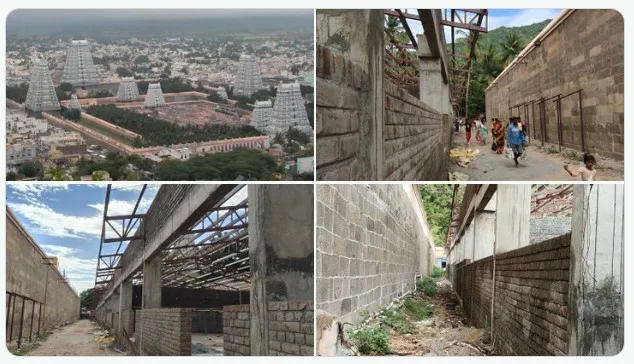
The Madras High Court Division Bench said, “We direct the HR & CE Department / Temple Authorities of the Arunachaleswarar Thirukoil, Tiruvannamalai, to file a justification report with regard to the said construction being taken up within the temple premises, with supporting documents, which shall be filed on the next date of hearing. Till such time, no further construction shall be made either inside or outside the temple premises of the Arunachaleswarar Temple, Tiruvannamalai.”
On 9 October 2025, the Madras High Court directed the Tamil Nadu government to constitute a Heritage Commission for protecting age-old buildings and premises not covered under the Ancient Monuments and Archaeological Sites and Remains Act, 1958, and the Tamil Nadu Ancient Monuments and Archaeological Sites and Remains Act, 1966. A special Division Bench comprising Justices R. Suresh Kumar and S. Sounthar, constituted for hearing temple-related cases, ordered that the Tamil Nadu Heritage Commission (TNHC) must be constituted within four weeks, and a compliance report should be filed before the court.
The interim order was passed on writ petitions filed by temple activist T. R. Ramesh and A. Radhakrishnan.
Tamil Nadu: Madras HC stays all constructions by HR & CE in Tiruvannamalai temple premises inside and outside
Reports: TS Venkatesan https://t.co/Cv6aOGZ5Hh
— Organiser Weekly (@eOrganiser) September 27, 2025
The judges had visited the Arunachaleswarar Temple in Tiruvannamalai on 5 October 2025 to inspect ongoing construction activities, accompanied by the District Collector and other officials. The visit was in connection with a case concerning constructions within and around the temple, including mandapams, free food distribution centres, and a new memorial for a temple elephant.
In its 16-page order, the Bench observed, “Though the State Legislature had enacted the TNHC Act in 2012 itself, the law remained dormant for 12 long years and was brought into force only with effect from 12 March 2024, after the former Chief Justice Sanjay V. Gangapurwala and Justice J. Sathya Narayana Prasad (since deceased) nudged the government to do so in a case filed by the Indian National Trust for Art and Cultural Heritage (INTACH).”
The court further stated, “Even after the law came into force, the State Government has so far not set up the Commission, which should be chaired by an eminent person with concern and commitment for heritage conservation, and should consist of not more than 16 members, including the Tourism Secretary, Urban Development Secretary, Municipal Administration Secretary, Rural Development Secretary, and Law Secretary, who shall be ex-officio members.”
The Bench recalled, “In our last order dated 25.09.2025, inter alia, we stated the following: The ongoing construction, as admitted by the HR & CE Department / Temple Authorities, upon perusal of photographs submitted by the petitioner’s side, discloses that, at least in some places, the ongoing construction is just adjacent to the main wall of the temple, which is a heritage wall. The gap between the ongoing construction and the main heritage wall is minimal—barely a lane wide. Therefore, if the ongoing construction is permitted to be completed, it would raise a serious question as to whether the proposed construction would truly facilitate the devotees or, conversely, have an adverse impact by hindering the aesthetic beauty of the temple itself. As the compound wall of the heritage temple also forms part of the heritage structure, no portion of it shall be exploited in the manner proposed by the HR & CE Department, particularly within the fourth pragaram of the Arulmigu Arunachaleswarar Thirukoil, Tiruvannamalai.”
The judges noted, “As proposed, on 05.10.2025, we visited the Arunachaleswarar Thirukoil, Tiruvannamalai, and carried out a detailed inspection. The ongoing constructions inside and outside the temple, as well as the proposed constructions and sites earmarked for them, were shown to us. Upon observing such constructions—both completed and underway—we were shocked to note that some huge constructions were being made inside the temple, especially in the fourth pragaram. Although the Temple Authorities defended these constructions as being for a proposed queue complex for devotees to wait during long queues, we were not satisfied, as the planned queue complex within the temple premises at the fourth pragaram measures 44 feet in width and 480 feet in length. When we specifically questioned why such a vast area was required even for a queue complex, the Temple Authorities sought time to file a detailed justification report.”
The court has posted the matter for further hearing on 23 October 2025 for filing the justification report, technical report, and any additional documents or literature from the Temple Authorities or the HR & CE Department before proceeding further in the case.















Comments