





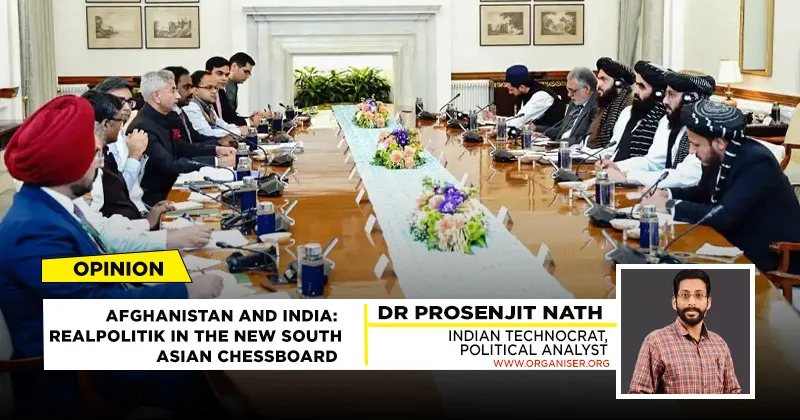
The geopolitics of South Asia has always been an intricate a dense web of conflicting interests, competing civilizational identities, historical grievances, and shifting alliances. It is a region where the past bleeds into the present and where religion, ideology, and nationalism intersect with strategy and economics. Today, this complexity has intensified with regime changes, generational shifts in political consciousness, and the renewed contest among global powers for influence. In this evolving context, Afghanistan, long known as the “graveyard of empires,” once again occupies the center stage of strategic realignment.
The recent meeting between India’s External Affairs Minister S Jaishankar and Taliban Foreign Minister Amir Khan Muttaqi has brought Afghanistan back into India’s diplomatic and strategic discourse. This encounter, seemingly modest in form but profound in implication, marks a cautious reset in India-Afghanistan relations. It also underlines India’s pragmatic understanding that moral posturing and rigid ideological positions have little place in international politics, where interests, not sentiments, shape the game.
The US withdrawal from Afghanistan in 2021 created a vacuum that altered the geopolitical equation of South Asia. The Taliban’s swift takeover of Kabul ended two decades of Western-backed governance but triggered a global dilemma: how to engage with a regime whose past is synonymous with extremism and repression. For most of the international community, including India, recognition of the Taliban regime was diplomatically untenable. Yet, the unfolding reality of South Asia, where geography and security concerns outweigh moral hesitations, has compelled states to reconsider their approach. Russia and China, both eager to expand their strategic footprints, moved swiftly to engage with the Taliban. Moscow viewed the group as a stabilizing counterweight to U.S. influence, while Beijing saw an opportunity to extend its Belt and Road Initiative (BRI) through Afghanistan’s mineral-rich terrain. India, initially cautious, soon recognized that continued disengagement would only cede ground to its rivals, particularly Pakistan and China. Thus, Muttaqi’s visit to New Delhi, the first since the Taliban’s return, signifies a critical step toward re-establishing India’s presence in Kabul.
Islamabad, predictably, reacted with unease. The timing of its airstrikes on Tehreek-e-Taliban Pakistan (TTP) camps in Kabul, coinciding with Muttaqi’s India visit was no coincidence. It reflected Pakistan’s frustration at losing influence over the Taliban, a group it once nurtured as a “strategic asset.” The decades-old tensions between Afghanistan and Pakistan, rooted in the unresolved Durand Line dispute of 1893, have resurfaced with intensity. The border remains one of the most contentious legacies of British colonial cartography, separating ethnic Pashtun communities and sowing perpetual mistrust. Pakistan’s coercive tactics, ranging from economic blackmail to cross-border military strikes, have backfired, pushing the Taliban to assert greater autonomy. Afghanistan’s engagement with India gives Kabul a diplomatic counterweight and an alternative source of economic and developmental support. For India, it opens a strategic corridor to undermine Pakistan’s monopoly over Afghan affairs.
India’s development footprint in Afghanistan is both deep and durable. Over $3 billion worth of assistance has flowed into more than 500 projects, such as roads, schools, hospitals, dams, and power lines. The 218-km Zaranj–Delaram highway, the Salma Dam in Herat, the Afghan Parliament building, and the Indira Gandhi Institute for Child Health stand as symbols of India’s constructive role. Educational scholarships, food aid, and cultural ties have further solidified India’s image as a benevolent partner rather than a geopolitical manipulator. However, the 2021 Taliban takeover forced India to suspend its operations and evacuate its diplomatic staff. The recent talks now pave the way for reopening India’s embassy in Kabul and resuming stalled projects. Beyond humanitarian engagement, the discussions included counter-terrorism cooperation, trade revival, and medical aid, six new health projects, twenty ambulances, and modern diagnostic equipment for Afghan hospitals. The Afghan foreign minister’s invitation for Indian investment in the mining sector reflects the Taliban’s growing realisation that India’s involvement ensures both legitimacy and economic relief.
Afghanistan’s vacuum has drawn China deeper into the region’s strategic orbit. Through the BRI and China-Pakistan Economic Corridor (CPEC), Beijing is eyeing Afghanistan’s mineral wealth and transit potential. The Taliban, desperate for investment, has courted Chinese firms, yet harbors deep suspicion of Beijing’s exploitative terms and its repression of Uighur Muslims. Pakistan, meanwhile, sees Afghanistan as a buffer and a client, not as a sovereign neighbor. Its obsession with controlling Kabul stems from its fear of strategic encirclement by India. For India, this tripartite dynamic of China’s opportunism, Pakistan’s insecurity, and Afghanistan’s fragility offers both risks and opportunities. Engaging with the Taliban is not about endorsement; it is about denying adversaries the strategic depth they seek. If India hesitates, China could soon dominate the Afghan landscape, connecting CPEC to Kabul and encircling India’s northern periphery. The new engagement, therefore, is a manifestation of realpolitik: India must act not as a moral power but as a strategic one.
The American withdrawal remains one of the most consequential geopolitical retreats of the 21st century. What was touted as “ending endless wars” effectively handed over Afghanistan to the Taliban and, indirectly, to China and Russia. The US’s attempt to wash its hands of the region betrayed strategic myopia. Afghanistan’s geostrategic significance as a land bridge between Central and South Asia ensures that no major power can ignore it for long. Former President Donald Trump’s remarks about reclaiming the Bagram air base underscore this enduring relevance. For now, Washington’s re-engagement appears limited to rhetoric, sanctions, and selective aid. The void it has left is being filled by regional powers China, Russia, Iran, and India, all playing their distinct games of influence. In this new great power competition, India’s re-entry into Afghanistan is both a necessity and an assertion of sovereignty in regional affairs.
India’s renewed engagement with the Taliban regime should not be misconstrued as ideological alignment. It is, as Jaishankar has often emphasized, “an engagement without endorsement.” Diplomacy demands pragmatism; moral absolutism serves no purpose in a region where interests overlap and ideologies clash. For Afghanistan, India’s return offers legitimacy and an avenue to counter Pakistan’s pressure. For India, it is about securing influence, stabilizing its extended neighborhood, and ensuring that terrorism emanating from Afghan soil is curbed. Soft power continues to be India’s greatest asset. Bollywood, cricket, and cultural exchanges have made India a familiar and trusted name among Afghans. When an earthquake devastated parts of Afghanistan, India was among the first responders, a gesture that deepened people-to-people goodwill. This empathy contrasts starkly with Pakistan’s coercive and condescending approach.
The Jaishankar–Muttaqi dialogue must be seen as the beginning of a long process of normalization, not its culmination. Reopening the Indian embassy, reviving development projects, and re-establishing trade routes via Chabahar and the Zaranj-Delaram highway will help both nations rebuild trust. Coordinated counter-terrorism efforts can reduce regional volatility. The proposal to establish an air corridor will further boost trade and connectivity, insulating Afghanistan’s economy from Pakistan’s chokehold. South Asia’s geopolitical churn, shaped by the SCO realignments, U.S.–China rivalry, and Pakistan’s domestic instability, demands a nuanced Indian approach. By engaging with the Taliban while safeguarding its principles and interests, India demonstrates that diplomacy in a turbulent world is not about purity but prudence.
In essence, the Jaishankar-Muttaqi meeting represents India’s assertion of strategic autonomy in the new South Asian order. It reflects an understanding that Afghanistan cannot be abandoned to Chinese capital or Pakistani manipulation. For New Delhi, engagement is not an endorsement; it is an act of strategic necessity, a reaffirmation that in the great game of South Asia, India will no longer play from the sidelines.













Comments