





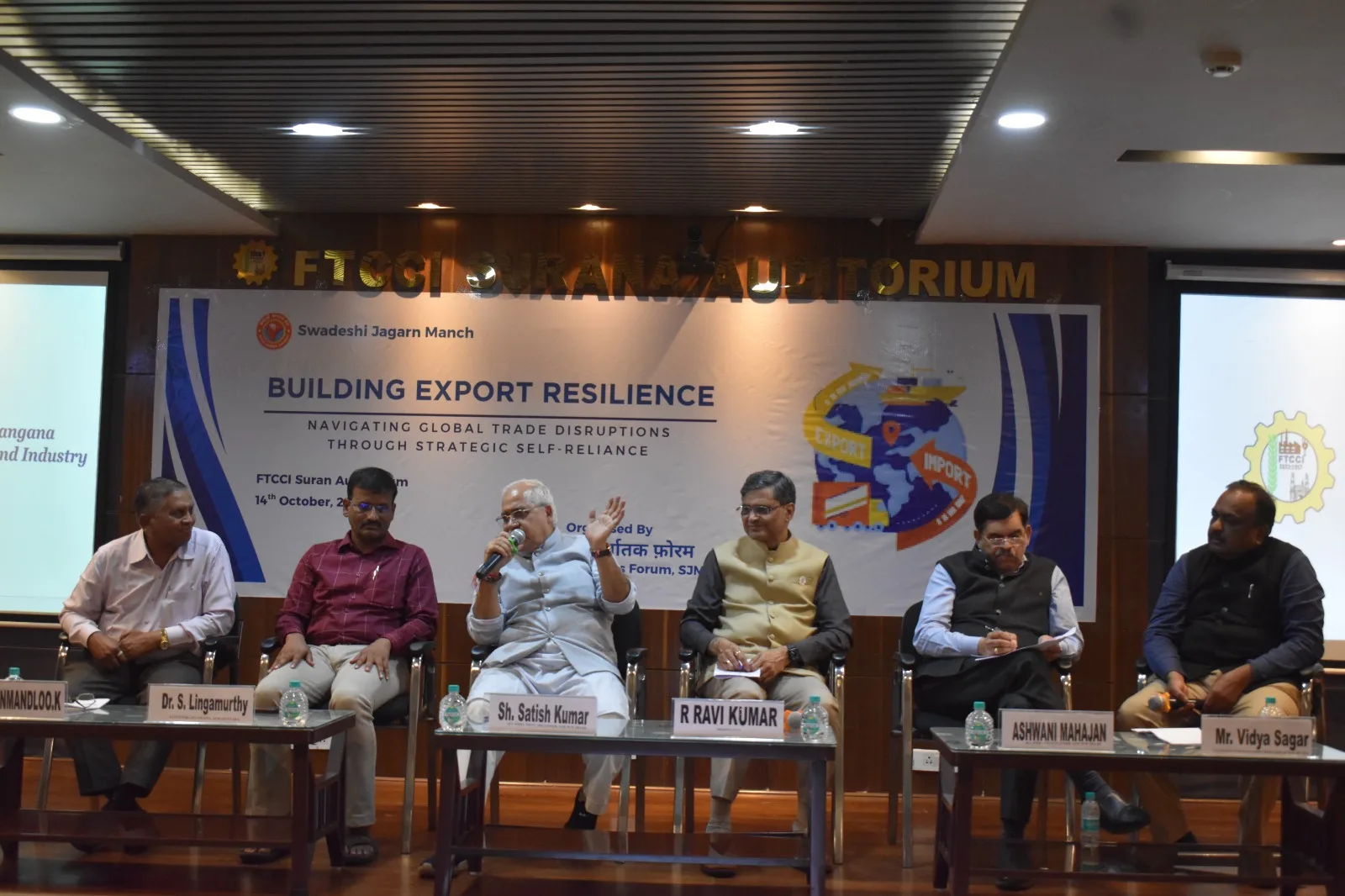
“India may have missed the earlier industrial revolutions, but this time, we stand at the threshold of a golden opportunity,” said Prof. Ashwani Mahajan, All India Co-Convener of the Swadeshi Jagaran Manch (SJM), setting an optimistic tone for the business seminar held in Hyderabad on October 14 . “The British built Lancashire, but India lost its industries. We missed the electric revolution, and even the IT revolution slipped by due to policy paralysis. Yet, Indians, by sheer individual brilliance, built and now lead the world’s biggest tech firms,” he noted. “Now, in this tariff-driven world, we must change our mindset, utilise this golden moment, and move decisively towards building a Viksit Bharat.”
Prof. Mahajan candidly acknowledged hurdles such as loan delays, corruption, and policy uncertainty, but credited the last decade with a “paradigm shift” in the nation’s industrial mindset. “The post-independence model doubted our entrepreneurs and preferred state-controlled industrialisation. But today, our policies and confidence have changed. We must capitalise on this momentum,” he urged.
The seminar, organised by Swadeshi Jagaran Manch (SJM), Telangana, in collaboration with the Federation of Telangana Chambers of Commerce and Industry (FTCCI), was held on October 14, 2025 at the Surana Auditorium, Hyderabad. Themed “Building Export Resilience: Navigating Global Trade Disruptions through Strategic Self-Reliance”, the event witnessed participation from more than 50 entrepreneurs, business owners, and trade representatives from across sectors.
Adding to the discussion, Satish Kumar, All India Joint Organising Secretary, SJM, said, “For over 60 years, we waited for a truly industry-friendly government, now we have one. But the journey is far from complete. Policy gaps and entrepreneurial challenges persist. Still, Indians are pushing the boundaries, proving their mettle, and taking the nation forward.”
From the business community, Vidya Sagar, Chairman & Managing Director, Sagar Asia, brought the issue of bank financing to the fore. “Getting loans remains a major bottleneck. These delays have become roadblocks to exploring new sectors,” he remarked, urging for simpler credit access to boost innovation and exports.
The voice from the renewable energy sector came through Bollampally Indrasen Reddy, CEO of Namaste Solar LLP, who cited a telling example of how policy tweaks can transform entire industries. “Just one term, Domestic Content Requirement (DCR), changed the face of India’s solar industry. It’s now booming. This shows that precise policy shifts can drive massive industrial growth,” he said.
Dr S. Lingamurthy, professor and SJM Convenor for Telangana, Andhra Pradesh, and Karnataka, framed the seminar’s larger vision: “These interactions aim to bridge the gap between policy and practice between industrialists and policymakers. Only through seamless coordination can we truly achieve Atmanirbhar Bharat.”
Participants noted that financing constraints, logistics inefficiencies, and regulatory uncertainties continue to impede growth, but also agreed that stronger cooperation between industry and government can help overcome these hurdles. Interestingly, several speakers viewed the recent U.S. tariff policies as a “blessing in disguise”, potentially spurring India to develop its domestic capacities and reduce import dependency.
The discussions also addressed key themes such as geopolitical trade dynamics, risk mitigation through market diversification, and the creation of indigenous solutions.
The Swadeshi Jagaran Manch plans to hold similar sessions across the country to foster a culture of self-reliant entrepreneurship, policy synergy, and resilient export growth, ensuring that India not only competes globally but leads the world with its own vision of development.
















Comments