





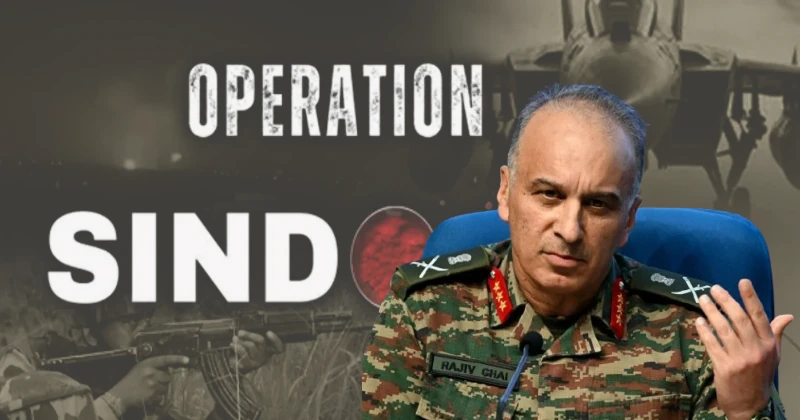
India’s Director General of Military Operations (DGMO) Lieutenant General Rajiv Ghai has laid bare the scale, precision, and strategic depth of Operation Sindoor a tri-service campaign that delivered a devastating blow to Pakistan’s terror infrastructure, military installations, and air power. Conducted in response to the Pahalgam terror attack, the operation not only destroyed key Pakistani assets but also forced Islamabad to sue for peace in just 88 hours, marking a watershed in India’s evolving military doctrine.
Lt Gen Rajiv Ghai revealed that Operation Sindoor was not a sudden retaliation but a calibrated, multi-dimensional response rooted in a pattern of cross-border terrorism sponsored by Pakistan. “This was not a distant engagement. It was a direct response to evolving threats, complex operational environments, and our imperative to respond to the scourge of terrorism,” Ghai said while addressing the United Nations Troop Contributing Countries (UNTCC) Chiefs’ Conclave in New Delhi, attended by top military officials from 30 nations.
He contextualised the campaign within the broader framework of India’s response to decades of terror infiltration, “It’s in the late 1980s that this problem began in J&K. Since then, over 28,000 terror incidents have taken place. More than 100,000 minorities were compelled to flee, over 15,000 innocent civilians and 3,000 security personnel were killed. It’s very clear where this comes from.”
#WATCH | Delhi | Director General Military Operations Lt Gen Rajiv Ghai says, "It's in the late 80s that this problem started in Jammu and Kashmir. Since then, we've had more than 28,000 terror incidents. Since the 90s, we've had more than 100,000 people from the minorities who… pic.twitter.com/4lSHjdZFnq
— ANI (@ANI) October 14, 2025
The Pahalgam terror attack brutal even by Pakistan’s record was the tipping point. The Indian government’s response combined military power, diplomatic resolve, and economic coercion into a single, coherent doctrine that showcased India’s new strategic maturity.
According to Lt Gen Ghai, after repeated drone intrusions even following DGMO-level communication between the two sides, India swung into full-scale retaliatory mode.
“So the drones came in in large numbers even after the two DGMOs had spoken. This led us to swing the Indian Air Force into action, and in the precision strikes they carried out on the night of the May 9 and 10, we hit 11 of their air bases.”
#WATCH | Delhi | Director General Military Operations Lt Gen Rajiv Ghai says, "So the drones came in in large numbers even after the two DGMOs had spoken… This led us to swing the Indian Air Force into action, and in the precision strikes that they carried out on the night of… pic.twitter.com/XhTdvxaest
— ANI (@ANI) October 14, 2025
In what he described as “one of the most clinically executed air campaigns in Indian history”, the Indian Air Force destroyed eight air bases, three hangars, and four radar sites, inflicting crippling damage on Pakistan’s air defence network.
The strikes also eliminated major assets on the ground:
- One C-130 class transport aircraft
- One Airborne Early Warning (AEW) aircraft
- Four to five high-tech fighter jets
- Multiple radar and electronic warfare systems
But what stunned the global military community was India’s record-breaking ground-to-air kill at over 300 kilometres, reportedly the longest in the world.
“We now know that the world’s longest-ever ground-to-air kill at 300 kilometres plus was achieved during this operation, downing five high-tech fighters. The impunity with which these attacks were carried out is what is significant,” Lt Gen Ghai said.
After India’s precision strikes, Pakistan attempted a chaotic counterattack using drones, rockets, and low-flying aircraft. “Some of those engagements, retaliation, rockets, drones, I think everything was a dismal failure. In large part, it was because of the strong, integrated air defence that we could put up,” the DGMO said.
Pakistan’s swarm-drone offensive launched even after communication between the two DGMOs was shredded mid-air by India’s layered missile and radar shield. The episode reinforced India’s new real-time integration of air defence and intelligence networks, an advancement that stunned observers from NATO and ASEAN nations at the conclave.
Operation Sindoor was not confined to the skies or the Line of Control. The Bharatiya Navy had sailed deep into the Arabian Sea, ready to unleash a devastating maritime response if Pakistan dared to escalate.
Lt Gen Ghai revealed, “The Indian Navy was also very much in action. This is perhaps a lesser-known fact the Navy had sailed into the Arabian Sea and was fully poised. Had the enemy decided to take it further, it could have been catastrophic for them not only from the sea but from other dimensions as well.”
A senior Army official present at the conclave described the naval stance as “India’s most assertive forward deployment since the 1971 war.”
#WATCH | Delhi | Director General Military Operations Lt Gen Rajiv Ghai says, "The Indian Navy was also in action… The Navy had sailed into the Arabian Sea and when the DGMO spoke, they were very well poised. Had the enemy decided to take it any further, it could have been… pic.twitter.com/lK5dhQkHY6
— ANI (@ANI) October 14, 2025
In a stunning show of coordinated statecraft, India placed the 1960 Indus Waters Treaty “in abeyance” immediately after the Pahalgam attack. The suspension of the treaty long considered untouchable marked a new threshold in India’s integrated doctrine of deterrence, where economic and diplomatic levers were employed alongside kinetic force.
Lt Gen Ghai remarked, “This was a fusion of military precision and diplomatic agility, informational superiority and economic leverage. We made sure to put into place critical conventional measures to apply pressure. We carried out significant forward deployments, extending our punitive reach to unprecedented levels.”
Lt Gen Ghai also exposed the brazen complicity between the Pakistan Army and UN-proscribed terrorist groups following Operation Sindoor. He cited the public participation of senior Pakistani military and political figures in the funerals of slain terrorists:
“A terrorist proscribed by the United Nations led a prayer service for those killed. The who’s who of the Pakistan Army were there including Lt Gen Fayyaz Hussain Shah (Corps Commander IV Corps), Maj Gen Rao Imran Sartaj (GOC 11 Infantry Division), Brig Mohammad Furqan Shabbir (Commander 15 Heavy Mechanised Brigade), Punjab IGP Usman Anwar, and provincial legislator Malik Sohaib Ahmed Bherth. It was an open flaunting of their nexus. Caution had been thrown to the winds.”
This open state-terror nexus, he said, reflected the Pakistan Army’s desperation to salvage its internal credibility after the humiliation of Operation Sindoor. Perhaps the most revealing detail from Lt Gen Ghai’s address was that Pakistan sought a ceasefire just 88 hours after the operation began.
“Eighty-eight hours is what it took for the enemy to come and ask for a cessation of hostilities. We achieved our political and military aims. We hit nine targets across the breadth of Pakistan. This is a maturing of India’s doctrine beyond the binaries of peace and war,” he said.
#WATCH | Delhi | Director General Military Operations Lt Gen Rajiv Ghai says, "88 hours is what it took for the enemy to come and ask for a cessation of hostilities. You're well aware of that. For that call to be made by my counterpart, then. We achieved our political and… pic.twitter.com/iBciGUvFxQ
— ANI (@ANI) October 14, 2025
The Indian DGMO’s Pakistani counterpart reportedly called him directly to request the halt a rare gesture that underscored the scale of damage inflicted. Lt Gen Ghai concluded his address by declaring that Operation Sindoor represents the dawn of a new era in India’s strategic doctrine one where deterrence is dynamic, multi-domain, and unapologetically assertive.
“Operation Sindoor showcased India’s ability to fuse the tools of national power military, diplomatic, economic, and informational. It was targeted, controlled, and non-escalatory. We openly acknowledged our actions to maintain credibility.”
India’s decisive conduct, he said, serves as a message to the world, “When faced with terror, India will act with precision, conviction, and the full weight of its national power.” The UNTCC Conclave, where the operation was debriefed, saw military representatives from 30 countries take note of India’s new model of counterterror warfare one that integrates kinetic response with psychological and diplomatic manoeuvres.
A senior European defence official present at the briefing was quoted as saying, “Operation Sindoor is to 21st-century warfare what Kargil was to mountain combat — a complete redefinition of strategic capability.”












Comments