





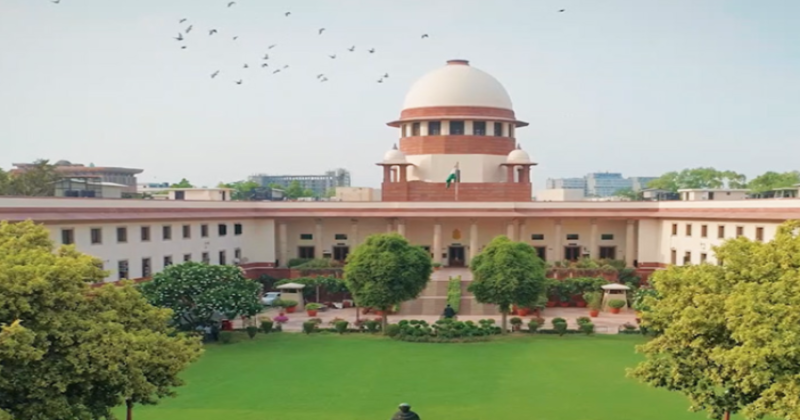
The Supreme Court of India on Monday (October 13) ordered the immediate release of Hansraj, a man convicted in a 1981 murder case, after confirming that he was 12 years and 5 months old at the time of the crime.
The bench of Justice Dipankar Datta and Justice Augustine George Masih admitted that Hansraj’s incarceration was not only unlawful but amounted to a violation of his fundamental right to life and liberty under Article 21 of the Constitution.
“The petitioner was a child at the time of the offence, and he has been behind bars for more than three years. His liberty has been curtailed not in accordance with the procedure established by law. Breach of Article 21 is writ large,” the bench stated.
According to a custody certificate dated August 14, 2025, Hansraj had served three years, ten months, and 28 days. His date of birth is June 10, 1969.
Hansraj and five others were tried for the murder of a man on November 2, 1981. The Sessions Court convicted all six on August 14, 1984, sentencing them to life imprisonment. However, the court found Hansraj to be 16 at the time and directed that he be sent to a children’s home under the Children’s Act, 1960.
The Allahabad High Court later acquitted all the accused in 2000, only for the Supreme Court in 2009 to overturn that acquittal and restore the convictions. Hansraj, who had since absconded, was arrested again in May 2022.
In its ruling, the Supreme Court reaffirmed that a plea of juvenility under Section 7-A of the Juvenile Justice (Care and Protection of Children) Act, 2000 can be raised at any stage of proceedings, even after a special leave petition under Article 136 has been disposed of.
The bench cited the 2010 precedent Dharambir v. State (NCT of Delhi), reiterating that anyone below 18 at the time of an offence, even before the Juvenile Justice Act came into effect, must be treated as a juvenile.
Hansraj’s counsel argued that his detention beyond three years amounted to illegal custody. The State of Uttar Pradesh, however, opposed the plea, contending that the Children’s Act, 1960, not the JJ Act, 2000, applied to the 1981 case, and that Hansraj’s long absconding made him unworthy of relief.
The bench dismissed the argument, stating that no provision in the 1960 Act restricted the court’s power to grant relief. Yet, the acknowledgment that “the purpose for which the Sessions Court directed that he be kept in a children’s home is no longer feasible now.”
The Supreme Court directed the Senior Superintendent of Central Jail, Varanasi, to release Hansraj immediately on the basis of a downloaded copy of the order, without waiting for a certified version.
















Comments