





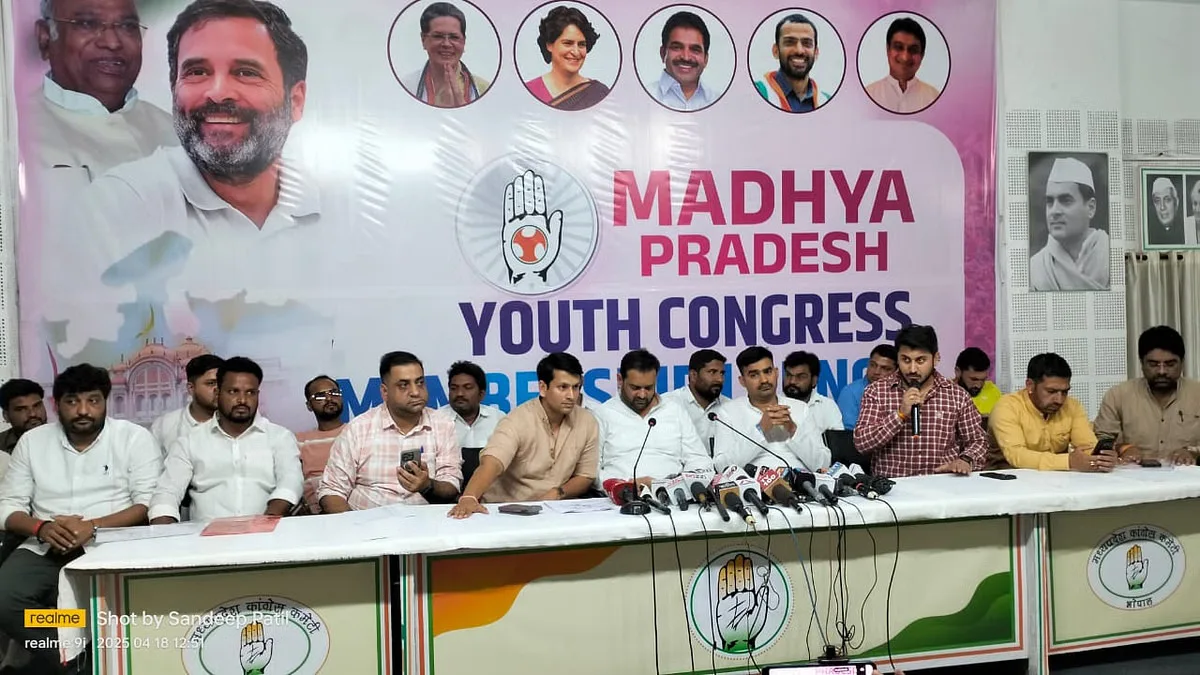
The Madhya Pradesh Youth Congress’s bold online membership campaign, aimed to provide for free and fair elections for the state president post, has dived into controversy. Over 5.16 lakh youth memberships have been cancelled, leaving the political fate and Rs 2.58 crore worth of membership fees in limbo.
Membership drive gone wrong
The membership drive started immediately after the Youth Congress declared internal elections on April 18. Between June 20 and July 19, a huge drive was brought online by way of an online mobile application, and every applicant was asked to pay a Rs 50 membership fee.
According to its internal data, 15,37,527 young people applied for membership in Madhya Pradesh. Out of them, 63,153 people did not pay the fee with their application, and 14,74,374 filled up the form as well as paid. But quite surprisingly, just 6,01,917 memberships were sanctioned, just about 40 percent of all valid applications.
The remaining, more than 5.16 lakh memberships, were rejected, and another 3.56 lakh applications were put on hold because of discrepancies.
AI verification behind massive rejections
As per the Youth Congress workers quoted in the media, the Central Election Authority (CEA) used Artificial Intelligence (AI) to process the verification. The computer system, they charge, rejected or put on hold applications over small issues like name spellings, wrong dates of birth, duplicate photographs, or telephone numbers. Applications were put on hold on account of small errors like misspelling of names, mismatch of father’s name, or incorrect birth date.
Complaint reaches national leadership
The mass rejection has caused a rift in the party. Shivraj Yadav, a contestant for the State Youth Congress President’s post, filed a formal complaint with the national president of the Indian Youth Congress (IYC) and the central election authority.
“More than 15 lakh youths joined the campaign wholeheartedly. If more than five lakh applications were rejected and more than three and a half lakh kept pending, it indicates grave procedural errors,” Yadav said. “The facility for correction in the app is not working. The CEA should cross-check the information and reinstate genuine memberships.”
Rs 2.58 crore of youths’ money in limbo
The 5.16 lakh applications that were refused amount to Rs 2.58 crore in forgone membership fee. With an additional Rs 1.78 crore in backlogged applications, the amount of unaccounted funds exceeds Rs 4.3 crore, a figure that is now stuck in limbo with no refund or reconciliation certainty.
Young workers claim they were never told of rejections or allowed adequate time to rectify minor errors. The CEA has extended a window for correction up to October 17, but the official app for data correction is said to be out of order. Most district-level workers assert even 30 percent of the forms held might not be sanctioned on account of technical issues.
Congress’s organisational credibility in question
The episode has elicited harsh criticism from the Bharatiya Janata Party (BJP), which has referred to it as a “membership scam” in the Congress culture.
Ashish Agarwal, the BJP’s state media in-charge, stated, “The Congress is cheating their own workers. They took crores from the youths in the name of membership and didn’t give them recognition. It is a scam, not a campaign.”
The BJP has called for an investigation into missing membership money and alleged manipulation of data during the AI verification process.
Digital democracy or digital deception?
The Congress has always sought to portray itself as a party that welcomes “digital democracy.” But the current Youth Congress membership debacle has again brought out in the open the failure of the party in transparency, accountability, and technical proficiency. Far from empowering the youth, the digital membership drive has become a massive embarrassment for the party.
If the matter is not sorted out well in time for the next organisational polls, more than eight lakh young Congress workers can be disenfranchised, a turn of events which could delegitimise the election result as well as engender further distrust among the very youngsters whom the Congress represents to claim.















Comments