





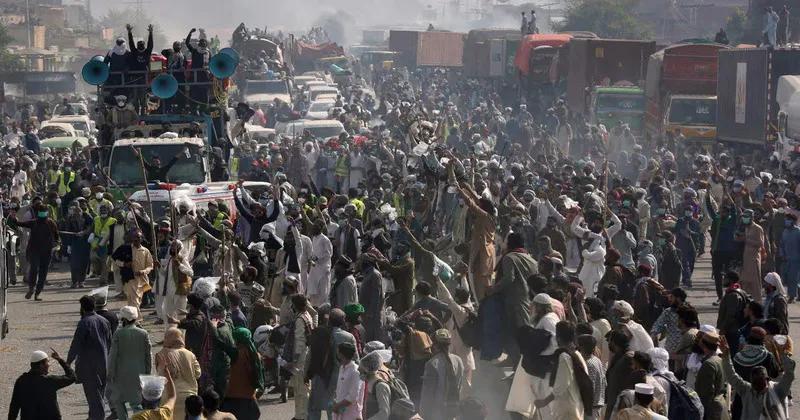
The recent outbreak of violence in Lahore, Muridke and the approach to Islamabad, sparked by protests from Tehreek-e-Labbaik Pakistan (TLP), represents one of the most intense confrontations in Pakistan in the recent years. What started as a march to support Palestinians has turned into a fierce conflict between an Islamist populist group and state authority. To grasp why these protests turned violent and the current situation, it is important to understand what TLP is and what it aims to achieve, as well as how the state felt compelled to respond.
TLP is not a new entity in Pakistan’s complicated landscape of religion and politics. Founded in 2015 by Khadim Hussain Rizvi, a controversial cleric who advocated for strict blasphemy laws, TLP gained traction by tapping into public outrage over perceived insults to Islam and the Prophet. Under Rizvi’s leadership, the party organized disruptive protests and enforced moral codes, forcing governments to respond to its demands. After violent protests in 2020 led to a formal ban, the group regained legal standing due to its ability to mobilize religious feelings. Following Khadim Rizvi’s death, his son Saad Hussain Rizvi took over as leader, intensifying the party’s confrontational approach and incorporating pro-Palestinian imagery and rhetoric to broaden its support base.
In early October 2025, TLP initiated the “Labbaik Ya Aqsa Million March,” intending to travel from Lahore to Islamabad to protest Israeli actions in Gaza and call for a stronger stance from the Pakistani government. The group planned a demonstration outside the U.S. Embassy, merging its religious message, which emphasized defending Muslims worldwide, with anti-imperialist politics. However, the government viewed this march as a direct challenge to its authority and a potential source of unrest.
In preparation for the protests, the authorities took preventive actions. They blocked key roads into Islamabad and Rawalpindi, suspended mobile internet services and imposed Section 144, a ban on public gatherings, in sensitive areas. While these measures were justified as necessary for maintaining law and order, they highlighted the government’s anxiety over the potential success of the march.
When TLP supporters tried to advance, violence erupted. Protesters faced tear gas, baton charges, and eventually live fire. Police reported that demonstrators used stones, petrol bombs, and firearms against security forces. At least three TLP members were confirmed dead and a police station house officer was also killed. Many law enforcement personnel and civilians sustained injuries. The police claimed protesters set fire to around 40 vehicles, while TLP alleged that many more of its supporters were killed, accusing authorities of using excessive and indiscriminate force.
The police operation began early in the morning, lasting about six hours starting around 3 a.m. to disperse protesters camped in Muridke. Authorities defended their actions as necessary to uphold state authority, framing TLP’s defiance as a move toward treason and terrorism. Legal groups condemned the violence, stating that unarmed protesters and TLP leaders were shot at and demanding legal action and the release of detainees.
Live videos from the protests captured gunfire, billowing smoke, burning vehicles, and frantic crowds caught in tear gas. In one video, Saad Rizvi is heard telling supporters, “Arrest is not a problem, bullets are not a problem; martyrdom is our destiny”. This defiant message highlights how much TLP’s appeal relies on themes of sacrifice, persecution and unwavering religious commitment.
By Monday, police reported having cleared the Muridke encampment and reestablished stricter control over routes linking Lahore, Islamabad, and surrounding motorways. Dozens of protesters were detained, and mobile data services were restored in parts of Rawalpindi and Islamabad. Schools in Islamabad closed early amid fears of new unrest. Currently, while large-scale marches toward the capital have been blocked, the government and TLP are reportedly in discussions for a possible resolution.
However, the outcome remains uncertain. During the turmoil, rumors emerged that Saad Rizvi had been fatally shot; the government has neither confirmed nor denied this, likely to avoid making him a martyr. The significant presence of Pakistan Rangers and paramilitary forces indicates that the state is not just trying to contain the situation but seeks to deter TLP. The government’s approach has included closing the roads, suspending communications, and arresting activists. It shows its readiness to use considerable force against what it perceives as a destabilizing force.
These clashes reveal deeper divides in Pakistani society: between religious populist movements and a state asserting control over violence, between public support for the Palestinian cause and the limits of protest and between political legitimacy and coercive authority. TLP’s goal is to corner the state: force it to make concessions or risk backlash. For the government, allowing TLP to enter Islamabad freely would signify a loss of authority; on the other hand, heavy-handed suppression could lead to increased unrest.
If the current standoff ends in a compromise then perhaps a limited release of detainees and some easing of protests, Pakistan may weather this storm. But if either side miscalculates, violence could escalate further and TLP could emerge as a significant player in future struggles over religion, identity and political legitimacy in Pakistan.











Comments