





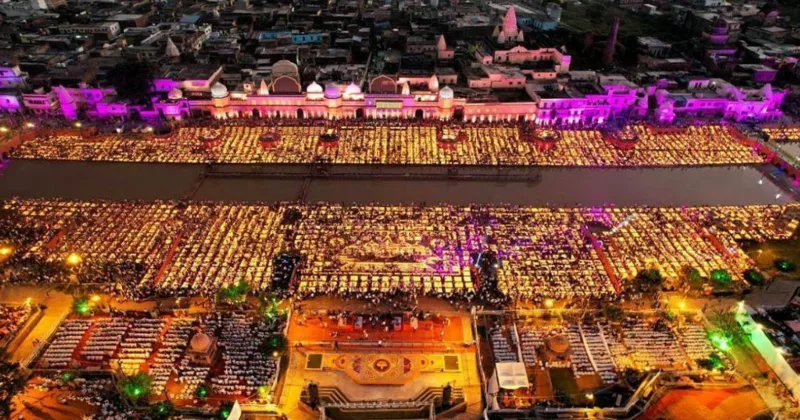
The Uttar Pradesh government on Saturday (October 11) announced that this year’s Deepotsav in Ayodhya will see the lighting of 28 lakh earthen lamps along the sacred Saryu River, marking a new world record in the number of diyas lit simultaneously.
As per the announcement, the scale of this year’s celebration has been “significantly enhanced” compared to previous editions, with an emphasis on showcasing Ayodhya’s cultural grandeur and spiritual essence.
Last year, over 25 lakh diyas had illuminated the ghats, drawing global attention to the city that embodies the legacy of Shri Ram. This year’s ambitious plan aims not only to surpass that record but also to transform Ayodhya into a glowing spectacle of devotion and unity.
The Deepotsav 2025 celebrations are scheduled for October 19, just days before Diwali, when Ayodhya commemorates the homecoming of Lord Ram, Sita, and Lakshman after 14 years of exile and victory over Ravana.
For 2025, the government has set a higher target, 28 lakh diyas, up from its earlier goal of 26 lakh. These lamps will be lit across 56 ghats along the Saryu, including newly added locations that are part of the expanded celebration.
For the first time in the history of Deepotsav, Laxman Kila Ghat will be part of the illuminated landscape. According to officials, the ghat will be adorned with 1.25 lakh lamps, symbolising the inclusion of every sacred corner of Ayodhya in the grand celebration.
Other key ghats will also witness spectacular illumination, 1.5 lakh diyas each at Ram Ki Paidi and Chaudhary Charan Singh Ghats, and another 1.5 lakh lamps at Bhajan Sandhya Ghat.
The heart of the event will be Ram Ki Paidi, where 15 to 16 lakh lamps will glow together, reflecting the image of Ayodhya’s temples and palaces on the waters of Saryu, a sight expected to mesmerise millions of devotees and visitors.
Uttar Pradesh Chief Minister Yogi Adityanath will formally inaugurate Deepotsav 2025 by lighting the first lamp, symbolising the victory of light over darkness and dharma over adharma.
Under his leadership, the Ayodhya Deepotsav has evolved from a local celebration into a globally recognised cultural phenomenon, reflecting the ideals of Ramrajya and reviving ancient Indian traditions through modern coordination and planning.
The scale of preparations this year is monumental. According to Sant Sharan Mishra, the nodal officer for the event, 30,000 volunteers will work tirelessly to arrange 33 lakh diyas across the 56 ghats.
“We will use approximately 75,000 litres of oil and 55 lakh cotton wicks,” Mishra said, adding that the volunteers have been trained to ensure the perfect synchronisation of the lighting ceremony.
The Ram Manohar Lohia Awadh University, Faizabad, has been entrusted with coordinating the event, forming 22 specialised committees to manage every aspect, from security and lamp counting to traffic management, cleanliness, media coordination, first aid, decoration, rangoli design, and volunteer identification.
This elaborate planning ensures that every diya lit on the ghats contributes to the grand visual harmony of the celebration.
Officials and organisers emphasise that the Deepotsav is not just a ritual or a religious observance, it is a national celebration of culture, unity, and peace.
The festival brings together artisans, volunteers, students, and religious organisations from across India, reflecting the collaborative spirit that defines India’s cultural ethos.
In recent years, the Ayodhya Deepotsav has gained international acclaim, drawing tourists, photographers, and devotees from across the world. The shimmering banks of Saryu, lit with millions of diyas, present a panoramic view of devotion and artistic splendour that rivals global cultural spectacles.
Since its inception under the Yogi Adityanath government, the Ayodhya Deepotsav has emerged as a symbol of India’s cultural renaissance. It bridges mythology with modern celebration, transforming Ayodhya into a city of lights that embodies faith, art, and devotion.
The synchronisation of millions of diyas, the chanting of hymns, and the reflection of golden lamps in the Saryu’s waters together create an unforgettable atmosphere, a confluence of faith, festivity, and fraternity.












Comments