




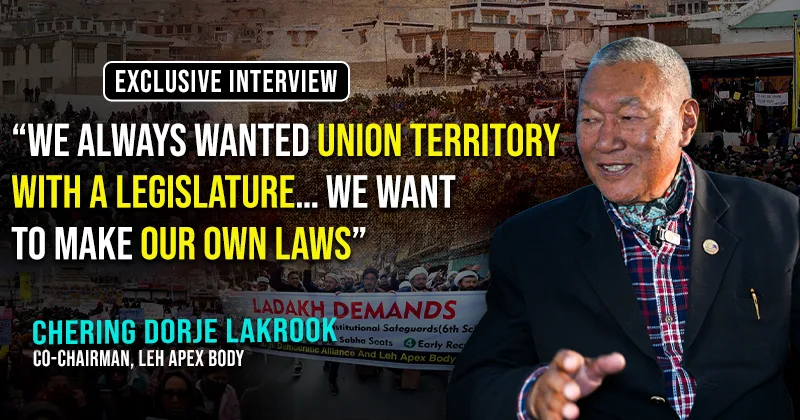
“We have always aspired for Union Territory (UT) status with a legislature,” said Chering Dorjay Lakrook, Co-Chairman of the Leh Apex Body and President of the Ladakh Buddhist Association. In a conversation with Organiser’s Senior Assistant Editor Nishant Kumar Azad in Leh, he discusses how the recent protests escalated into violence and outlines the key concerns of the people of Ladakh. Excerpts:
In 2019, Ladakh welcomed the move to make it a UT as its people always aspired. In just five years, what changed have taken place you want statehood?
Our demand for UT is very old, but we were not asking just for UT. We always wanted UT with a legislature. Although we opposed Article 370 because it was an obstacle in our way to becoming a UT, and we were happy about the abrogation of Article 370. Soon, we realised that we lost more than we gained. It protected us for 70 years. Our land and jobs were completely safe.
As far as the 85 per cent reservation for locals is concerned, it has only recently been announced. It took the Government six years to do even that. Now, the funds that come from the Union Government, only 10 per cent of them go to the Council. If we have a UT with a legislature, then all the funds will come to the us and we can plan how and where to spend the funds. With statehood, we can make our own laws.
How did a peaceful protest turn violent?
From the very beginning, our protest was peaceful, and it remained so. On the 23rd, two of our people sitting on a hunger strike turned critical and were hospitalised, so more people came the next day. People were very angry about the Government not advancing the talks. We demanded to advance the talks. There was no need to keep a 16-day gap between the talks. The anger became uncontrollable. Claims that outside forces provoked them, or that they were playing into someone else’s hands, are completely wrong. Youth in the protest were educated yet unemployed. They had been angry for a long time: why has there been no recruitment in Ladakh for so many years. Many lives have been lost due to violence. We have demanded a judicial probe; instead, the Government has ordered a magisterial inquiry. Now the curfew is lifted, and schools and markets are open, the situation seems normal. It only appears normal. We do not call this normalcy. The internet is still uncertain. There is a lot of anger among the people.
Apex bodies opposed the talks that were to take place with the Government. If you do not sit at the table, how will a solution emerge?
We never said we are against talks. Our entire effort was to solve things through talks. Primarily, we want the detainees arrested during and after the September 24 protests to be released and cases against them to be withdrawn. Less than half have been released so far. Even though they are out on bail, cases will continue against them. Talks happen in a friendly atmosphere. There should be peace. If the Government accepts these conditions, we are ready to go for talks.
Ladakh’s economy largely depends on tourism. With this tussle between the Government and locals, won’t tourism suffer?
Our entire struggle is to safeguard the interests of locals. The problem is that outsiders have now bought land here. A hotel chain has come up. It is snatching away our livelihood. We want to regulate tourism ourselves; that is why we need the Sixth Schedule.
With a population of about 3–3.25 lakh, you are demanding two MPs. How is that justified?
Though the population is small but look at the area. It is bigger than Punjab, Haryana and Delhi. Can one MP cover such a vast region? This is a strategic frontier with two hostile neighbours China and Pakistan.
When protests began, the Kargil Apex Body was initially not with you. Did it join on the condition that the Leh Apex body would support its two-MPs and statehood demands?
This may be correct. When we came together on one platform, we framed four demands. Earlier, it was not four. Initially, it was statehood and the Sixth Schedule; In fact, from our side, it originally focused on the Sixth Schedule alone. You speak of job opportunities, but you oppose the Government’s move to establish projects like a solar plant that can create jobs.
You speak of job opportunities, but you oppose the Government’s move to establish projects like a solar plant that can create jobs.
The solar power project is planned in areas where our nomads live and the Pashmina goat grazes. They are the source of Ladakh’s Pashmina. The entire belt falls within the project. Where will the nomadic herders go now. They say solar projects will generate employment. The nomads there are illiterate. What employment will they get? Also, to run this project, you need 45,000 employees. The entire population of that area is only 15,000. So, most of the people will come from outside. That area is ecologically fragile. We are not against projects, but they should not come up by uprooting people.
Ladakh is a strategic border region, with Pakistan and China as neighbours. If Ladakh makes its own laws after statehood, don’t you think the Army will require permissions for everything from the State Government? Won’t that be a problem?
Nothing of the sort will happen. Our relationship with the Army in Ladakh is better than anywhere else. Even today, all State land is with our Council. Has the Army ever had a problem acquiring land? When the Galwan happened and the Army needed more land, it did not even had to ask. Although the Council owns the land, it never objected. Such fears are baseless.
Opinions are divided on the arrest of Sonam Wangchuk. Some of his speeches have gone viral. Some say he provoked the youth and led to the violence. Some of Congress leaders’ press conferences did too.
If Sonam Wangchuk’s speeches provoked the youth, what were all the agencies doing? Did he become “anti-national” only after September 24? Some people also say Nepalis were injured, implying an outsider hand. They were not part of the procession; they were bystanders. Are we so foolish as to believe that three people were brought from Nepal to provoke us? Who would go there to die?
As for the Congress’s provocative statements, if that is the case, then it is for the Government to act; they should have stopped it earlier if that was the problem.
Given your political experience and your role now, what message do you have for youth?
I would tell the youth, never resort to violence. India is a democratic country; everything should be resolved peacefully. But the government must also be responsive. It should not take years to solve genuine problems. Coordination is needed on both sides. We are completely against violence; it is not in Ladakh’s blood. Ladakh is considered a peaceful land.
(The interview was recorded on October 4, 2025)












Comments