




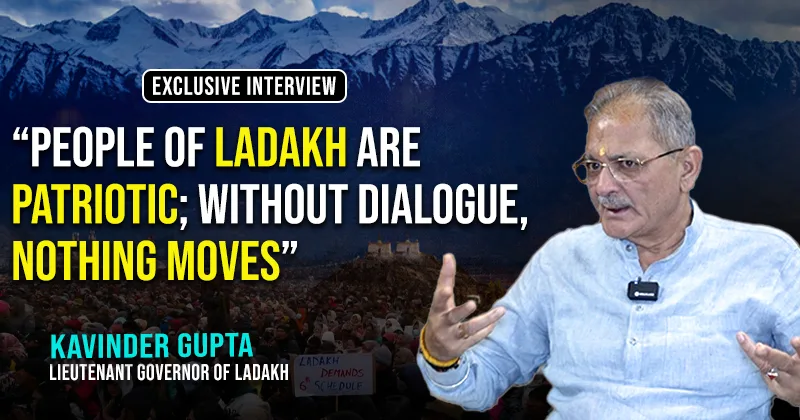
On September 24, Ladakh witnessed its worst violence since 1989, leaving four people dead and around 100 injured, including 40–50 security personnel. The unrest saw incidents of arson at the BJP office and stone-pelting near the Secretariat. The unprecedented violence occurred against the backdrop of growing demands for statehood, inclusion under the Sixth Schedule, and representation through two parliamentary seats. While the grant of Union Territory (UT) status in 2019 was initially welcomed by Ladakhis, the push for statehood has gained renewed momentum in recent months. In an exclusive interview with Organiser Senior Assistant Editor Nishant Kumar Azad in Leh, recently appointed Lieutenant Governor of Ladakh Kavinder Gupta spoke on the recent violence, issues concerning Ladakh and how the Government plans to restore peace and tranquillity in the Union Territory. Excerpts:
What was the root cause of the September 24 violence?
In a democracy, people raise demands, they are discussed, debated, and often addressed. But in this case, there were some suspicious elements behind the protest. Two days before September 24, a press conference seemed to set the tone. A youth-led sit-in then moved to the protest site, where speeches became increasingly provocative. The BJP office and building of Ladakh Autonomous Hill Development Council (LAHDC) were set on fire, and there were attempts to snatch weapons from security personnel. We have video evidence of the scuffles. As the violence escalated and officers were attacked, shots were fired, resulting in deaths of four people. This should not have happened. My condolences go out to victims’ families what occurred was truly unfortunate.
Now, about 9–10 days later, the situation has largely stabilised. Some are still trying to vitiate Ladakh’s atmosphere, but as a sensitive border region adjoining Pakistan and China, we cannot allow this to happen. Efforts to maintain law and order are ongoing, and officials, the police, and the public have
responded responsibly.
People often cite the BJP manifesto’s promise of Sixth Schedule status for Ladakh. The local Apex Bodies have said they will not engage until their demands are met. How can this deadlock
be broken?
The Government of India has invited all the stakeholders on multiple occasions for talks, but they chose not to attend. Only they can explain why. Talks can happen only when all parties come to the table. Ultimately, these issues can be resolved only through a dialogue.
Currently, four States Meghalaya, Assam, Mizoram, and Tripura have provisions under the Sixth Schedule. What is the obstacle in Ladakh, and why cannot it be applied there?
Since the Centre is handling these discussions, it would not be appropriate for me to comment at this stage.
Given recent events in Bangladesh and Nepal, you have suggested external interference in Ladakh. It is alleged that Sonam Wangchuk has even invoked the Arab Spring. Do you believe a similar playbook is being attempted in India?
Yes, a similar playbook was attempted here and we foiled it. Certain elements tried to disturb peace through provocative speeches and other means. The people of Ladakh have always been patriotic whether in 1947, 1962, 1965, 1971, 1999, or during the Galwan clash, they have stood firmly with India. A handful may have been part of a toolkit, but we identified and stopped them.
We are seeing a return to normalcy, curfew has been lifted, schools and markets have reopened. What steps will you take to ensure the situation does not reignite?
We are open to dialogue with all stakeholders, but violence is not a solution. I am ready for talks, and so is the Centre. The violence that occurred that day should not be mixed up with the broader protest demonstrations are common in a democracy, but the direction things took that day was unacceptable.
This agitation revolves around a few core issues, mainly the demand for statehood. How justified is their demand?
This demand has been recently added, and the Centre is looking into it and will respond. My position should align with theirs, and discussions will continue on the same lines. I am confident that the Government of India will do everything possible within the framework of the Constitution.
Civil society groups have raised several concerns about industrial projects in Ladakh, particularly a proposed solar power plant, warning that it could trigger a water crisis given the region’s fragile ecology.
When it comes to renewable energy, the world is moving forward, and Ladakh has immense potential. Not long ago, many homes here lacked electricity and relied on generators, even up to 2012. Rooftop solar has transformed that reality. People now have access to reliable power and new livelihood opportunities. The Government has played a key role in this transition, including a provision of Rs 15,000 per kW for commercial installations, which hoteliers and other businesses are adopting because it is necessary. At the same time, we are adhering to environmental safeguards, tree-plantation drives, and other standards to protect the ecology. Our industrial policy is designed to be sustainable and ecologically sensitive.
“Some elements tried to vitiate the atmosphere using provocative speeches and tactics. We foiled that playbook; Ladakh must remain peaceful, especially as a sensitive border region”
There are allegations against Sonam Wangchuk, the NSA has been invoked, and he is currently in custody in Rajasthan. Until recently, the Government was reaching out to him and consulting him on various issues. Even he welcomed the decision to grant UT status to Ladakh in 2019. Then what changed between him and the Government?
We appreciate anyone who engages in genuine public service. However, his references to Bangladesh, Nepal and the Arab world in recent videos were wrong and provoked people to engage in violence. The arrest is evidence-based and has not been taken lightly. We will not compromise on national unity and integrity.
Ladakh’s economy relies heavily on tourism. Incidents like this can hurt tourism, as we have seen in the case of J&K. How serious is the impact?
An incident did occur, but we must ensure it is not repeated. Ladakh has historically been peaceful and must continue to remain so. The Government is taking multiple steps to boost tourism, and global interest remains strong. There is vast potential in adventure tourism and winter sports, as Ladakh offers experiences found nowhere else.
“Govt. has invited all stakeholders on multiple occasions for talks, but they chose not to attend… Talks can happen only when all parties come to the table”
What progress has Ladakh seen since becoming a Union Territory in 2019?
Since the grant of UT status in 2019, Ladakh has witnessed significant growth across sectors. Tourist arrivals increased from about 2.8 lakh in 2019 to 5.2 lakh in 2023, and around 4 lakh in 2024 — with a healthy share of foreign visitors. But it is not just tourism, in education and healthcare too, we have expanded capacity. On an average, we have one teacher for every seven students.
Road connectivity has also improved dramatically, with roads now reaching remote villages right up to the Pakistan border. The Border Roads Organisation (BRO) has done excellent work in this regard. The budget has grown from Rs 250 crore before 2019 (when Ladakh was part of Jammu & Kashmir) to Rs 6,400 crore today, with dedicated allocations for the Border Roads Task Force (BRTF), the Army, both Hill Councils, and major projects such as the Zojila Tunnel.
Overall, there is no shortage of resources, and infrastructure development has been extensive. With a population density of just seven people per square kilometre — and in some places only four houses — roads are reaching people. For our three lakh residents, we remain fully committed to ensuring access to employment, education, and healthcare for all.
You have highlighted employment and development across sectors, yet youth rallied around the issue of opportunities. Why?
Ladakh has a large Scheduled Tribes (ST) population, and 85 per cent of Government jobs would be reserved for locals, along with a 10 per cent quota for the Economically Weaker Section (EWS). This virtually covers the entire population. In addition, large-scale recruitments have been carried out.
What is your message to the youth in this sensitive region?
As the Prime Minister says, 65 per cent of India is youth and they are our greatest strength. Ladakhis have always served the nation with dedication. We must engage with them through discussions, seminars, and consultations with youth groups, social workers, and others who have plans for Ladakh. Decisions will be made through such consultations, keeping the interests of Ladakh, particularly its youth, at the forefront.
(The interview was recorded on October 3, 2025)












Comments