





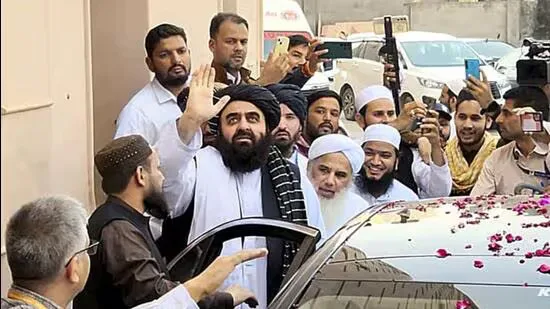
Afghanistan’s Foreign Minister Mawlawi Amir Khan Muttaqi’s visit to Darul Uloom Deoband in Uttar Pradesh’s Saharanpur has sparked wide diplomatic interest, with many calling it a turning point in South Asian Islamic diplomacy. The visit, the first of its kind by a top Taliban leader, is seen as a calculated move by Kabul to realign its spiritual bearings and reclaim its religious identity independent of Pakistan’s clerical influence.
Addressing scholars and students at the seminary, Muttaqi praised Darul Uloom Deoband as a “Madre Ilm” (Mother of Knowledge), declaring that Afghanistan’s spiritual strength has long drawn inspiration from the Indian institution that has guided generations of Afghan ulema. “A true Deobandi stands for moderation, unity of the Ummah, and peaceful coexistence,” Muttaqi said, emphasising that the Deobandi philosophy rejects violence in the name of Islam.
He expressed deep gratitude to the Indian scholars for preserving the intellectual and spiritual legacy of the Deobandi school, which he described as a beacon of ilm (knowledge) and akhlaq (character). His remarks, according to diplomatic insiders, mark a subtle but clear divergence from the rigid and militant interpretation propagated by Pakistan-based seminaries.
A senior Deobandi cleric, welcoming Muttaqi as a “student returning to his school,” underscored the visit’s spiritual significance. “Ilm and akhlaq, not war, define the real Deobandi ethos,” he said, adding that the enduring bond between India and Afghanistan rests on shared scholarship, spiritual discipline, and the pursuit of ‘aman aur insaaf’ (peace and justice).
The cleric further highlighted that dialogue and education remain the true instruments for bridging political divides, a sentiment that resonated deeply among scholars and observers alike. The seminary, established in 1866, has historically influenced Islamic thought across South and Central Asia, shaping religious education systems from Kabul to Karachi.
For decades, the Taliban movement has been linked to Pakistan’s Darul Uloom Haqqania, located in Akora Khattak, a seminary infamously dubbed the “University of Jihad” due to its militant associations. By choosing to visit Deoband instead, Kabul appears intent on distancing its religious legitimacy from Rawalpindi’s sphere of control.
“This visit represents more than mere symbolism,” said a South Asia diplomatic analyst quoted in News 18 report. “It’s a signal that the Taliban leadership wants to re-anchor Afghan Islam in its original, non-violent Deobandi lineage that originated in India and not the radicalised version that evolved in Pakistan.”
The move comes amid rising tensions between Pakistan and the Taliban regime over border disputes and Islamabad’s recent deportation of Afghan refugees. Analysts say Muttaqi’s outreach to Deoband and by extension, India could serve as both a message to Pakistan and a soft-power gesture towards the global community, portraying Afghanistan as a moderate Islamic state seeking regional harmony.
This outreach also coincides with New Delhi’s cautious but increasing engagement with the Taliban government. Muttaqi’s visit follows a series of quiet diplomatic exchanges in recent months, reflecting India’s pragmatic interest in maintaining stability in its extended neighborhood while countering Pakistan’s strategic leverage.
“The visit of Afghanistan’s Foreign Minister to Deoband signifies a realignment of faith and politics in the region,” said another scholar of Islamic diplomacy. “By re-engaging with the Indian source of the Deobandi movement, Kabul is reclaiming its theological independence and symbolically shifting its spiritual gravity back towards the land where this tradition was born.”
In this evolving landscape, Muttaqi’s words at Deoband stand out as both reverence and rebellion, reverence toward India’s centuries-old center of Islamic learning and rebellion against the ideological tutelage of Pakistan’s religious establishment.
As scenes from the visit circulated widely on social media, showing Muttaqi walking through the corridors of Deoband’s campus, they carried a quiet but powerful message: Afghanistan’s quest for faith-based legitimacy may now look eastward, toward India, rather than southward, toward Pakistan.
Whether this symbolic outreach will translate into tangible policy shifts remains to be seen.













Comments