





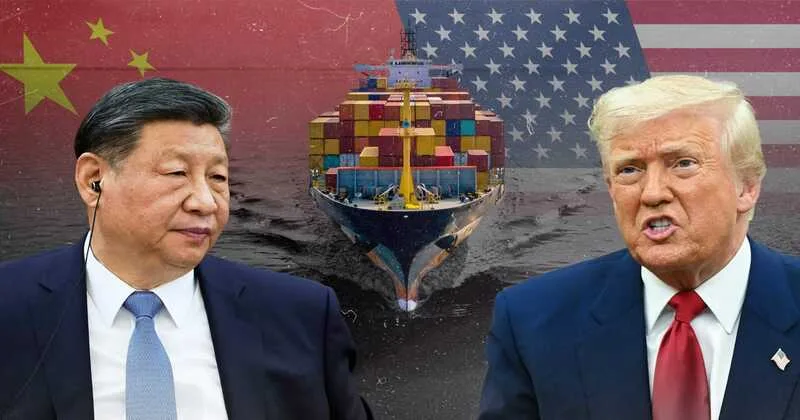
US President Donald Trump has announced an additional 100% tariff on all Chinese goods, effective November 1, intensifying the ongoing trade war between the world’s two largest economies. The move comes on top of the existing tariffs already in place, which currently include 50% on steel and aluminum, 7.5% on consumer goods, and 40% on other imports from China. With the new measures, the total tariff burden on Chinese goods could rise to nearly 150%. The White House confirmed that, along with the new tariffs, Washington will also enforce strict restrictions on the export of strategic software products to China from November 1. The decision follows what Trump described as “unacceptable trade practices” and “unfair restrictions” imposed by Beijing on critical raw materials.
The immediate trigger for Trump’s decision was the Xi administration’s recent order tightening controls on the export of rare earth elements from China. Under the new Chinese regulation, foreign companies must obtain prior licenses for exports exceeding 0.1 percent of rare earth production. The Chinese government has officially stated that the measure is intended to prevent the misuse of these materials. However, US officials believe it represents an attempt by China to weaponize its dominance in the rare earth market, as the country currently holds nearly 70 percent of the world’s supply. Trump, addressing reporters at the White House, said that China’s move amounted to an effort to monopolize the global rare earth industry and that the United States could not allow such control over critical resources. He argued that the new tariffs were a direct response to China’s attempt to exert political and economic pressure through export restrictions.
"It is impossible to believe that China would have taken such an action, but they have, and the rest is History. Thank you for your attention to this matter!" – President Donald J. Trump pic.twitter.com/Kx6deI2voC
— The White House (@WhiteHouse) October 10, 2025
The United States had earlier planned a bilateral meeting between Trump and Chinese President Xi Jinping at the upcoming Asia-Pacific Economic Cooperation (APEC) summit in South Korea. However, Trump has since canceled the meeting, citing the deteriorating trade relationship. He stated that under the current circumstances, such a meeting would serve no purpose. Trump added that while he would still attend the APEC summit in South Korea, a meeting with Xi would not take place as originally planned. Beijing has yet to officially respond to Washington’s latest announcement. However, observers note that the Chinese leadership may retaliate with further trade or regulatory measures in the coming weeks.
Stocks plunge, gold soars, and crude oil falls amid escalating US–China trade war
The escalation has caused major turmoil across global financial markets. In the United States, the Dow Jones Industrial Average plunged nearly 900 points, a decline of 1.09 percent. The S&P 500 fell 2.71 percent, while the tech-heavy Nasdaq dropped 3.56 percent, the steepest fall since last April. Technology stocks were hit particularly hard, with Nvidia falling 5 percent, AMD 8 percent, and Tesla 5 percent.
Chinese markets also suffered sharp declines, with the Shanghai Composite Index falling 0.94 percent and the Hong Kong Hang Seng Index dropping 1.73 percent. Major Chinese tech firms such as Alibaba and Baidu led the losses, each plunging around 8 percent. European markets followed suit, with leading indices declining up to 1.75 percent amid concerns over the renewed trade conflict. The commodity markets mirrored this volatility. Global crude oil prices tumbled as fears grew that the trade war could dampen demand. West Texas Intermediate (WTI) crude fell 4.24 percent to $58.90 per barrel, while Brent crude slipped 3.82 percent to $62.73. In contrast, gold prices surged as investors sought safe-haven assets during the turmoil. Gold rose by $56 to reach $4,017 per ounce, and analysts expect further gains in domestic Indian markets.
Trade war expands to agriculture and shipping
Agricultural and shipping sectors have also become new fronts in the escalating tensions. Trump is reportedly frustrated over China’s continued refusal to purchase US soybeans despite repeated requests from Washington. China, once the largest buyer of American soybeans, has instead turned to Argentina in recent months for its imports. In addition, the United States recently raised port and docking fees for Chinese shipping vessels. China retaliated by increasing its own port charges for US ships, further intensifying the standoff. The tit-for-tat measures underscore how the trade conflict has expanded beyond tariffs into wider sectors of economic and strategic competition.
With neither side showing signs of compromise, analysts warn that the situation could lead to a prolonged trade confrontation, with severe implications for global supply chains, market stability, and diplomatic relations between Washington and Beijing.
















Comments