





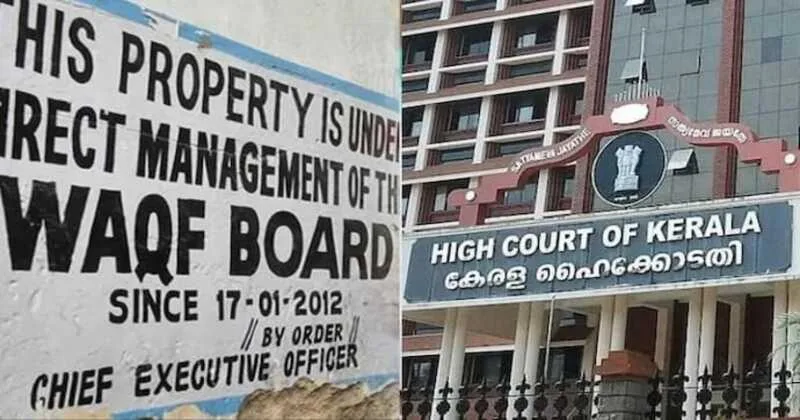
The Kerala High Court Division Bench has come out strongly against the Waqf Board in the Munambam land case, which has drawn statewide attention. The court’s observations, clarifying that the Munambam property in Ernakulam district is not waqf land, are expected to bring relief to thousands of people across the country facing similar disputes. The judgment offers a major reprieve to those unable to pay taxes or obtain loans due to ongoing cases over alleged waqf ownership.
The Division Bench took a critical view of the Waqf Act, stating that it allows individuals to claim ownership of land without presenting any documentary evidence. According to the court, simply asserting that a property is waqf is sufficient under the Act, it does not require supporting documents or witness testimony. Once declared waqf, the land cannot be reclaimed, as the law presumes “once a waqf, always a waqf.” Even years later, if someone alleges that a property was intended to be waqf, it automatically becomes disputed, forcing the owner to seek redress through the Waqf Tribunal. Until such cases are settled, owners are often unable to pay land tax or use the property for loans. The court went so far as to describe such misuse of the law as a “crime.”
Will the Taj Mahal also become a Waqf?
The Division Bench expressed strong concern about the implications of such unchecked powers, observing that if unilateral waqf declarations are legally upheld, any land or building could be claimed as waqf property in the future. “The Taj Mahal, the Red Fort, the Assembly Building, even this court building, any could be declared waqf by merely citing some document,” the Bench remarked. It warned that such arbitrary declarations have no place in a secular country like India, emphasizing that the judiciary is bound to act in accordance with the Constitution and protect citizens’ rights from encroachment. The court also censured the Waqf Board for blatantly disregarding the fundamental rights of those residing on or owning disputed land. It said the Board’s move to declare Munambam land as waqf amounted to an attempt to usurp private property.
Land not a permanent religious endowment, waqf declaration of 2019 found illegal
The High Court observed that the land granted to Farooq College management in 1950 was not a permanent offering to Allah and therefore did not constitute waqf. The court noted that the 1950 transfer documents showed no intention to dedicate the property permanently for religious use. Consequently, the land given to Farooq College could not be considered waqf land. The Division Bench made these observations while hearing a government appeal challenging the cancellation of the appointment of a judicial commission that had been tasked with inspecting the Munambam property. The single bench had previously ruled that any further steps must comply strictly with the Waqf Act. However, the Division Bench overturned that interpretation, clarifying that the land was transferred under conditions allowing for its reclamation, making it non-waqf.
The court noted that the Waqf Board’s 2019 decision to declare the Munambam land as waqf was unilateral and violated the provisions of the Waqf Acts of 1954, 1984, and 1995. These Acts require a systematic process, including land surveys, quasi-judicial inquiries, reports to the state government, and official gazette notifications, none of which were followed in this case.The Bench reaffirmed that the state government has the authority to appoint commissions and conduct investigations in such matters. The Waqf Board’s action, taken 69 years after the original land transfer, was deemed an “unjustifiable delay.” The court further ruled that the government is empowered to implement the recommendations made by the judicial commission. Justice C. N. Ramachandran Nair had earlier been appointed by the government to inspect the disputed Munambam land, but his appointment was quashed by a single bench. The government appealed the decision, and the Division Bench has now clarified that the state acted within its powers. The single bench’s earlier order was therefore a setback for the government, which has now been rectified.
Thousands trapped in similar disputes
The Munambam verdict has national significance, as similar disputes are ongoing across India. Thousands of citizens have been affected by waqf-related claims, many of which lack documentary evidence. According to figures presented by Union Home Minister Amit Shah in Parliament, the Waqf Board claimed ownership of 18 lakh acres of land between 1913 and 2013. As of 2025, this number has surged to 39 lakh acres, an increase of 21 lakh acres in just over a decade.
In some cases, even high-value private and public properties have faced waqf claims. The Waqf Board had once claimed ownership of Antilia, the multi-crore Mumbai residence of industrialist Mukesh Ambani. In Tamil Nadu, a similar claim was made over the 1,500-year-old Thiruthandur temple and its surrounding village. Although the Madras High Court ruled in favour of the residents and criticized the arbitrariness of the Waqf Act, the villagers are still unable to pay taxes due to the lingering legal status of the land. In Gujarat, two islands off the coast of Dwarka are under waqf dispute. In Hyderabad, lands on which corporate offices of Vipra and Microsoft stand have also been claimed as waqf property. A similar case has been filed over the ITC Hotel in Bengaluru. In Madhya Pradesh’s Burhanpur, the Waqf Board laid claim to monuments under the Archaeological Survey of India. Although the lower court dismissed the claim, the Board has appealed to the Supreme Court.
The Waqf land issue is active across several states including Tamil Nadu, Telangana, Madhya Pradesh, Uttar Pradesh, and Delhi. In Karnataka, the Waqf Board issued notices to farmers in Kolhar and Devarahipparagi of Vijayapura district, asserting ownership of their agricultural lands. The Karnataka Waqf Board has also made claims over historical monuments, government buildings, and lands in Mysore and Srirangapatna. These include Tipu Sultan’s armoury, the Sri Chamarajendra Memorial Museum, the Chikamma Chikkadevi temple in Mahadevapura village, a government school in Chandagalu village, and other state-owned properties. Most of these claims reportedly proceeded without supporting documents.
The Kerala High Court’s strong stance in the Munambam case has been hailed as a landmark ruling that could benefit thousands of people facing similar hardships. By affirming that the government can independently investigate and reject baseless waqf claims, the judgment reinforces constitutional protections for property rights and upholds the principles of secular governance. The court’s verdict signals that religious institutions, regardless of denomination, cannot override the law or infringe upon citizens’ rights through arbitrary claims. For many trapped in years of uncertainty, the Munambam decision offers both clarity and hope, restoring their right to pay taxes, seek loans, and exercise ownership over their land without fear of sudden religious reclassification.














Comments