





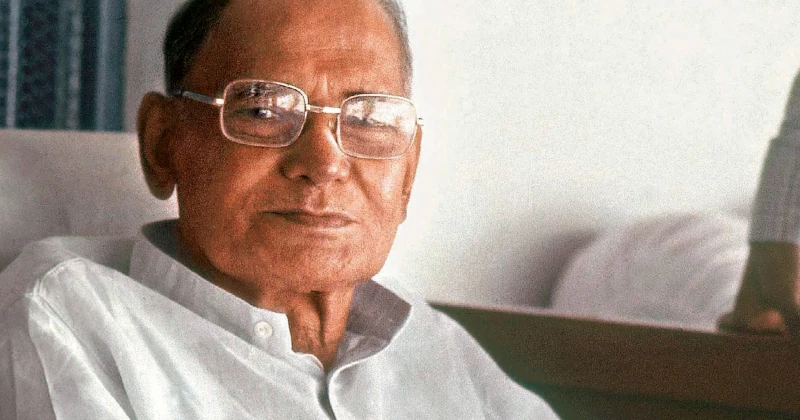
Eighty kilometres from Patna, in a quiet village named Sitabdiara near the confluence of the Ganga and Ghaghara rivers, was born on October 11, 1902 a man who would go on to shake the very foundations of political power in India Lok Nayak Jayaprakash Narayan. Born into an aristocratic family to Harsa Dayal and Phul Rani, Jayaprakash, fondly remembered as JP, evolved from a young Gandhian volunteer into the torchbearer of socialist idealism, and eventually, the moral force behind India’s Total Revolution movement that challenged authoritarianism in independent India.
Educated initially at Patna Collegiate School and later at Suena College, Jayaprakash’s academic promise soon took a turn toward political awakening. Responding to Mahatma Gandhi’s clarion call for the Non-Cooperation Movement, he left formal education to join the nationalist struggle. After completing his I.Sc. from Bihar Vidyapitha, he married Prabhavati, daughter of prominent lawyer and Champaran Satyagraha leader Brajakishore Prasad.
In 1922, his thirst for knowledge took him to the United States, where he studied at institutions including the Universities of Chicago, Wisconsin, California, and Ohio. It was here that JP learned the dignity of labour working in orchards and restaurants to fund his education. His exposure to Karl Marx’s writings deeply influenced his thinking and laid the foundation for his socialist ideology.
Returning to India in 1929, Jayaprakash briefly taught sociology at Banaras Hindu University. But with India’s political scene surging under Gandhi’s leadership and the declaration of ‘Purna Swarajya’ at the Lahore Congress Session in 1929, JP abandoned academia for activism. He immersed himself in the underground network that kept India’s freedom movement alive during the British crackdown of the 1930 Salt Satyagraha.
While JP admired Gandhi’s principles, he was not afraid to differ from him. When Gandhi signed the Gandhi-Irwin Pact in 1931, suspending the civil disobedience movement, JP strongly disagreed, believing it diluted the momentum for complete independence. His defiance led to multiple imprisonments, including stints in Nasik and Hazaribagh jails, where he forged lifelong friendships with revolutionaries like Achyut Patwardhan and Minoo Masani.
Together with Acharya Narendra Dev, he co-founded the All India Congress Socialist Party a radical faction within the Congress that sought to merge Gandhian ethics with socialist economics. Among his close associates were Ram Manohar Lohia, Kamaladevi Chattopadhyay, and Masani all pioneers of socialist thought in India.
During World War II, JP’s defiance intensified. Arrested by the British and held in Bombay, Delhi, and later Hazaribagh prisons, he displayed unmatched courage by escaping from jail with five comrades scaling the walls of confinement in an audacious act that became a symbol of resistance. Despite being declared a fugitive, he continued to mobilize underground resistance before being recaptured. His unwavering courage made him a legend even before independence.
After independence, when electoral politics failed to deliver his vision of a just society, Jayaprakash turned his focus to constructive social reform. He actively supported Vinoba Bhave’s Sarvodaya and Bhoodan movements, travelling across India to promote voluntary land redistribution and economic equality. His compassion extended even to criminals leading to the historic surrender of dreaded Chambal dacoits, including Sardar Madho Singh, a testament to JP’s transformative humanism.
Jayaprakash shared a special bond with Odisha. He presided over the Provincial Youth Conference in 1939 and revisited the state during the 1970s to propagate the message of Bhoodan and Total Revolution. His interactions with eminent Odia leaders Gopabandhu Choudhury, Rama Devi, Manmohan Choudhury, Surendra Nath Dwivedy, Harekrushna Mahatab, Biju Patnaik, and Rabi Ray strengthened his influence across social and political movements in the region.
Jayaprakash Narayan breathed his last on October 8 1979 at his humble residence in Kadamkuan, Patna, managed by the Mahila Charkha Samiti an organisation his wife Prabhavati had helped establish. His passing marked the end of an era but not of his ideals.
![VP CP Radhakrishna visited the ancestral village of Lok Nayak Jay Prakash Narayan on October 11, Image courtesy X [VPIndia]](https://organiser.org/wp-content/uploads/2025/10/g298xxtxoaa7tcw-e1760190402441-120x63.webp)












Comments