





With Gaza and West Asia once again moving toward peace after years of conflict, glimmers of optimism have emerged in the international financial sector. The ceasefire in Gaza and US President Donald Trump’s statement hinting that the next diplomatic step could involve peace between Russia and Ukraine have boosted investor confidence across global markets.
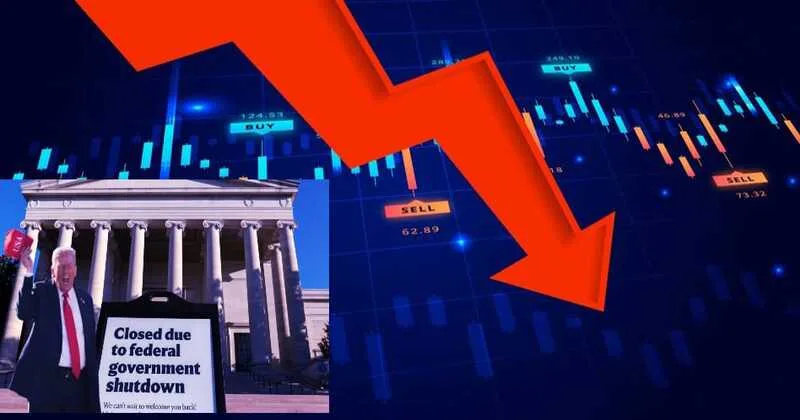
However, optimism was tempered by developments in the United States, where the government shutdown entered its tenth day. The world’s largest economy faces renewed uncertainty as the US Senate failed for the seventh time to pass a temporary funding bill to end the shutdown. The rising unemployment rate and the administration’s decision to withhold key economic indicators, including employment and inflation data, have added to market disappointment. Leading financial institutions JP Morgan and Goldman Sachs released their estimates showing a rise in unemployment claims. The number of people seeking unemployment benefits increased to 235,000 in the week ended October 4, compared with 224,000 the previous week, reflecting a cooling labour market. The sluggish economic data dragged down Wall Street indices, the S&P 500 fell by 0.28%, the Nasdaq slipped by 0.08%, and the Dow Jones Industrial Average dropped by 0.52%. after several days of record-breaking rallies, investors appeared to be locking in profits, leading to a pullback in equity prices. Despite the slowdown, futures trading indicated some stability, with S&P 500 and Nasdaq 100 futures edging up by 0.1%, and Dow Jones futures rising 0.08%, suggesting cautious optimism among traders.
🚨BREAKING: THE US GOVERNMENT SHUTDOWN IS NOW FORECASTED TO LAST NEARLY 24 DAYS.
LONGEST SHUTDOWN IN THE HISTORY. 🤯 pic.twitter.com/Ff130QGngA
— cryptothedoggy (@cryptothedoggy) October 9, 2025
European markets mirrored the weakness seen in the US. Banking stocks came under pressure after HSBC announced plans to privatize its subsidiary, Hang Seng Bank. The news triggered a 5% decline in HSBC’s London-listed shares, dragging the FTSE 100 index down by 0.41%. The broader sentiment across Europe remained subdued amid concerns about slowing global growth and corporate profitability. The downtrend in US and European stocks reverberated across Asian markets as well. China’s Shanghai Composite Index slipped 0.13%, Hong Kong’s Hang Seng fell 0.85%, Japan’s Nikkei declined 1.01%, and Australia’s ASX200 shed 0.26%. South Korea’s KOSPI, which reopened after a public holiday, bucked the trend and gained 0.66%, supported by technology and semiconductor stocks.
The Gift Nifty fell over 30 points in early trade, reflecting global market weakness. However, analysts expect a possible recovery as foreign institutional investors (FIIs) resumed buying. On Thursday, FIIs purchased Indian equities worth ₹864.36 crore, signalling renewed confidence in the domestic market. Meanwhile, Tata Elxsi’s quarterly results showed a 7.2% increase in profit compared to the previous quarter, though annual profit declined by 33%, indicating sectoral volatility. On the commodities front, international gold prices plunged sharply following the Gaza ceasefire, the dollar’s rebound, and profit-taking after last week’s surge. Gold, which traded above $4,050 per ounce on Thursday, fell to $3,947 before recovering slightly to $3,980. Analysts expect further downward pressure on prices in the Indian market today as global demand cools.
Overall, while geopolitical peace efforts in Gaza and Central Asia have lifted market sentiment, persistent economic uncertainty in the United States, coupled with weak corporate earnings and volatile commodity prices, continues to cloud the global financial outlook. Investors remain watchful, balancing optimism over peace with caution over economic headwinds.















Comments