





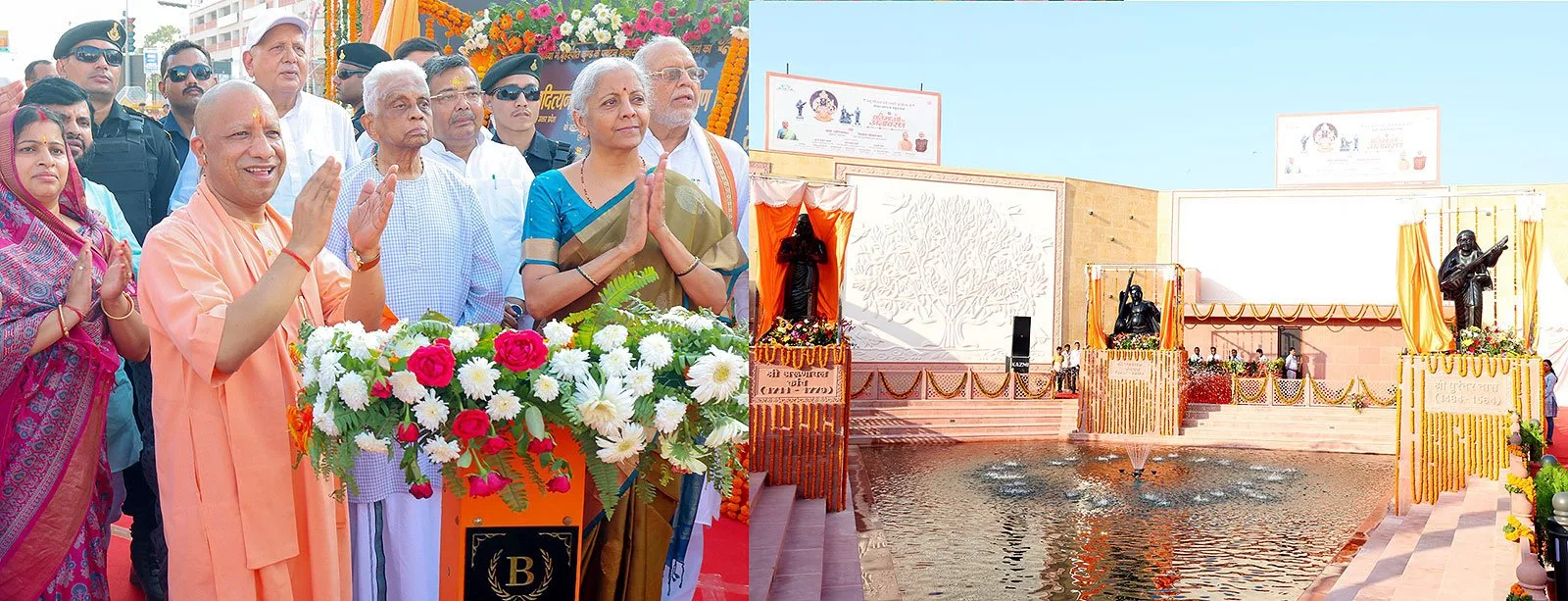
AYODHYA: “In the whole of South India, Sri Ram is present in some form or the other. Bhagwan Ram may reside in Ayodhya, but he is also present in every household in South India. Devotion to Bhagwan Ram in South India is not merely a matter of faith, but a way of life,” said Nirmala Sitharaman, the Union Finance Minister, in Ayodhya.
Speaking at the gathering at the Ram Mandir during a programme, on October 8, held after the unveiling of the statues of Sri Purandara Dasa, Sri Arunachala Kavirayar, and Sri Tyagaraja at Brihaspati Kund in Ayodhya, Uttar Pradesh, the Chief Minister Yogi Adityanath and the Finance Minister drew parallels between the North and the South through Bhagwan Ram.
Adding further, Nirmala Sitharaman said, “In Kerala, during the month of Ashadha, homes light lamps and recite the Valmiki Ramayana, reflecting the intangible tradition of devotion as the soul of the nation.”
The unveiling of statues of three eminent South Indian musical sants, Tyagaraja Swamigal, Purandara Dasar, and Arunachala Kavi, stands as an example of how unified the country is through devotion.
She said that with the surge in the number of devotees from South India visiting Ayodhya every month to offer prayers at the Shri Ram Mandir and other sacred places as part of their pilgrimage, the initiative aims to establish a deeper connection between the two regions of India.
The Union Finance Minister said, “In Tamil, Telugu, Kannada, and Malayalam, the glory of Shri Ram has been sung; this is the soul of India.”
In her address, Sitharaman said that the day is sacred, and that the installation of statues of sants who remembered Ram with every breath in Ayodhya could have happened only with Shri Ram’s divine will.
Paying rich tributes to the Carnatic poet Tyagaraja Swamigal, she said, “In his life of devotion, Tyagarajar refused to sing in a king’s durbar (court) or before kings, dedicating every song solely to Sri Ram. His composition Sita Kalyanam (Wedding of Ma Sita) is sung at weddings across South India, including at my daughter’s marriage.”
Speaking about another sant who wrote in Tamil, Nirmala Sitharaman said, “Sri Arunachala Kavi’s Tamil epic Ramanatakam (Rama Drama) deeply reveres Maa Sita, quoting his lines, ‘Look at Mother Sita with a hundred thousand eyes; no one is more beautiful than her.’”
She further said, “This Arunachala Kavi, in many topics, expresses the emotions and feelings within Sri Ramji’s mind as though he truly understands them. I am not an authority, there are many scholars present here, even then, I try to speak. Ramji was seated, and Hanumanji, who went in search of Ma Sita and found her in Ashoka Vanam in Sri Lanka, had been sent to discover her whereabouts.
“When Hanuman returned from Lanka after finding Sita, the very first words he uttered were “Kanden Sitayai” — Found Sita — so that not even for a moment would Rama worry about the outcome of his mission. It was this deep emotion and poetic intuition that inspired Arunachala… pic.twitter.com/uMcI8u5ZSX
— 𑀓𑀺𑀭𑀼𑀱𑁆𑀡𑀷𑁆 🇮🇳 (@tskrishnan) October 8, 2025
This emotion in the poet’s mind portrays Hanumanji reaching there and thinking, what should I say? Have you met Sitamai? Have you seen her? Do you recognise her or not? His heart is full of sorrow. The poet says, ‘If I am late, it feels like a sin.’ But when we delay, overthinking begins. Instead of saying ‘I went there, looked for her, met Sita Ma,’ he begins with one line, one word, ‘Kanden Sitayai,’ which means, ‘O Sri Ram, I have seen her.’ Don’t wait any longer. I have seen Ma Sita.
Later on, he narrates all the details about his visit, the hurdles on the way, Lanka, Ravan’s arrogance in his court, meeting Ma Sita, showing her the jewels given by you, and bringing back her jewels to prove the meeting. These words ‘I have seen Sita Ma’ put to rest all of Ram’s worries about her.
Similarly, in Ramanatakam, Arunachala Kavi’s understanding of each character, Ramji and Sitaji goes so deep into their emotions that it moves every listener. Each word by Arunachala Kavi is powerful. If you understand Tamil, tears will not stop flowing from your eyes. When Hanuman returned from Lanka after finding Sita, the very first words he uttered were ‘Kanden Sitayai’ (Found Sita) so that not even for a moment would Rama worry about the outcome of his mission. It was this deep emotion and poetic intuition that inspired Arunachala Kavirayar to compose the famous song Kanden Sitayai. Hanuman, after returning from Sri Lanka, told the grieving Ram in just one word — ‘I have seen Ma Sita.’ That alone was enough.”
Watch Live: Smt @nsitharaman's address at a programme after unveiling the statues of Sri Purandara dasa, Sri Arunachala Kavirayar and Sri Tyagaraja at Brihaspati Kund in Ayodhya, Uttar Pradesh. https://t.co/uSi6uLKyPm
— Nirmala Sitharaman Office (@nsitharamanoffc) October 8, 2025
She said, “By divine grace, the Arangetram (debut performance) of his Rama Natakam took place at Srirangam itself — an auspicious beginning for a work of such devotion.”
Nirmala Sitharaman also noted that not only male sants, but also a woman from the potter community composed Molla Ramayanam in Telugu, setting an example of devotion.












Comments