





I have publicly stated that by March 31 2026 this country will be free from Naxalism. Many people assume that with the end of violent acts the problem of Naxalism would be over — but that is not the case. Why did Naxalism arise in this country? Why did it grow and evolve? Who nurtured its ideological roots?
Until Indian society identifies and addresses those who provide ideological, legal and financial support to Naxalism, and until we do not ensure the return of such people into the mainstream, the fight against Naxalism will not end. We can get the Naxals to surrender, we can get our forces to confront them, arrest them or neutralise them in combat — but much more must be done to tackle the ideology itself. For that reason, I consider the discussions held here both timely and essential.
Internal security and the protection of the country’s borders have been central to our ideology from the Bharatiya Jana Sangh days to the Bharatiya Janata Party. If I summarise the core objectives that guided the journey of the Bharatiya Jana Sangh and later the BJP, three things stand out: first, the internal and external security of the nation; second, cultural nationalism; and third, the revival of the various strands of Indian culture. Among these, security of the country — both internal and external — is a very important objective. Today I will focus on internal security.
Focus on Internal Security Hotspots
In 2014, under the leadership of Prime Minister Shri Narendra Modi ji, the BJP formed an NDA Government with a full majority for the first time. Today, for the third consecutive term, the NDA under his leadership has again formed a full-majority Government. If we are to study party performance, or the performance of governments and policies on a particular issue, we have no option but to make comparative assessments. I will return to Naxalism shortly, but when Prime Minister Modi assumed office, three major internal-security hotspots required urgent attention: Jammu & Kashmir, North East, and Left wing corridor. These three hotspots had severely undermined the nation’s internal security for four to five decades, costing thousands of lives, causing enormous damage to property, and diverting a significant portion of public funds from poverty alleviation toward managing these conflicts. Security forces also suffered heavy casualties.
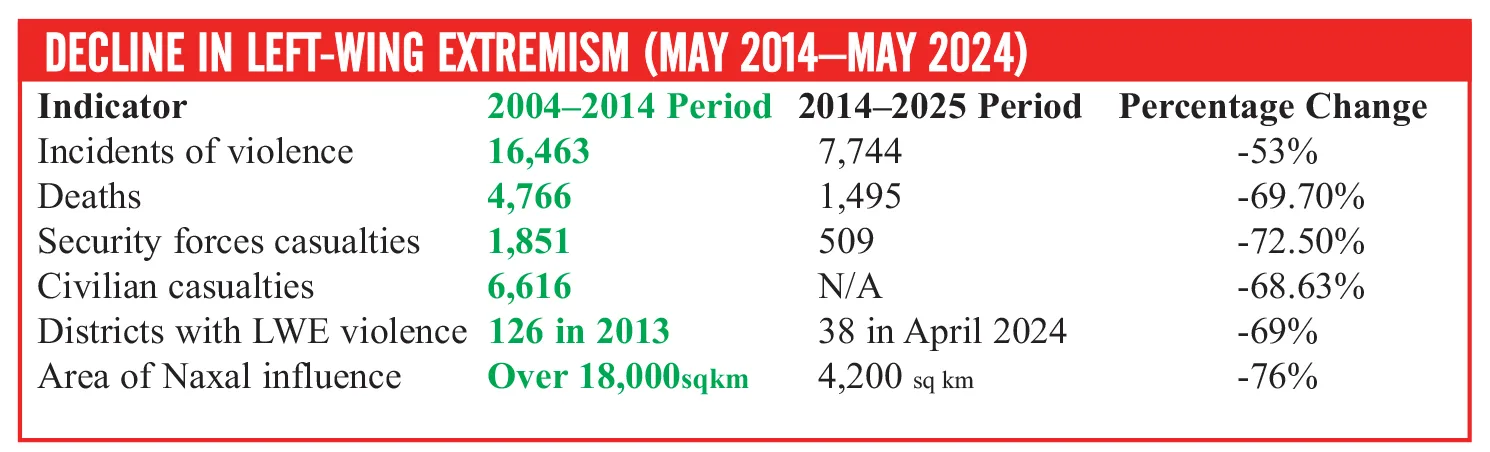
Immediately after Prime Minister Modi took office, the BJP-led Government focused on these three hotspots and implemented a clear long-term strategy. I want to share the results with you. In the North East, deaths of security personnel dropped by 70 per cent in 2014–2024 compared with 2004–2014. Civilian casualties fell by 85 per cent in the same time frame. Through 12 landmark peace accords, the Government brought some 10,500 young people, who had been carrying automatic weapons supplied by India’s enemies back into the mainstream by facilitating their surrender. North East, which once felt alienated from India, is now better physically connected by rail and waterways. But more importantly, the emotional distance between Delhi and the North East has narrowed — this Government has been central to that change. As a worker in ABVP in my youth, I remember how alienated the region once seemed. Now, after insurgents surrendered, the North East has moved toward peace and development.
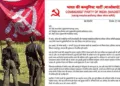
The armed Left Wing rebellion began in the early 1970s. In 1971, independent India saw the highest number of incidents — 3,620 that year. During the 1980s, the People’s War Group expanded into Maharashtra, Madhya Pradesh, Andhra Pradesh, Telangana, Chhattisgarh, Uttar Pradesh, Jharkhand, Bihar, and Kerala. Later, after the 80s, left‑wing factions began merging, and in 2004 the CPI (Maoist), a major group, was formed, giving Naxal violence a more serious character. The area once referred to as the “Red Corridor” included Jharkhand, Bihar, Uttar Pradesh, Chhattisgarh, Odisha, Maharashtra, Telangana, Madhya Pradesh and Kerala — roughly 17 per cent of the country’s landmass was once considered part of this corridor, and about 12 crore people lived in the shadow of Naxal violence. At that time, roughly 10 per cent of the population suffered under Naxalism. By contrast, Kashmir accounted for just one per cent of territory affected by terrorism, and the Northeast about 3.3 per cent of the country — which demonstrates how vast the Naxal problem was in comparison to the other two hotspots.
Ruthless Strategy to Trounce Naxalism
When the Modi Government came to power in 2014, it adopted a three-pronged approach: dialogue, security, and coordination. Today I can say with confidence — in this large forum — that armed Naxalism in this country will be finished by March 31 2026. Earlier, the Government’s responses were fragmented—at times limited to negotiations, at times focused on development drives, and at other times on security operations. These were largely incident-based, without any permanent policy framework. In effect, the steering wheel of the Government’s response seemed to lie in the hands of the Naxalites. After 2014, various campaigns, operations and programmes of the Government came into the hands of the Government. This policy shift produced results. The BJP-led Government replaced the scattered approach with a unified and ruthless strategy. I have no hesitation using the phrase “ruthless strategy.” Our policy offers a red carpet to those who want to lay down arms and surrender. You are welcome — you are our people who lost their way. The most lucrative surrender policy has been formulated—thanks to Vijay ji and the Chhattisgarh Government; the Union Government has also implemented effective measures. Even today we reiterate that we do not want to kill anyone. However, if someone takes up arms and kills innocent tribals, the state’s duty is to protect them and confront the perpetrators.
Eliminating Naxalites Who Are Targeting Constitution
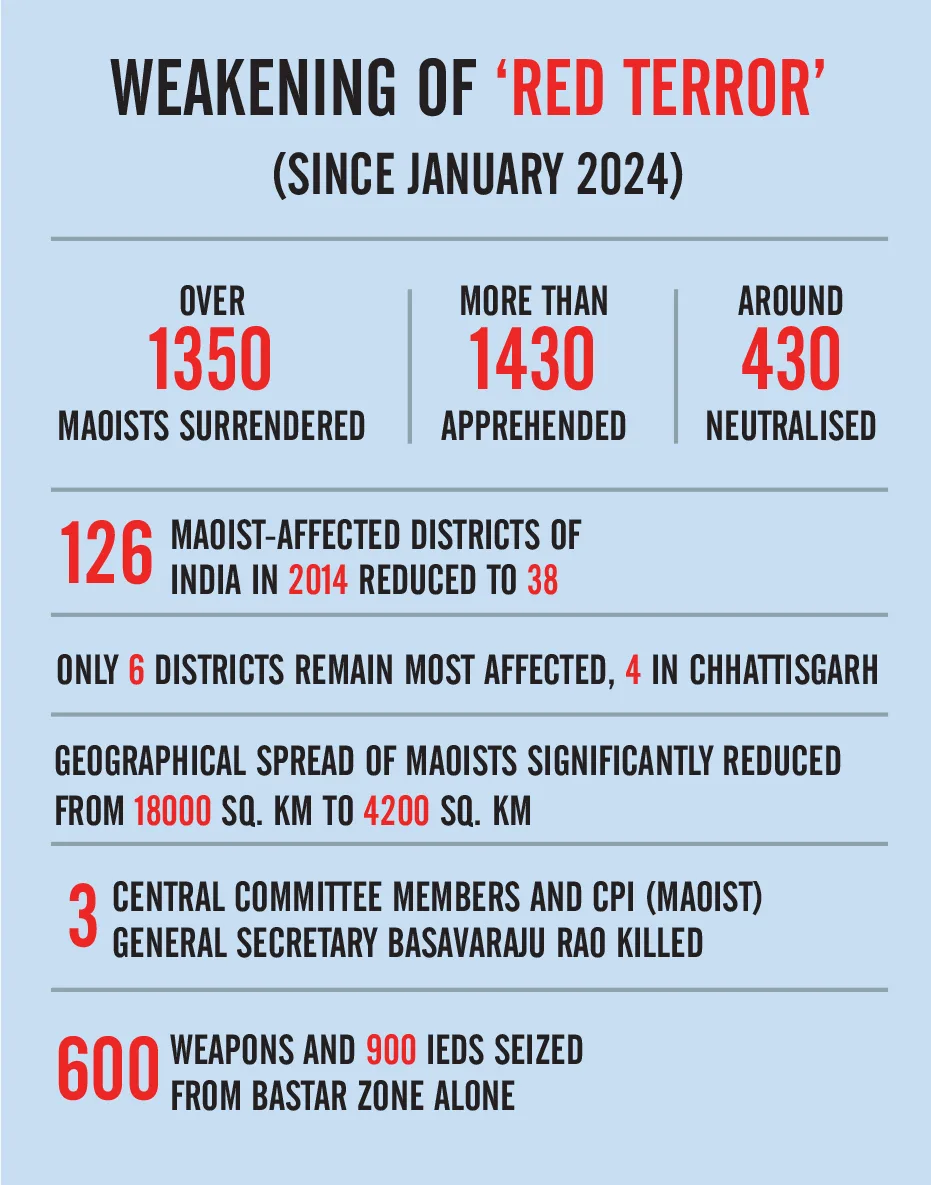
Since 2019, I have been serving as Union Home Minister, and under the leadership of Prime Minister Modi ji, operations against Naxalism are being carried out across India. Jharkhand and Bihar are largely freed now; Andhra Pradesh and Telangana have been freed; Maharashtra is on the verge of being free of Naxalism. But in Chhattisgarh, progress lagged because the Congress-led state government failed to provide the sustained cooperation needed for joint initiatives. I will avoid any political critique, but in 2024, the BJP formed the Government in Chhattisgarh. Within a year, the state recorded its highest ever neutralisation of Naxals — 270 in a single year. The Left Wing sympathisers who defend Naxalites and say we should not kill our own, let me be clear: we do not wish to kill. But 290 were killed because they carried weapons; where arrests were possible, we made arrests: 1,090 arrests and 881 surrenders. This demonstrates our approach: we make every effort to arrest and facilitate surrenders, and we provide a comprehensive surrender policy. But when armed groups target innocent citizens, security forces have no option but to respond with force.
In 2025 — the second year of the BJP Government in Chhattisgarh — as of today 270 Naxals have been neutralised; 680 have been arrested; and 1,225 have surrendered. In areas where operations were intensified, the number of surrenders and arrests greatly outnumbered neutralisations. The rising number of surrenders indicates that Naxals are running out of time. They had built a protected camp on difficult terrain along the Telangana–Chhattisgarh border — heavily armed, with a food stock to cover their needs for two years, weapons fabrication and IED workshops. It took five days for troops to reach it on foot — such was its remoteness. Many rivers and lakes were there, and they had built a 50 sq. km base. On May 23 2025, under Operation Black Forest, that base was destroyed and 27 hardcore Naxals were killed. In Bijapur, 24 hardcore Naxals were neutralised. This broke the spine of the remaining Naxal resistance in Chhattisgarh. Among those neutralised in 2024 were 1 zonal committee member, 5 sub‑zonal committee members, 2 state committee members, 31 divisional committee members and 59 area committee members. The list of remaining Naxalites has become smaller than the list of wanted Naxalites now. In 2014 there were only 66 fortified police stations; from 1960 to 2014 there were just 66 such stations. In Modi Government’s ten years, 576 new fortified police stations were built. In 2014, there were 126 Naxal‑affected districts; now only 18 districts remain Naxal-affected. This shows how quickly the affected area has reduced. The category of most‑affected districts has shrunk from 36 to 6. The number of affected police stations fell from about 330 to 151 — of those, 41 are newly created police stations, so if we subtract them, roughly 100 old police stations remain affected. In the last six years alone, 336 security camps were established and 68 night‑landing helipads were created. We have even made 76 night-landing helipads for CRPF troops — previously there were limited facilities for ministers and officials; now our forces also have necessary infrastructure.
Strategic Measures Against Naxalism
- Central and state security forces (DRG, STF, CRPF, COBRA) were given freedom and integrated training for joint operations
- Targeted operations like Operation Octopus and Operation Double Bull were conducted
- Operation Black Forest (May 23, 2025) destroyed a large Naxalite camp at Karregutaa Hills, killing 27 hardcore Naxalites and breaking the “backbone of the remaining Naxalites in Chhattisgarh.”
Financial and Legal Clampdown
- Strict control blocked over 90 per cent of Naxalite arms and ammunition supply after 2019
- NIA and ED tightened the noose on Naxalite financing, seizing properties worth crores
- Action was taken against urban Naxal support, legal aid networks, and media narrative crafting. More than 18 central committee members have been neutralised
Success in Other Hotspots
- North East: 12 peace agreements signed; 10,500 armed youths brought into the mainstream. Security personnel deaths down by 70 per cent and civilian deaths down by 85 per cent (2014–2024 vs. 2004–2014)
- Jammu & Kashmir (J&K): Abrogation of Article 370 in 2019. Violent incidents down by 75 per cent (7,300 in 2004–2014 to 1,800 in 2014–2024). Security personnel deaths down by 65 per cent and civilian deaths by 77 per cdent. Panchayat elections were held with a 99.8 per cent voter turnout
To reduce Naxals’ money-flow, the NIA, ED and State Governments have seized crores of rupees worth of property and have freezed bank accounts. I have convened 12 coordination meetings with chief ministers, and in Chhattisgarh alone I held eight meetings to ensure synchronised action. The Chhattisgarh Government has introduced lucrative surrender packages: Rs 5 lakh for senior cadres, Rs 2.5 lakh for mid and lower‑level cadres, and Rs 10,000 for vocational training assistance. Many development initiatives have been undertaken in areas affected by left‑wing extremism. There was a claim that Naxalism arose from development imbalance — initially I accepted that argument partially, but after detailed study, journalists interested in deeper detail can contact my office, the evidence shows that of the 56 districts outside the Pashupati–Tirupati corridor that were the most backward, many did not witness Naxalism. Worldwide, wherever left‑wing ideologies have taken root, violence and ideology often go hand in hand — that is the root of Naxalism. If an ideology does not denounce violence, if it does not regard violence as wrong, how can a country function? I say firmly that those who claim development imbalance is the root cause of left‑wing extremism are misleading the nation. Our Constitution has specific Articles and provides numerous arrangements for tribal welfare; tribal welfare falls under the purview of the President and the Governors; the responsibility and budgetary provisions are laid out, and many schemes exist for their development. After centuries of colonial rule we gained independence with limited resources and could not develop everything at once; some regions lagged. That is no longer the case. For 60 crore poor people, Prime Minister Modi launched many schemes: housing, toilets, household electricity, clean drinking water, five kilograms of grain, life insurance up to Rs 5 lakh, and cooking gas connections. Who prevents these facilities from reaching Naxal areas?
I directly ask left‑leaning intellectuals who support the movement: if schools did not reach Bijapur or Sukma in Chhattisgarh, who is responsible? During Atal ji’s time there was Sarv Shiksha Abhiyan which was later consolidated by Modi ji, so why did schools not reach those areas? Because you obstructed them with violence; you killed road contractors and prevented network expansion. If five kilograms of rice reaches the rest of the country, why not there? Because you prevented ration distribution and blocked ration cards. You do not want the development of Adivasis — you want to keep your ideology alive – an ideology that is being rejected across the world. Therefore, this propaganda must be understood and countered. I challenge those who write articles supporting armed movements: how can you possibly justify such violence within the four corners of our Constitution and in a civilized society? Armed movements do not empower people, they only create a vacuum — a vacuum of state authority, of governance, of constitution, and of security. There is a misconception that weapons are taken up because development is absent. The truth is that many regions of India have faced deprivation, yet their people chose the democratic path — through Panchayats, legislative assemblies, and Parliament — to secure development. Today, where development is still blocked, it is not because of poverty but because of Left-wing ideology. This pattern is not unique to India; we saw the same in Colombia, Peru, and Cambodia, where ideology was spread through violence. But let me state clearly: that model will not succeed in India, not under the decisive and no-nonsense leadership of Prime Minister Narendra Modi.
I am confident we will win this battle. Approximately 12 per cent of India’s land area and about 17 crore people will be freed from this long-standing problem. This is a matter of great satisfaction for all of us. I also appeal to all NGOs: do everything you can for tribal areas. These communities have endured nearly four decades of suffering. Government, civil society, and volunteers should make these regions a focus of sustained development until they stand fully developed and enjoy the same dignity as every Indian citizen in the world.
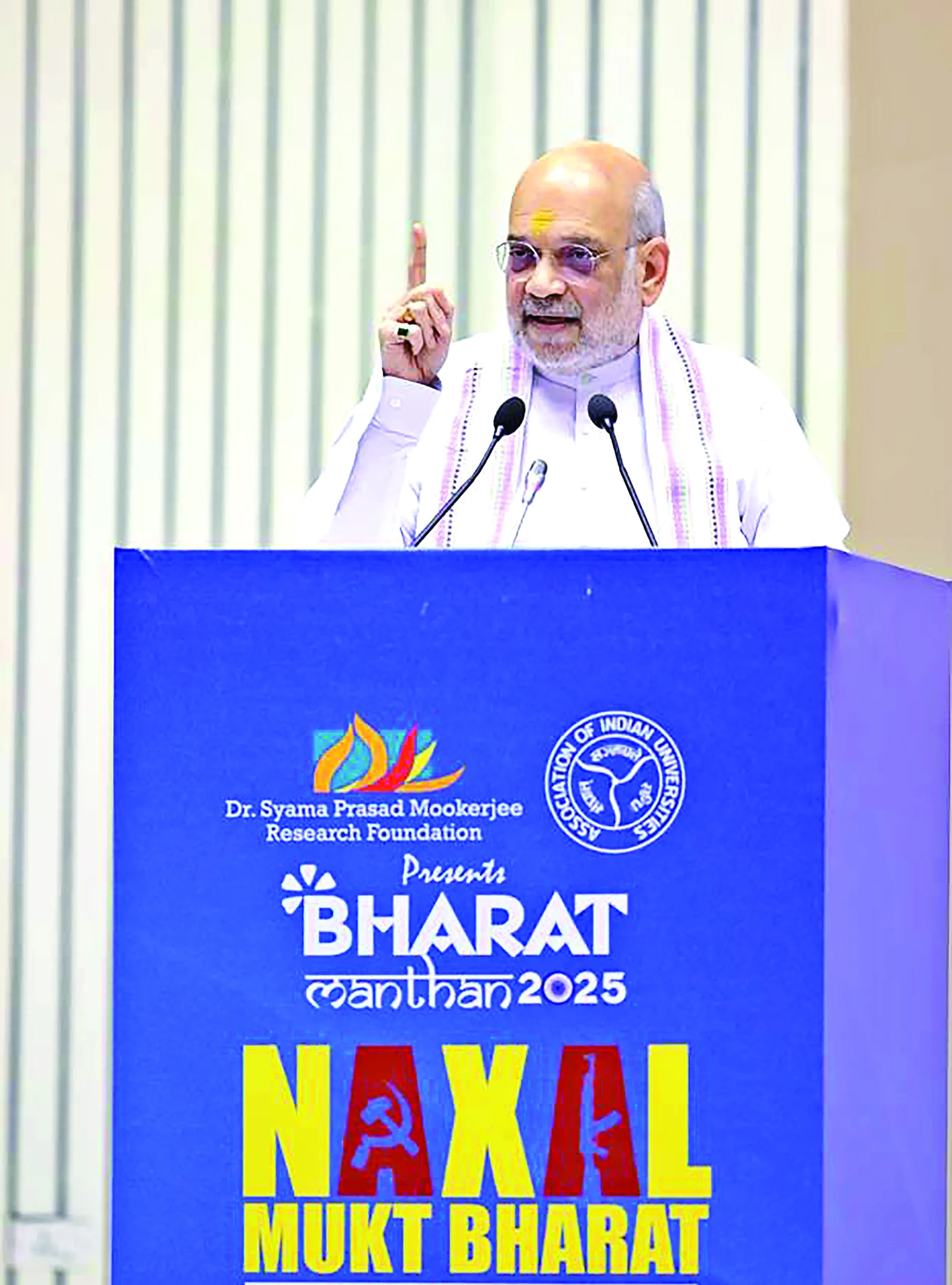
(Excerpt of the speech by Home Minister Amit Shah at valedictory session of ‘Bharat Manthan-2025: Naxal Mukt Bharat – Ending Red Terror Under Modi’s Leadership’ in New Delhi on September 28, organised by SPMRF)













Comments