





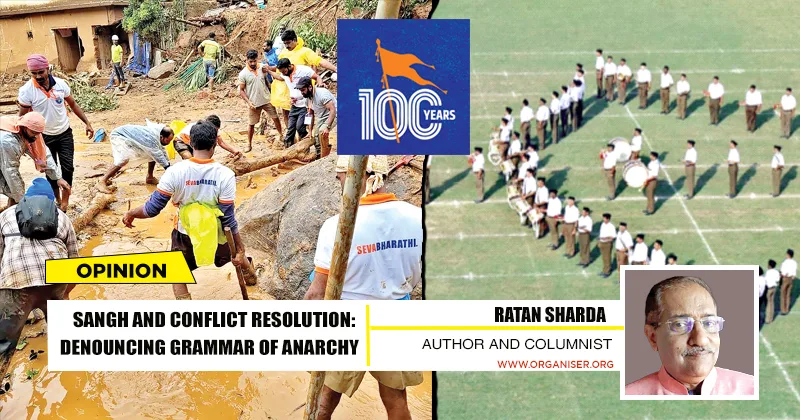
All debates on the Rashtriya Swayamsevak Sangh (RSS) often focus on Hindutva, Hindu-Muslim relations, secularism, communalism, or its perceived role in Bharat’s freedom struggle. Yet, RSS’s critical contribution to strengthening national unity and resisting divisive forces—both intellectually and on the ground—is often overlooked or unknown, partly due to limited public communication and media coverage.
RSS has consistently confronted forces of disruption with ideas and action. It has not only criticised Governments on key issues but also cooperated and worked on the ground to mitigate adverse situations. In my book Conflict Resolution – The RSS Way, I provide a detailed account of the RSS’s role in strengthening national integration in three particularly challenging regions since Independence: the North East, Jammu-Kashmir, and Punjab.
Overview Of RSS Efforts Outcome
A distinctive feature of RSS thinking is that it never looked at disruptive elements and incidents in isolation, as many media and leaders in Bharat tend to do. It connected the dots to draw a nationwide picture of emerging or present enemies of national integration, now captioned as ‘Breaking India’ forces by Rajiv Malhotra.
The 2003 resolution noted:
“Mallapuram district has been Islamised completely while the Hindu population in Kozhikode district has reduced to less than 20 per cent. Marad episode is only a recent example of a conspiracy going on for last several years to de-Hinduise the entire Kerala coast. Terrorist outfits like Al-Umma and Lashkar-e-Taiba are actively engaged in this conspiracy at the behest of Pakistan’s ISI. Gameplan of these outfits is to make the entire coast a safe haven for smuggling of narcotics and weapons. They exercise control over many mosques, which have become warehouses of weapons rather than being prayer-houses. The police have recovered many arms and explosives from the mosque of Marad also.”
It then went on to link it to the unrest in North East, Its resolution underlined “Instances like destruction of temples in Changlang and Tirap of Arunachal Pradesh and putting up Cross after destroying a temple in Jampoi Hill of Tripura are taking place every now and then. All this clearly indicates a sinister nexus exist between Christian missionaries and terrorists in the entire North East region.
It went on to show Marxist collusion in the disturbances, “The Marxists have joined hands with Muslim elements in West Bengal and indulged in wanton violence on Hindus during the recent Panchayat elections. Many people have been brutally murdered in Dhantala, Omrapota, Ghoshkadanga and other places. Many minor girls and women have been molested / raped. Youths are being prevented from taking part in Hindu activities including the RSS; penalties are imposed on Hindu house-owners for living in their own villages, and death threats are issued on refusal to obey their dictates. All these incidents are a clear proof of the patronage given to terrorists in the leftist strongholds and their own involvement in such activities. One of the sitting MPs of the CPM has accepted that the atrocities committed by the CPM-supported goons are a matter of concern to their own party.”
This resolution was passed when BJP-led alliance ruled at the Centre. Many resolutions have exposed the alliance of Jihadi, Maoist, Christian and so-called secular forces. Bharat has witnessed partnerships of disruptive forces creating violent conflicts and sustaining long insurgencies.
Other challenges to national integration include the Dravidianist ideology based on the Aryan-Dravid divide, and casteism hyped by Left and anti-Hindu forces under the garb of social justice but actually fragmenting Hindu society. RSS-inspired Itihas Sankalan Samiti, led by archaeologist Padmashri DS Wakankar, pioneered discovery of Saraswati river using modern methods. This struck a body blow to Aryan Invasion Theory and exposed the political desperation of those still clinging to it.
RSS has for decades worked to bridge caste differences and foster brotherhood. One of the five Panch Parivartan efforts during its centenary focused on removing caste divisions from social psyche. Denial of Bharat’s inherent cultural unity has encouraged centrifugal tendencies—religious, tribal, caste, or linguistic. Yet, sustained RSS work in nurturing overarching geo-cultural nationhood has eroded the myth that the British “created” Bharat.
RSS actively engaged in North East, Jammu & Kashmir, and Punjab, recognising dangers ignored by politicians and media. It warned of crises ahead, speaking politically incorrect truths. In the North East, separatism is backed by Church sects and neighbouring countries. In Kashmir, Pakistan and Wahhabi Islam fuel separatism with the dream of Ghazwa-e-Hind, imagining Kashmir as gateway to convert Bharat into Dar-ul-Islam. Punjab unrest began with destabilising Akali ministries in the 1970s, leading to Anandpur Sahib Resolution—the seed of Khalistan, revived whenever politically convenient.
All these movements had overt or covert support from Communists, who floated the idea that Bharat is not a nation but a British-imposed union of 17 separate nationalities. This Adhikari doctrine (1943) sought division into 17 sovereign nations and backed Pakistan’s creation and autonomy for Jammu-Kashmir. Silent acceptance of this by Nehruvian politics gave oxygen to separatism.
RSS consistently countered this, presenting a culturally unified nation at the core of its arguments. Its resolutions and ground actions on insurgencies reflected conviction about Bharat’s Sanskritik unity. Though fine-tuned to organisational strength, refusal of Government and ruling class to heed RSS intelligence lost many chances to correct historic wrongs. RSS was alert to international conspiracies over accession of Jammu-Kashmir. In October 1947, Swayamsevaks fought Pakistani troops and Kabailis, at cost of hundreds of lives, while keeping Dogra forces and Indian Army informed—showing national integrity rests on citizens’ responsibility. It consistently opposed Article 370, later exposing Article 35(A), long hidden by parties. It highlighted discrimination by Kashmir valley politicians against other regions and faiths.
RSS alone agitated for uplift of Pakistani Hindu refugees who ended up in Jammu in 1947, denied full rights unlike others from divided Bharat. Its inspired organisations ran Sewa projects for persecuted communities—giving physical and emotional support, keeping them attached to Bharat. Over the years, RSS built a counter-narrative: insurgency was limited to small areas, while most citizens of J&K and Ladakh were patriotic. This patient effort educated Bharatiyas, isolated insurgents, and helped the new Government finally break the deadlock and opened up new possibilities.
Punjab, along with Bengal, saw the largest human migration and violence during Partition. Punjab, the sword arm of Bharat and bulwark against North-West invasions, witnessed RSS Swayamsevaks displaying courage and sacrifice. Many lost lives, businesses, and families before reuniting.
RSS stood with Sikhs in declaring Punjabi as Punjab’s language and supporting Punjabi Suba, reducing friction between the two communities. Though not in favour of linguistic reorganisation of States, it backed Punjabi Suba as Punjabis’ right, since other regions of Bharat were reorganised on linguistic basis. Intellectual honesty, sense of history and political understanding is seen in this stand.
RSS opposed Khalistani separatism, fanned by political parties for electoral gains. Its resolutions highlighted Hindu-Sikh blood ties. With like-minded citizens, it formed Rashtriya Suraksha Samiti Punjab to resist divisive forces, created funds for terror victims, and prevented large-scale migration of non-Sikhs. Many Swayamsevaks fell to terrorist violence but RSS persisted. It also criticised Human Rights lobbies targeting policemen who fought separatism. Punjab, unlike distant North East, was an insurgency in the mainland; its success could have let off a chain reaction of balkanisation of this country.
RSS’s wide network gave it unmatched ground intelligence, enabling region-specific strategies. In the volatile North East, dominated by Churches for over a century, RSS began in 1950 with limited resources, focusing on building right kind of institutions and education where only Church-run schools existed. It worked silently and in diverse ways with the local tribal population. It built network with Hindu organisations like Ramakrishna Mission and Jai Gurudev, slowly reconnecting the region to Bharat. It revived native faiths, traditions, and skills, creating indigenous faith movements under Janajatiya bodies. These nurtured confidence, cultural renaissance, and readiness to struggle against the Church domination. Education, health, and livelihoods became key tools. Over time, this intelligent strategy bore fruit, and by 2014 a groundswell of renewed confidence in being part of Bharat emerged from 2014.
In Assam, RSS worked hard to change the approach of treating all immigrants as foreigners, and slowly created a counter-viewpoint that one must differentiate between persecuted refugees and illegal migrants who come to Bharat for economic gains. RSS provided serious ground-level intelligence to the nation and Government from the region, often at a heavy cost to its members and Pracharaks.
RSS response to conflicts and insurgencies is shaped by its view of the unifying spirit of Bharat, visible in its cultural unity expressed in diverse forms and celebrated across the country. It takes an overarching, integral view of national security, not distracted by local factors or incidents.
RSS has adopted the same positive approach of serving tribal society, educating them, helping them remain rooted in their traditions, and enabling them to become self-reliant
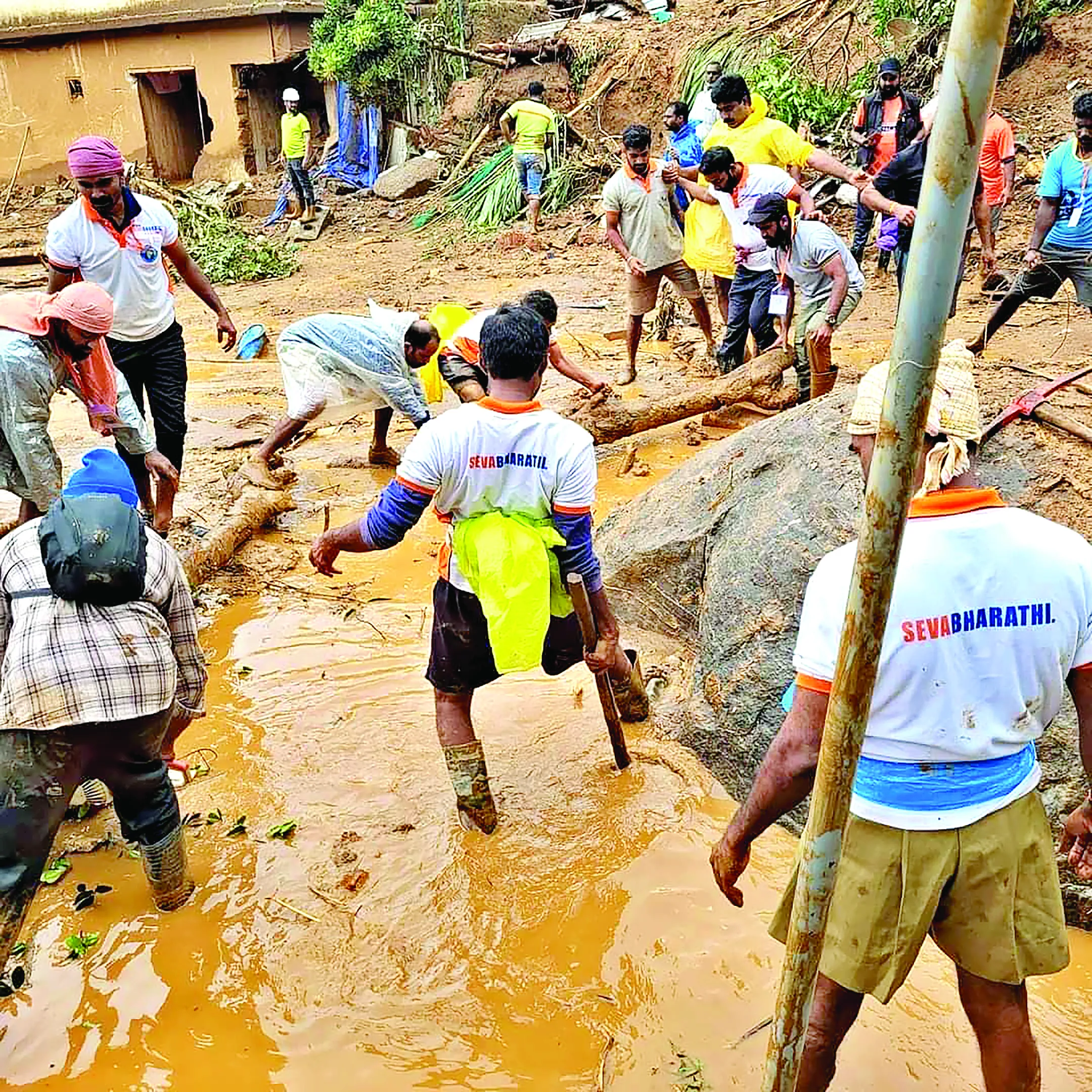
It exhorts its cadre to take up any challenge, whether a national calamity or a security issue. It also seeks citizen support by arousing their sense of patriotism. This approach underlines its philosophy that one cannot depend on Government alone in a democracy; people’s participation is equally important for the good of the country.
One region where the underground ultra-Left has had an upper hand against RSS is in the Maoist insurgency in the tribal and mining belt of Central India, extending to the eastern coast. Here too, RSS has adopted the same positive approach of serving tribal society, educating them, helping them remain rooted in their traditions, and enabling them to become self-reliant. This has posed a major roadblock to evangelists and Left forces. With this resolute approach, the government is now steadily overcoming the Maoist insurgency.
To summarise, the RSS strategy in resolving conflicts has been to:
- Identify the root cause(s) of the conflict
- Take a firm line against appeasement of insurgents without compromise
- Maintain a consistent stand against any idea of separatism
- Gain the faith and support of those aligned with the nation and Government
- Help resolve humanitarian issues
- Expose foreign interference wherever detected
- Identify fault lines within conflict-ridden societies as well as unifying factors, and emphasise the unifying ones
- Continuously evolve and fine-tune strategies
- Avoid leaving any issue solely to politicians and governments
- Educate citizens to create the right environment and lobby with the Government
- Deploy cadre on the ground wherever possible
We see a strange and dichotomous socio-political discourse that has shaped the national scene since Independence. While many countries have been successfully broken by insurgencies, Bharat has withstood serious violence for a much longer period and managed to overcome or control them. The major reason lies in Bharat’s deep cultural unity—a reality that intellectuals looking at Bharat through Western lenses have failed to acknowledge.











Comments