





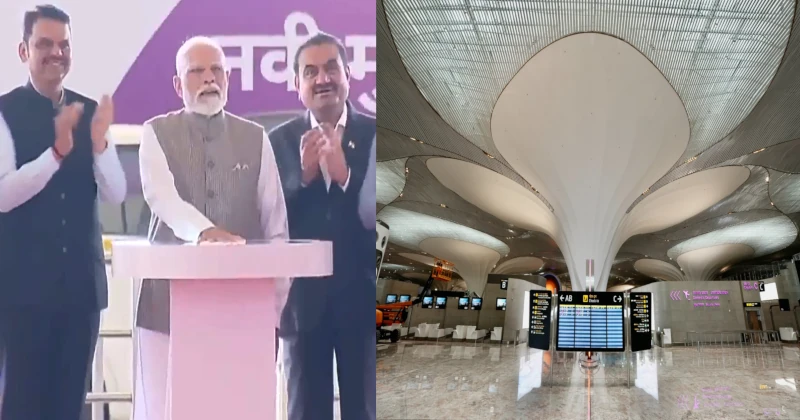
Prime Minister Narendra Modi on October 9, inaugurated the long-awaited Navi Mumbai International Airport (NMIA), marking a defining moment in India’s aviation history. With this, Mumbai joins the league of global cities like London, New York, and Tokyo that boast multiple international airports a development that will decisively reshape the city’s transport and economic landscape.
The state-of-the-art Greenfield airport, built under a public–private partnership (PPP) between Adani Airport Holdings Ltd (AAHL) and CIDCO (City and Industrial Development Corporation of Maharashtra Ltd), represents India’s most ambitious aviation infrastructure project yet. The Rs 19,650-crore project is expected to begin commercial operations by December 2025, with several leading airlines already lining up for operations.
#WATCH | Navi Mumbai, Maharashtra | Prime Minister Narendra Modi inaugurates Phase 1 of the Navi Mumbai International Airport, built at a cost of around Rs 19,650 crore.
(Source: DD News) pic.twitter.com/6kSxFSHNgB
— ANI (@ANI) October 8, 2025
Maharashtra Deputy Chief Minister Devendra Fadnavis announced that the much-awaited Navi Mumbai International Airport, set to be inaugurated by Prime Minister Narendra Modi tomorrow, will mark a new era in world-class air travel.
Sharing details on X, Fadnavis said the airport embodies a seamless blend of cutting-edge technology and modern design, positioning it as a global infrastructure masterpiece. Inspired by the lotus flower, the airport’s architecture features expansive glass façades, open spaces, and abundant natural light, creating an airy and contemporary ambience.
💫Step into the future of world class air travel!
Travellers will now experience an amalgamation of cutting edge technology and inspired modern design making the Navi Mumbai International Airport a global infrastructure masterpiece. Its architecture is inspired by the lotus… pic.twitter.com/9TX0zpnuhO
— Devendra Fadnavis (@Dev_Fadnavis) October 7, 2025
The Navi Mumbai International Airport is India’s first fully digital airport, equipped with advanced automation, AI-based systems, and integrated passenger services. It offers an array of cutting-edge features from AI-enabled baggage tracking and online immigration services to pre-booked parking slots and a fully automated terminal.
Arun Bansal, CEO of Adani Airport Holdings Ltd, described NMIA as an “anxiety-free airport” designed to redefine passenger comfort. “From check-in to baggage collection, automation will ensure seamless travel. For instance, passengers will receive live baggage tracking updates on their phones a first for Indian airports,” he said.
Spread across 1,160 hectares, NMIA will initially handle 20 million passengers annually through one runway and one terminal. At full capacity, it will expand to four terminals and two runways, capable of handling an astonishing 155 million passengers every year ranking it among the largest airports in Asia.
The project is also expected to generate over two lakh jobs across aviation, logistics, IT, hospitality, and real estate sectors, further reinforcing Maharashtra’s economic growth and Mumbai’s position as a global business hub.
Maharashtra Chief Minister said the airport will mark a “paradigm shift in India’s infrastructure journey,” adding that “travellers will now experience an amalgamation of cutting-edge technology and inspired modern design, making the Navi Mumbai International Airport a global infrastructure masterpiece.”
NMIA is being celebrated not just for its scale but for its sustainability and connectivity. It will be India’s first airport with dedicated storage for Sustainable Aviation Fuel (SAF), solar power generation of 47 MW, and EV-based public connectivity across the city.
It will also be the first airport in India to be linked by water taxi, in addition to multiple transport systems expressways, metro lines, suburban rail networks, and waterways, establishing it as India’s first truly multi-modal aviation hub.
Among its unique offerings is an Automated People Mover (APM) an advanced transit system connecting all four passenger terminals and linking the city-side infrastructure for smooth inter-terminal transfers.
The inauguration of NMIA is part of Prime Minister Modi’s two-day visit to Maharashtra, which also includes several landmark projects in Mumbai aimed at reshaping urban connectivity.
Later in the day, will PM Modi also inaugurate Phase 2B of the Mumbai Metro Line 3, extending from Acharya Atre Chowk to Cuffe Parade, at an estimated cost of Rs 12,200 crore. With this, the entire 33.5-km Aqua Line Mumbai’s first fully underground metro corridor is now complete, built at a total cost of Rs 37,270 crore.
Designed to handle 13 lakh passengers daily, Metro Line-3 connects the city’s cultural, administrative, and financial districts including Fort, Kala Ghoda, the Bombay High Court, RBI, BSE, and Nariman Point ensuring seamless integration with railways, monorails, airports, and other metro lines.
In a further push toward digital integration, PM Modi will launch “Mumbai One” India’s first integrated mobility app that unifies 11 public transport operators (PTOs), covering metros, monorails, suburban railways, and buses across the Mumbai Metropolitan Region.
Additionally, the Prime Minister will inaugurate STEP (Short-Term Employability Program) a flagship skill initiative by the Department of Skill, Employment, Entrepreneurship, and Innovation. STEP aims to align industrial skill demands with vocational training, introducing 2,500 new training batches, including 364 exclusive batches for women and courses in emerging technologies like AI, IoT, Electric Vehicles, Solar, and Additive Manufacturing.













Comments