





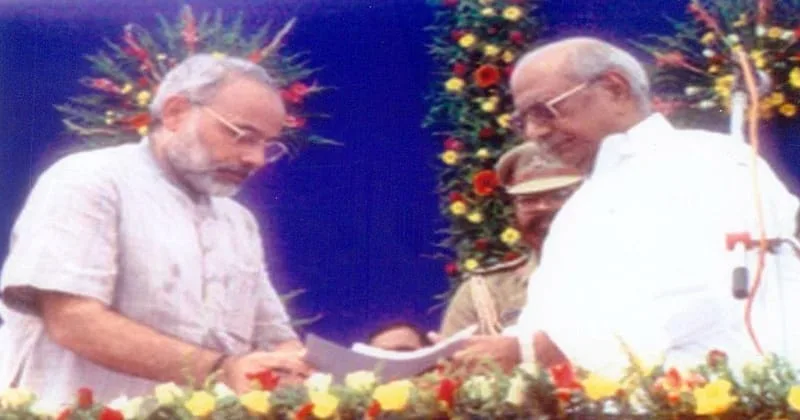
October 7, 2001, marked a pivotal moment in Indian politics. On that day, Prime Minister Narendra Modi took the oath as the Chief Minister of Gujarat for the first time. This moment signalled the beginning of an uninterrupted journey at the helm of governance, first in Gujarat, and later at the national level, that has continued for 25 years and counting.
As Prime Minister Modi enters his 25th year at the helm of a government, this milestone is not just a personal achievement; it symbolises a political transformation that has redefined leadership, governance, and mass connectivity in contemporary India. His journey from Gandhinagar to New Delhi has been marked by determination, shaped by conviction, forged through challenges, and driven by an unwavering focus on development and nation-building.
On this day in 2001, I took oath as Gujarat’s Chief Minister for the first time. Thanks to the continuous blessings of my fellow Indians, I am entering my 25th year of serving as the head of a Government. My gratitude to the people of India. Through all these years, it has been… pic.twitter.com/21qoOAEC3E
— Narendra Modi (@narendramodi) October 7, 2025
Early Days: Chief Minister of Gujarat (2001-2014)
When PM Modi assumed office as Gujarat’s Chief Minister in 2001, he was a relatively unknown face to the general public, though he had been a trusted RSS pracharak and a strategic mind within the BJP. Gujarat was reeling from a devastating earthquake that had struck Bhuj in January that year, causing widespread destruction and a crisis of confidence.
Modi’s tenure as CM began under challenging circumstances. Yet, his governance style, marked by decisiveness, administrative reform, and a business-friendly approach, soon began to attract attention. His model of governance in Gujarat came to be associated with rapid infrastructure development, industrial growth, and a focus on electricity reform, especially through the Jyotigram Yojana, which ensured 24×7 power supply to rural areas.
Over his 13-year tenure as Gujarat’s CM, Modi was re-elected thrice (2002, 2007, and 2012), each time with a stronger mandate. His supporters praised his leadership as efficient and growth-oriented. The years that followed saw him consolidating his image as a leader focused on development (“vikas”), introducing policies that bolstered Gujarat’s GDP growth and made it a preferred destination for investment.
2014: From state leader to national icon
By 2013, the growing demand within the BJP’s rank and file for Modi to lead the party in the 2014 general elections could no longer be ignored. He was declared the BJP’s Prime Ministerial candidate, and what followed was a high-octane campaign that redefined Indian electioneering. Modi’s message of “Sabka Saath, Sabka Vikas” (together with all, development for all), his persona as a self-made leader from humble beginnings, and his critique of dynastic politics struck a chord across demographics. In May 2014, the BJP won an absolute majority in the Lok Sabha, a first for any party in three decades, and Modi was sworn in as India’s 14th Prime Minister on May 26, 2014. His leadership was no longer just a matter of state; it was now a national and global reality.
Prime ministerial tenure: Transforming India
As Prime Minister, Narendra Modi brought with him the same energy, discipline, and vision that had marked his years in Gujarat. But now, the canvas was broader, the responsibilities deeper, and the expectations higher.
Economic and Infrastructure Reforms
From the rollout of the Goods and Services Tax (GST) to the push for Make in India, Modi’s government placed economic reforms at the centre of its agenda. Infrastructure development saw a significant boost with mega projects in roadways, railways, and urban development, including smart cities, Bharatmala, and Sagarmala projects.
The Digital India campaign transformed government service delivery, banking inclusion (through Jan Dhan Yojana), and mobile connectivity, making India a leading digital economy.
Social Welfare and Inclusion
Modi’s government launched several welfare schemes aimed at empowering the marginalised: Ujjwala Yojana (free LPG connections to women), Swachh Bharat Abhiyan (clean India mission), Ayushman Bharat (world’s largest health insurance scheme), and PM Awas Yojana (housing for all) among others. His approach blended traditional welfare measures with a modern, scalable delivery mechanism.
National Security and Diplomacy
On national security, Modi’s tenure witnessed a more assertive India, particularly evident in the surgical strikes post-Uri attack (2016) and the Balakot airstrike (2019) after Pulwama. His foreign policy has emphasised India’s global stature, with active engagement in forums like the G20, BRICS, and QUAD, and efforts to attract investment and technology partnerships.
Cultural and Civilisational Pride
One of Modi’s consistent themes has been fostering pride in India’s civilisational heritage. From the reconstruction of the Kashi Vishwanath corridor, revitalisation of Kedarnath, and the Ram Mandir in Ayodhya, to promoting traditional practices like Yoga globally, Modi has sought to reconnect Indians with their cultural roots.
2019 and Beyond: A New Mandate, New Challenges
In 2019, Modi led the BJP to another historic win, this time with a bigger mandate. The second term has seen landmark decisions: abrogation of Article 370, Citizenship Amendment Act, the handling of the COVID-19 pandemic, the Aatmanirbhar Bharat initiative, and the push toward green energy and self-reliance. Despite global disruptions, India under PM Modi has remained one of the world’s fastest-growing major economies. His handling of the G20 presidency in 2023 further solidified his image as a global statesman.
What sets PM Modi apart is his unique connection with the people. His use of technology, from Mann Ki Baat to social media outreach, has made him one of the most followed political leaders globally. He has often presented himself not just as a Prime Minister but as a sevak of the people, emphasising transparency, accountability, and dedication. Even critics concede that his work ethic, tireless campaigning, and vision for India’s future have reshaped political engagement in India.
Entering the 25th Year: A Milestone Moment
As PM Modi enters his 25th year as head of government, the significance is both political and symbolic. Very few leaders in Indian history or indeed globally have maintained such sustained popularity, electoral success, and active leadership over a quarter century. This milestone is not just a celebration of longevity but a reflection of the trust millions of Indians have placed in him repeatedly across states, elections, and generations.
From the dusty lanes of Vadnagar to the corridors of power in New Delhi, PM Modi’s journey is the story of ambition, resilience, and unwavering public service. As India stands on the cusp of becoming a developed nation, Modi’s leadership continues to shape its trajectory politically, economically, and culturally. PM Modi has made a lasting impact on India’s political history.











Comments