





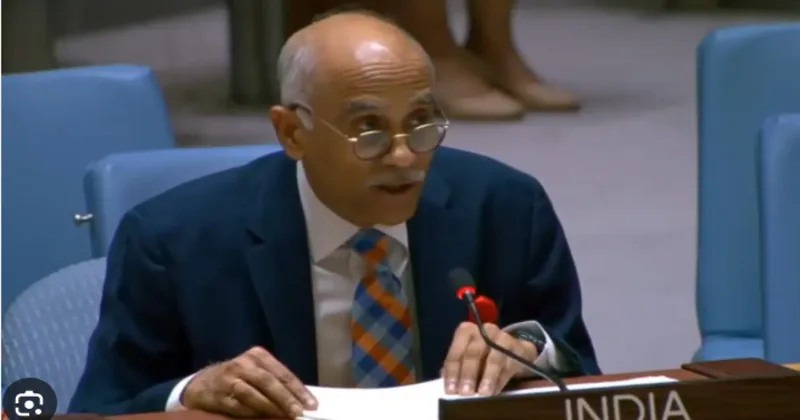
In the latest round of diplomatic tension, India strongly countered Pakistan’s comments on Kashmir at the United Nations. India described Islamabad’s stance as a “delusional tirade” and called out its hypocrisy for highlighting the suffering of Kashmiri women. This exchange took place during an open debate on Women, Peace and Security at the UN Security Council. It highlights how the Kashmir issue has become a recurring point of conflict in India-Pakistan discussions and shows New Delhi’s effort to reshape the narrative by pushing back decisively.
Pakistan’s representative, Counsellor Saima Saleem, claimed that women in Kashmir have suffered from structural violence, including sexual abuse, arbitrary detentions, harassment of civil society members, and a lack of accountability for perpetrators. She argued that leaving Kashmir out of the Women, Peace and Security agenda would “erase its legitimacy” and disrespect the suffering of Kashmiri women.
In reply, India’s Permanent Representative to the UN, Parvathaneni Harish, stated that Pakistan lacked the moral authority to lecture India on human rights and accused Islamabad of using “misdirection and hyperbole.”
Harish’s response quickly shifted to the events of 1971, particularly Operation Searchlight, when the Pakistani army violently suppressed what was then East Pakistan. India referenced the figure of 400,000 women allegedly raped by Pakistani forces in a campaign of genocidal violence, insisting that a country that “bombs its own people” and has committed “systematic genocide” is unqualified to criticize others. The Indian envoy pointed out that Pakistan’s repeated focus on Kashmir was primarily a tactic to distract from its own record of human rights abuses and state-sponsored distortions. “The world sees through Pakistan’s propaganda,” he remarked.
Instead of simply countering Pakistan’s claims about Kashmir, it delved into historical context to hold Islamabad accountable for its own history of violence. This approach serves two main purposes: to undermine Pakistan’s credibility regarding Kashmir and to steer the conversation back to issues of accountability, historical justice, and credibility in the international human rights community.
The immediate result has been a noticeable increase in diplomatic posturing. Media in both India and Pakistan have reported extensively on the UN discussion, portraying it as another battleground in the long-standing Kashmir conflict. Domestically, this diplomatic move resonates well with narratives of strength and decisiveness in foreign policy in India. It shows observers that India is not willing to let Pakistan dominate the conversation, especially on humanitarian or human rights issues. On the Pakistani side, the rebuttal likely puts pressure on its own political and media circles to more forcefully defend its position or respond similarly in other diplomatic settings.
In international forums, observers might see India’s aggressive approach as part of a larger strategy to undermine Pakistan’s claims over Kashmir and position India as a more credible advocate for human rights issues. By prominently referencing the 1971 atrocities, India aims to preempt Pakistan’s moral arguments and shift focus away from Kashmir. Some analysts could view this as a daring strategy, while others might argue that it risks framing international diplomacy in a way that keeps historical wounds open.
Perceptions of the exchange are already diverging. In India, many consider the discussion a diplomatic win—a moment when the world saw Pakistan’s narrative falter under historical examination.
Therefore, India’s decision to challenge Pakistan’s remarks on Kashmir at the UN served as a defense against claims of abuses and an offensive move to undermine Pakistan’s moral standing on women’s rights and human rights overall. This response illustrates how deeply intertwined the Kashmir conflict is in both nations’ foreign policy narratives.












Comments