





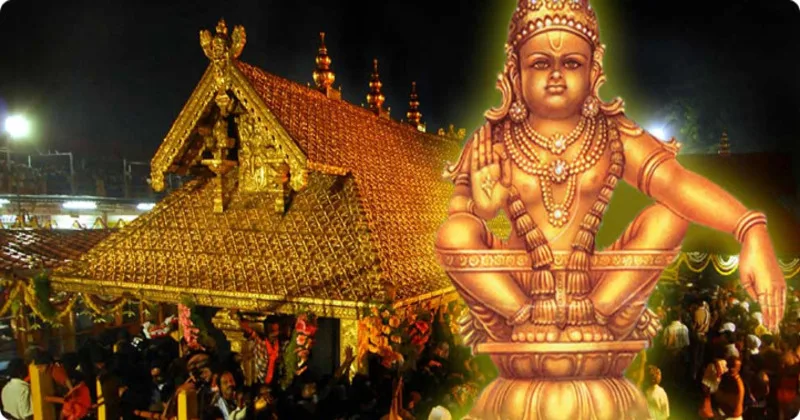
Honest officials of the Travancore Devaswom Board (TDB) reportedly dread hearing the name “Sabarimala.” The post of Sabarimala Executive Officer, considered one of the most powerful and politically sensitive positions under the board, has become a source of fear and crisis. Some officers have even chosen voluntary retirement to avoid being assigned to the temple. Yet, ironically, such reluctance is rarely seen among those who manage to secure the post, often through alleged bribes running into lakhs of rupees to political leaders of Kerala’s ruling Communist–Congress alliance. At the heart of this nexus lies the ongoing ‘gold layer controversy’ at Sabarimala, which has exposed the scale of corruption within the system. The Devaswom Vigilance has submitted a detailed report to the Kerala High Court presenting clear evidence of administrative lapses and suspected manipulation in the temple’s gold plating works.
According to the vigilance findings, officials reported that the Dwarapalaka (temple guardian) sculptures at Sabarimala underwent gold and copper plating in 2019. The key accused named in the case include former Administrative Officer Murari Babu, Thiruvabharanam Commissioner K.S. Baiju, and Executive Officer Sudheesh. Murari Babu had written to Unnikrishnan Potty in 2024, seeking approval for the gold plating works as part of temple renovation. However, the Devaswom Board had rejected this proposal, as noted in the vigilance report. Notably, Murari Babu himself was the Executive Officer in 2024 when he wrote the letter, following an earlier controversy involving the ghee coconut abhishekam ritual conducted under Unnikrishnan Potty’s supervision in 2023.
When the Dwarapalaka panels were transported to Chennai for gold plating and later brought back to Sabarimala, the Mahasar, the official record of the transaction, was prepared by the same officers accused of forgery and embezzlement in a prior vigilance case. Among those named were V.S. Rajendra Prasad and J. Jayaprakash, both facing charges for misappropriating over ₹50 lakh through falsified documents. Rajendra Prasad, a former Sabarimala Executive Officer, had previously served as the private secretary to former TDB member and CPM representative P.M. Thankappan. These same officials prepared the Mahasar when the panels were reinstalled at the Sannidhanam in September 2019. Of the 12 officials listed in the Mahasar, one was J. Jayaprakash, then Administrative Officer of Nilakkal and now posted in Aluva, who was also arrested in the vigilance case. Alarmingly, the Mahasar did not bear the signatures of several key authorities, the Thiruvabharanam Commissioner (custodian of temple valuables), the Devaswom Smith (responsible for verifying material quality), or the Vigilance Officer. Although Jayaprakash’s name appears in the Mahasar, he, too, did not sign it, raising further suspicion.
The Suspension Review Committee, which included the Additional Chief Secretary of the Home Department and the Vigilance Director, had earlier recommended that Jayaprakash not be reinstated, citing his pending corruption charges. However, this directive was ignored. When K. Radhakrishnan served as Devaswom Minister, the department had written to rectify the reinstatement, but with the change in ministerial leadership, the issue was brushed aside. The Board justified the reinstatement by citing a High Court order. Rajendra Prasad later retired from service.
Corruption in Nilakkal Supplies and Reinstatement of Suspended Officers as Sabarimala Custodians
The roots of this scandal trace back to 2018–19, during the Mandala-Makaravilakku pilgrim season, when large-scale corruption allegedly took place in the procurement of groceries and vegetables from a Kollam-based contractor for the Nilakkal mess and Annadanam services. Rajendra Prasad and Jayaprakash were accused of fabricating bills and documents to embezzle more than ₹1.5 crore. According to records, goods worth ₹30,00,903 were supplied, for which ₹8,28,000 was paid by cheque and the remaining amount in cash. However, the contractor refused to accept the cash payment and later, through an RTI application, discovered a forged voucher worth ₹1.5 crore bearing his firm’s name. The contractor subsequently filed a formal complaint with the Devaswom Board against the two officers, but no action followed.
A subsequent vigilance probe found them guilty and led to their suspension. However, the then Board led by CPI(M) leader A. Padmakumar reinstated both officers in service, defying the Devaswom Manual and vigilance recommendations. In a highly questionable move, the duo was even posted as Executive Officer and Assistant Executive Officer, positions that made them custodians of Sabarimala’s finances and assets.
The High Court later observed that the officials were clearly aware of the gold plating done on the Dwarapalaka sculptures in 1998–99 and the subsequent reduction in their weight. Yet, the Mahasar falsely described the panels as merely copper-plated, omitting any mention of the missing gold layer weighing not less than 1.5 kilograms. The court noted that this deliberate omission appeared to be a calculated attempt to mislead the authorities.
In light of these findings, the High Court has ordered a detailed inquiry into the entire episode. A Special Investigation Team (SIT), headed by ADGP H. Venkatesh, has been constituted to probe the matter further. The team will convene soon to assess the evidence collected by Devaswom Vigilance and determine whether the alleged officials and contractors colluded to siphon off temple funds and gold.
The controversy has reignited public anger and raised broader concerns about political interference, nepotism, and endemic corruption in the administration of Kerala’s temples. With allegations of bribes, forged records, and manipulated appointments, the Sabarimala gold plating scandal underscores the urgent need for transparency and accountability within the Travancore Devaswom Board,a body entrusted with managing some of the most sacred temples in Kerala.
The gold layer controversy, which began as a technical issue concerning temple sculpture restoration, has now unfolded into a major institutional crisis. As the High Court-mandated probe deepens, it is likely to expose not only individual culpability but also the systemic rot within one of Kerala’s most powerful religious and administrative institutions.















Comments