





India astronomy projects, Thirty Meter Telescope India, Square Kilometre Array India, LIGO-India observatory, Indian space research, cosmic discoveries, international mega science projects, India astrophysics research
When India initially looks into deep galaxies with a scientific eye for the first time, very few could have predicted that one day this nation would be a world partner in the construction of some of the most sophisticated observatories in human history. Indian scientists and engineers are key merely players and contributors to international mega science projects across astronomy and astrophysics. These initiatives are making India a knowledge hub, powering with technological advancements and opening doors for young researchers.
At the core of this change lies a straightforward yet strong notion, science on this scale simply cannot be done in solitude. Constructing the world’s biggest telescopes or detectors requires enormous resources, cutting-edge technology and global coordination. Through joining these global forums, India not only acquires access to cutting-edge science but also the ability to work on developing technologies that can be implemented into industry, defence, healthcare and other fields.
The Thirty Meter Telescope: India’s Window to the Early Universe
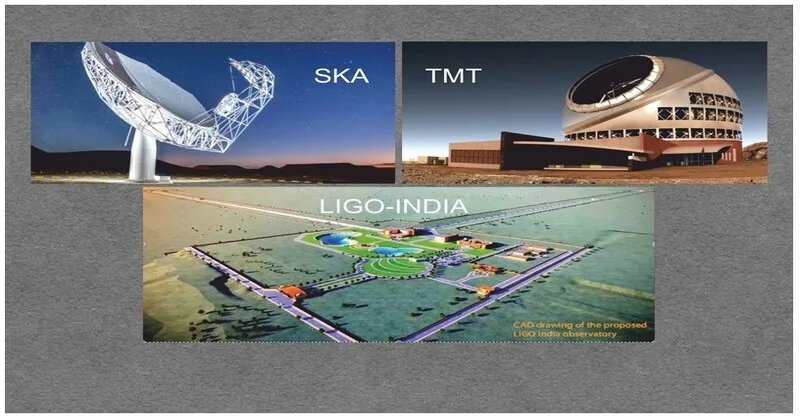
The most ambitious undertaking in astronomy today is the Thirty Meter Telescope (TMT). It have a massive mirror composed of 492 hexagonal pieces, the instrument will be able to see deeper into space and time than any other facility. When it is operational, it will seek answers to the origins of stars and galaxies, the formation of dark matter and dark energy and even the findings for extraterrestrial life.
India has been a part of the TMT since 2010 and joined as a full partner in 2014 with a 10 percent share. India contribution is not symbolic but also technical to the core. Indian groups are with the responsibility for key subsystems through institutions such as ARIES, IIA, IUCAA and TIFR for edge sensors, actuators, segment support assemblies and 82 polished mirror segments made at a new state-of-the-art Bengaluru facility.
What distinguishes this is the extent of the contribution made by Indian industries. MSMEs are creating methods for glass cutting to national laboratories for refining mirror coatings, the project is introducing high-end precision manufacturing to India. Indian scientists are playing a direct role in determining the design of instruments like the High-Resolution Optical Spectrometer (HROS). This active engagement guarantees that if and when TMT finds the secrets of the universe, India will be sitting at the discovery table and not watching as a spectator.
Square Kilometer Array: Listening to Universe
If TMT is looking at the far universe, the Square Kilometer Array (SKA) is listening to it. Observatory is co located in Australia and South Africa, SKA will be the world’s most sensitive radio telescope with the ability to hear weak signals from the early universe.
India’s association with SKA dates back to 2010. Researchers from the National Centre for Radio Astrophysics (NCRA) collaborating with industry has conceptualized the Telescope Manager system, the genius behind the whole observatory. Indian groups also participated in the design the Pulsar Search System and data transport systems key pieces of equipment for managing the vast flows of information SKA will generate.
India is working on prototyping hardware presently and gearing up for the main construction stage. Involved in four different areas such as delivery of the observatory management system, creating digital hardware at SKA-Low stations, assisting in pulsar detection systems, and even creating receivers for SKA-Mid. The SKA-mid will consist of an array of about 200 offset Gregorian dish antennas with receivers designed to cover the frequency range 350 MHz to 14 GHz. Equally important, India will be hosting one of the Regional Data Centres, providing Indian scientists top priority access to SKA’s huge repository of data.
With science objectives, everything from exploring black holes and confirming Einstein predictions to examine cosmic magnetism and the origins of life. SKA will revolutionize radio astronomy. For India, it further implies developing in country capabilities in high-speed computing, data science and state of the art electronics areas that have applicability far beyond astronomy.
LIGO-India: Discovering the Ripples of Space-Time
In 2015, the discovery of gravitational waves verified a prediction by Einstein a hundred years ago. This breakthrough has opened a new window into the universe and India will be at the center of the next chapter of this tale.
The LIGO-India facility in Maharashtra, will be a global-level gravitational wave observatory with four-kilometre-long arms constructed under ultra-high vacuum conditions. It is an Indo-US project being executed jointly by India’s Department of Atomic Energy (DAE), Department of Science and Technology (DST) and the US National Science Foundation. Everything from the vacuum systems to advanced optics, lasers and precision control technologies will be done by the Indian side.
What is truly amazing about LIGO-India is that it will enable astronomers to examine black holes, neutron stars and even probe the very frontiers of general relativity with the technological applications. Constructing one of the world’s biggest ultra-high vacuum systems and becoming expert in measurement techniques at the quantum level, it will enhance India’s potential in the biotech, materials sciences and space exploration sectors.
Indian scientists have been engaged in gravitational wave research for a long time, with more than a hundred scientists already part of the worldwide LIGO-Virgo-KAGRA collaboration. This new center will not only increase scientific output but also educate a new crop of professionals in precision engineering and instrumentation.
Beyond the Big Three: Expanding India’s Global Footprint
TMT, SKA and LIGO-India are the initial starting for India and is also participating in other global projects that hold the promise of thrilling discoveries.
· Vera C. Rubin Observatory (Chile): Indian organizations are members of the Rubin-India Consortium, which will provide access to enormous data from the Legacy Survey of Space and Time. The ten-year-long project will scan the sky multiple times, taking more than 800 images of every region. For Indian postdocs and students, it implies unrivalled training in data analysis and exposure to cutting-edge research.
• Cherenkov Telescope Array (CTA): Intended to explore high-energy gamma rays, CTA consist of arrays in both hemispheres. Indian institutes like BARC, TIFR and SINP have been involved from its designing phase, making performance enhancements and getting ready for more substantial contributions to construction.
• Mauna Kea Spectroscopic Explorer (Hawaii): India under IIA, is assisting in designing elements of this future telescope segmented mirror system. Such participation enhances Indian capabilities in mirror technology and will be supplement for ongoing work in TMT.
Vision Beyond Astronomy
What unites these projects is not only the search to comprehend the universe but also their contribution to India’s industrial and technological landscape. All of these projects require cutting-edge materials, high-precision optics, big data analytics and global collaboration. Through their involvement Indian industries, MSMEs and national labs are gaining capabilities and standards that can be transferred to aerospace, defence, healthcare and computing.
No less significant is the human capital that is being developed. Hundreds of engineers, postdocs and students will have hands-on experience with some of the most sophisticated systems in the world. This helps ensure that the knowledge remains in the country, allowing for a self-sustaining cycle of innovation.
As India marks its success in space exploration from Chandrayaan to Aditya-L1, these mega science projects are the next horizon. They reflect a future path to solve the largest mysteries of the cosmos, nations have to unite. For India, the project is not just about scientific exploration but to position itself as a technology, innovation and knowledge leader of the world.
In the coming years, when galaxies are charted anew, when echoes of the cosmic dawn are received or when the weak ripple of a far-off merger is felt on Earth, India’s contribution will be inscribed. The nation is no longer merely observing the stars but also it is constructing the instruments that enable mankind to comprehend them.










Comments