




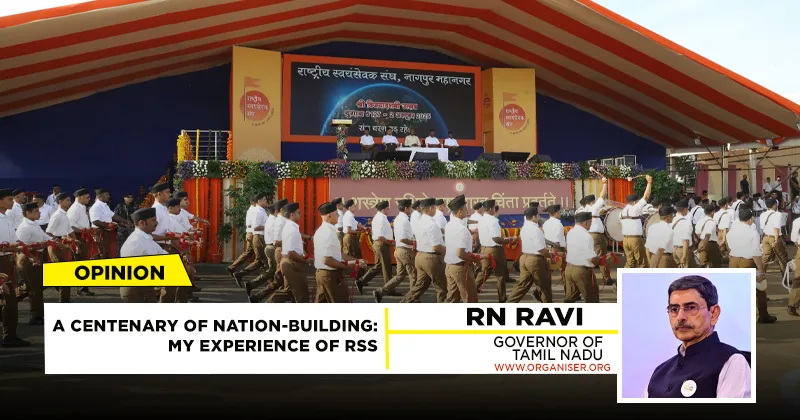
This Vijayadashami, the Rashtriya Swayamsevak Sangh completes one hundred years of its journey dedicated to nation building through character-building of individual citizens. It was founded by a far-sighted visionary, Dr Keshav Baliram Hedgewar, on this day in 1925, when the country was passing through the darkest phase of its national life.
An enslaved nation’s history, identity, and culture were systematically being destroyed by the colonial rulers and their theological collaborators – foreign Christian missionaries.
They had mischievously fabricated its past – shaming its history, language, faith, and cultural heritage. The invidiously contrived history was vigorously peddled in schools, colleges, as well as public and private discourses. People were continually orchestrated to believe that adopting the language, faith, and mannerisms of the British was the only way to their brighter future and spiritual salvation.
The nation’s sense of selfhood was emasculated. Mahatma Gandhi had summed up the devastating impact of the colonial rule in his Round Table address to the British on October 20, 1931, using an apt metaphor for Bharat – a Beautiful Tree that perished because the British had dug and destroyed its roots.
In such a dark and dismal backdrop, Dr. Hedgewar realised that a mere political liberation of the country, as and when it happened through a political movement for Independence, would be insufficient to undo the comprehensive damages done to the body and soul of Bharat during the centuries of colonisation.
Such an Independence would lack the needed intellectual confidence and spiritual energy to restore the nation, her sense of selfhood, and self-confidence so as to march with dignity among the comity of nations and eventually lead the world to a just, equitable, and sustainable future. The revolution for a genuine Independence had to be comprehensive.
Inspired by the vision and teachings of Swami Vivekananda, Dr. Hedgewar launched that comprehensive revolution. He planted the seeds of an enduring socio-cultural mass movement that would begin with the comprehensive transformation of individual citizens and would germinate in the villages of Bharat where her soul lived. The RSS was born.
My Early Days:
:My first brush with the RSS happened in early 1981 while serving as a junior Superintendent of Police in Calicut, Kerala. A vicious cycle of brutal political violence had erupted in the adjacent north, Tellicherry Sub-division of Kannur district, between the cadres of the Communist Party Marxist, the ruling party in the State, and the local sympathisers of the RSS.
Kannur district, being the stronghold of the CPM, was not to brook the nascent presence of the RSS in the area and seemed determined to go to any extent to thwart it.
The presence of the RSS was seeding a dichotomy between the ruling political ideology and a social engineering was in the offing. More and more people seemed happy and welcoming of the RSS as they felt that it was doing good to their young children – who, after their association with the RSS, had become visibly more disciplined in their personal life and more adept in their social relations.
They became more respectful to their parents and elders besides doing better in their studies. They were also becoming more aware of and respectful to the idea of Bharat as a glorious nation.
Violence Ensues
The CPM perceived this unfolding dichotomy as a potential existential threat. The RSS had to be banished from the region. The CPM cadres killed, in quick succession, some local persons for hosting RSS pracharaks and organising RSS Sakhas in their localities.
Their preferred weapons of choice were locally manufactured Improvised Explosive Devices, popularly called bombs. Perceived deliberate inaction of police in catching the known culprits provoked deadly retaliations mostly with daggers and knives.
Rising death counts and resulting public hue and cry in the State and its widespread condemnation compelled the state government to change the local police leadership. I was chosen as the Special Officer to Tellicherry for curbing the spiralling violence and restoring normalcy.
For reasons not fully known to me as yet, within a few days of my arrival in Tellicherry, accurate pinpointed information on locations where IEDs were manufactured and parked began reaching me through unnamed local sources. The search operations yielded rich hauls of IEDs, running in several thousands, largely from the premises of senior local leaders of the ruling CPM.
They were so confident of being beyond the reach of law that they had not taken adequate precautions to keep the IEDs sufficiently concealed. The rival side was also dealt with equal harshness. However, recoveries of daggers and knives, which are common household implements, did not elicit much media attention.
A Political Twist
Recoveries of thousands of bombs from the ruling party leaders angered and embarrassed them so much that Sri E.K. Nayanar, the Chief Minister who hailed from Kannur district, rushed to Tellicherry and in his May Day public address profusely abused and accused me of being an RSS member.
Listening to him up close, I was bemused at the disproportionate public importance given to a junior police officer for doing his duty by the highest executive of the state. My well-wishers in the service and society warned me of the serious personal consequences in the offing.
However, as luck would have it, before I could be suspended, Smt. Indira Gandhi, the Prime Minister, sensed yet another opportunity in her political career (the first was in July 1959, when she got dismissed the E.M.S. Namboodiripad-led communist government in Kerala) and dismissed the E.K. Nayanar-led government, invoking a collapse of the Constitutional order. President’s Rule was imposed in the State. Normalcy was soon restored. I returned to Calicut.
North-East Days
A decade later, I, as an officer of the Intelligence Bureau in the Ministry of Home Affairs, got an opportunity to serve in the North-East Bharat.
Rampant violence by an ever-increasing number of well-armed ethnic militia groups demanding outright Independence of their so-called homelands from Bharat raged in the region. Almost the entire North-East was placed under the Army, which struggled to ensure that writs of the state could run in some parts, at least symbolically.
Having never been to the region before, the North-East was a terra incognita for me. I received the initial customary briefings in the Ministry and also from seniors about the land and the people.
The mainstream government understanding of the region was essentially the legacy of the wisdom bequeathed by the colonial administrators – a region replete with countless communities of savages often at war with each other, who understood only the language of force, and hence the state must demonstrate superior force to subdue them.
However, upon reaching there and reaching out to the people, often without any ostensible security cover, I was shocked at the extent of divergence between the ground realities and the narratives in the higher echelons of the Government. The people, though distressed and distraught at the unending violence that had totally disrupted their life and livelihood and killed their kin, were friendly and hospitable.
During my social outreach in the region for professional reasons, I was surprised to meet numerous RSS pracharaks living in villages with the people for several years as members of their family. They were from various parts of Bharat and had learnt local languages, adopted their customs and costumes, and respected their indigenous faith with humility.
They had become indistinguishable from the locals except at times in their physical features, which was inconsequential for the people. They played local games with villagers, taught the young children to read and write, and provided basic medical care in times of need.
They were looked up to by the villagers even for resolving their disputes. RSS pracharaks had reached areas that were beyond the reach of the government yet and won the hearts of the people who were looked down on as violent savages by the administration.












Comments