





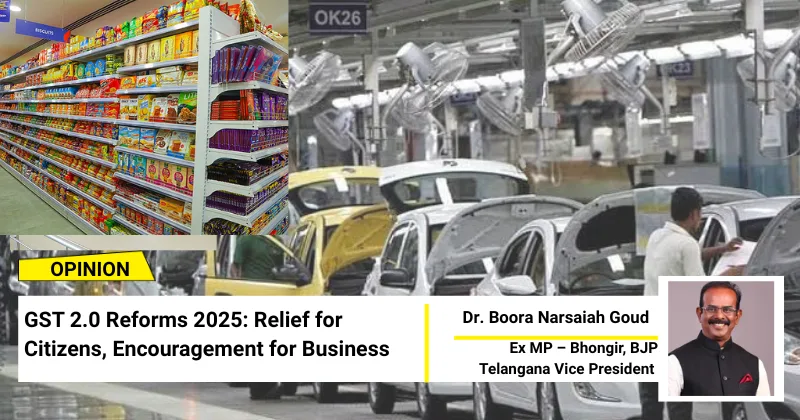
“We will bring next-generation GST reforms that will reduce the tax burden on citizens. This will be a Diwali gift for you.” – Prime Minister Narendra Modi
This was the promise given by Prime Minister Modi from the Red Fort on 15 August 2025 — today, celebrated as the festival of taxes. In 2017, the Goods and Services Tax (GST) was introduced as the country’s largest tax reform. Now, with the next-generation reforms, GST is transforming into a more simplified, just, and development-oriented system — this was the message Modi ji gave to the entire nation.
Journey of GST: From Tax Deluge to Unified Tax
Before GST, India’s indirect tax system was fragmented. Different states imposed different taxes at varying rates. The same product often faced double taxation (VAT + Service Tax). But Modi ji accomplished what the Congress never dared to attempt.
On 1 July 2017, with the implementation of GST, 17 taxes and 13 cesses were merged into a single tax system. Thus, the dream of “One Nation – One Tax – One Market” was realised. Just as India attained freedom on 15 August, in a similar way, on 1 July 2017, the country gained liberation from the deluge of taxes. By addressing the fear of revenue loss and assuring the states, the impossible was made possible.
Why Were New Reforms Necessary?
Although GST was successful, the existence of five different slabs (0%, 5%, 12%, 18%, 28%) created confusion for citizens and businesses. The particularly high 28% rate on cement, vehicles, and household appliances became burdensome.
When GST was first introduced, both the Centre and the States feared revenue losses. However, the Centre assured full compensation to states until 2022. Yet, from 2020–2022, Covid created a major disruption in revenues. During that period, the Centre announced the Rs 20 lakh crore Atmanirbhar Bharat Plan and, in the second wave, additional assistance of Rs 6,28,633 crore. Consequently, GST 2.0 reforms were postponed.
Hence, in his Independence Day address in 2025, Prime Minister Modi declared: “We will simplify GST. The tax system will become transparent and just.”
GST Reforms: A Shield for All, A Fortress for Entrepreneurs
Just as it is said of God — “Do not think He is here but not there; search anywhere and you will find Him.”
In the same way, from the poor to the rich, from bike to Benz, from farmer to industrialist, from education to healthcare — Modi ji’s reforms stand as support for all sections of society.
GST 2.0: Only Two Slabs
Going forward, there will now be only two slabs — 5% and 18%. The earlier 12% and 28% slabs have been abolished. Only tobacco, pan masala, carbonated drinks, luxury cars, yachts, and private aircraft will continue to attract 40% tax.
Like the beautiful rainbow in the sky, these reforms have become a rainbow on earth, bringing benefits to all sections of society.
Benefits to Every Home, Relief to Every Family
Soaps, shampoos, toothbrushes, toothpaste, and bicycles will now attract only 5% GST. Indian breads, paneer, and UHT milk will be tax-free (0%). Chocolates, coffee, sauces, pasta, namkeen, and meat products will see reductions from 12% or 18% down to 5%. TVs above 32 inches, air conditioners, and dishwashers will see rates reduced from 28% to 18%.
India has nearly 30 crore families. Through GST reforms, each family will save on average Rs 10,000–Rs 35,000 per year. Combined across all families, this amounts to a direct benefit of nearly Rs 4–5 lakh crore.
Automobile Sector – The Chariot of the Economy
Vehicles have become an essential part of daily life, and they drive the wheels of economic progress like the great chariot of Jagannath. The maximum benefit will accrue to vehicle owners.
Under GST 2.0, bikes, small cars, buses, trucks, three-wheelers, and spare parts have been reduced from 28% to 18%. This translates into massive gains. For example, India sees sales of about 2.5 crore new vehicles annually, while Telangana accounts for 10–12 lakh vehicles. The GST reforms will provide buyers with Rs 1.07–1.30 lakh crore in annual benefits nationwide, and Telangana alone will benefit by Rs 4,800 crore.
Agriculture – Strengthening the Farmer
Beyond the many ongoing farmer welfare schemes, GST 2.0 will boost agricultural mechanisation and productivity. Tractors are reduced from 12% to 5%. Harvesters, threshers, drip irrigation systems, sprinklers, poultry and beekeeping equipment are reduced from 12% to 5%. Bio-pesticides are reduced from 12% to 5%. Tractor tyres and spare parts are reduced from 18% to 5%.
India sells about 10 lakh tractors and harvesters annually. With these reforms, Indian farmers will gain Rs 16,000 crore annually, and farmers in Telangana will benefit by Rs 700 crore.
Housing & Infrastructure
Cement has been reduced from 28% to 18%. Marble, granite, and travertine have been reduced from 12% to 5%. Bamboo flooring and wooden boxes are reduced from 12% to 5%.
This will make housing construction cheaper and increase demand in the real estate sector. Real estate acts like engine oil, powering every other sector. Super GST will benefit the construction sector by Rs 30,000 crore nationally and Rs 3,000 crore in Telangana.
Healthcare – Affordable Medicines
Medicines are now cheaper. Thirty-three life-saving drugs and diagnostic kits are reduced from 12% to 0%. Ayurveda, Unani, and Homeopathy medicines are reduced from 12% to 5%. Medical oxygen, thermometers, and surgical equipment are reduced from 12–18% to 5%. Eyeglasses are reduced from 28% to 5%.
India’s annual healthcare turnover is about Rs 4.3–5 lakh crore. Through GST reforms, citizens will gain Rs 35,000 crore annually.
Services Sector – A Major Boost
Hotels with room tariffs up to Rs 7,500, salons, gyms, and beauty parlours will now attract only 5% GST instead of 12% or 18%. This sector’s annual turnover is about Rs 3.8 lakh crore, with savings of Rs 15,000–20,000 crore.
Insurance for Every Home, Assurance for Every Family
Insurance has become a necessity. India has nearly 100 crore life and health insurance policyholders. The annual turnover of the insurance sector is about Rs 9 lakh crore. With GST reduced to 0%, policyholders will benefit by Rs 65,000–75,000 crore. The middle class, in particular, will receive the greatest relief.
Education – The Root of Progress
Books, erasers, crayons, and pencils will now be tax-free (0%). Other geometry boxes, trays, and cartoons will be taxed at 5%. Students will benefit to the tune of about Rs 2,000 crore.
Artisans – Relief for Workers, Strength for India
Handicrafts, toys, statues, paintings, man-made textiles, and garments will see rates reduced from 18%/12% to 5%. This will benefit 75 lakh artisans, provide relief worth Rs 25,000 crore, and support a Rs 3.5 lakh crore industry.
GST 2.0 Reforms – Indirect Benefits
The reforms go beyond simply reducing taxes. They will:
Reduce prices and increase demand, boosting household savings and consumption.
Support MSMEs by reducing costs on inputs like cement, auto parts, and handicrafts.
Simplify compliance with a two-rate structure, leading to fewer disputes and quicker decisions.
Expand the tax net, as simpler rates encourage compliance and increase revenues.
Support domestic manufacturing and exports by correcting inverted duty structures.
Grow revenue collections, as lower rates combined with better compliance have historically increased collections.
Accelerate economic momentum: lower costs → higher demand → larger tax base → stronger revenues → sustainable growth.
Provide social protection: exemption of GST on insurance and essential medicines will strengthen household security and access to healthcare.
The Core Mantra of GST 2.0
“Alpalābhaḥ Bahuvikrayaḥ, Vyāpārasya Mahattvam Etat.”
(Small profit, large sales — that is the greatness of business.)
In essence, the secret of GST reforms lies in lower margins but higher volumes.
India, with a population of 140 crore, stands as a nation admired and envied by many. Amidst global pressures and challenges, every citizen, every consumer is now an economic soldier.













Comments