





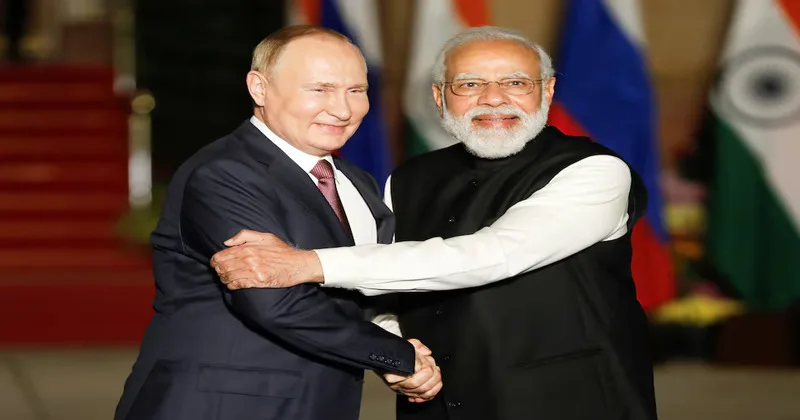
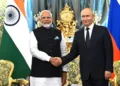
Vladimir Putin’s recent comments about India and Prime Minister Narendra Modi have gained attention not just for their friendly tone, but also for what they show about the changing global dynamics related to energy, trade and independence. Speaking at the Valdai Discussion Club in Sochi, Putin called Modi a “wise leader” who “thinks first about his country”. He described the bond between India and Russia as “special” and assured that Moscow would help ease the economic impact of U.S. tariffs on India.
Putin’s remarks come amid increasing pressure from Washington, which has raised tariffs on Indian exports to 50% in response to India’s ongoing imports of discounted Russian oil. The U.S. views these imports as funding Russia’s war economy, while India sees them as crucial for its energy needs and demands. Defending India’s position, Putin claimed that rejecting Russian energy would lead to economic losses of about US$9–10 billion and could also have political repercussions domestically. He questioned if losses would occur anyway, why India should refuse. He added that the Indian people would not accept humiliation and expressed confidence that Modi would stand up to external pressure.
Beyond praise, Putin highlighted practical steps. He mentioned that Russia could balance Indian losses by increasing the import of agricultural products and medicines from India, which would help with the trade imbalance. He tasked his government, including economic commissions, with tackling logistics, cross-border payments, financing methods and other challenges between the two countries. Additionally, Putin indicated plans to visit India in December and expressed hope that the 15th anniversary of their privileged strategic partnership would coincide with a renewed focus on their relationship.
Seen positively, Putin’s remarks give diplomatic support to India’s careful position. They promote the idea that India is not merely resisting U.S. pressure but is following its own strategic interests. The idea of a special relationship underscores Moscow’s wish to keep India as a trustworthy partner, not just a follower and positions India as a vital part of Russia’s vision for a multipolar world. It also sends a message globally that penalizing India could have wider repercussions in energy and finance.
However, success depends on implementation. India needs to turn this supportive gesture into real outcomes: boosting exports to Russia, restructuring payment systems outside of dollar transactions, and addressing logistical challenges. On the Indian side, the government has shown resilience by refusing to turn away from Russian oil. India indeed, emphasizes strategic independence and multi-alignment.
The effects could be significant. First, a reduced trade imbalance, if Russia increases its imports from India that would help lessen the impact of U.S. tariffs and maintain trade flow. Second, ambitious changes in payment and funding systems could reduce India’s dependence on dollar transactions, making it stronger against outside pressure. Third, Putin’s support may embolden India in its foreign policy, indicating it won’t be easily cornered in global issues. Lastly, Moscow’s defense of New Delhi could build trust and lead to deeper cooperation in defense, energy, technology and space.
The ripple effects of this alignment reach into the geopolitical dynamics of South Asia. Pakistan is increasingly leaning toward the United States for economic and security support. Meanwhile, India is strengthening its partnership with Russia. This situation could lead to sharper polarization in the region. This divergence may strengthen divisions in South Asia’s security calculations. In this environment, powers like India could assert greater independence while smaller states adjust under competing influences.
Yet, there are challenges and potential pitfalls. Furthermore, as India strengthens ties with the US and other Western nations in areas like semiconductors, defense and clean energy, it must avoid being pushed into a strict choice. Geopolitical tensions, especially regarding Ukraine, loom large:
Putin’s praise for Modi is serves as part of a strategic diplomatic effort aimed at strengthening India’s resolve, reinforcing bilateral relations and indicating that the costs of economic pressure could backfire. Ultimately, the developing narrative between Moscow and New Delhi, amid U.S. pressure, has the potential to reshape 21st-century diplomacy.










Comments