





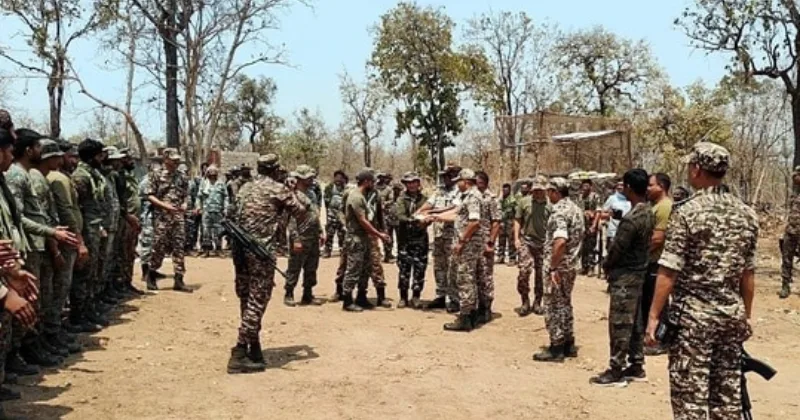
For more than a decade, the Narendra Modi-led Government has made significant advances in ending the protracted Maoist insurgency that was the gravest internal security threat to Bharat. After 2014, a harmonious integration of robust security operations, welfare initiatives, and a unified approach (as opposed to an erstwhile scattered approach), facilitated a drastic reduction in the geographical and operational spread of Red terror. It’s imperative to delve deeper into the paradigm shift in the comprehensive strategy adopted and executed by the Modi Government to uproot this decades-old menace.
Tyranny of “Red Corridor”
In his valedictory address at ‘Bharat Manthan-2025: Naxal Mukt Bharat – Ending Red Terror Under Modi’s Leadership’ held in Vigyan Bhawan, Union Home Minister and Minister of Cooperation Amit Shah reiterated that Bharat will be free from Naxalism by March 31, 2026. However, he also asserted that the fight against Maoism won’t end until the ideological base and supporters of Maoists are exposed and countered with cultural nationalism.
Genesis of Maoism
Naxalism, also known as Maoist, emerged in Naxalbari, West Bengal, under the guise of a peasant uprising against the bourgeois. In reality, it was a political struggle for usurping power. As Amit Shah pointed out, after the 1980s, Maoist groups joined ranks. And in 2004, the major CPI (Maoist) group was conceived, resulting in notorious Naxal violence.
Masquerading as class struggle, over the years, it descended into violent anarchism led by Maoist guerrilla groups aiming to overthrow the elected Government of India through armed struggle. At its peak, Naxalism was renamed “Red Corridor”, covering vast areas in States like Chhattisgarh, Jharkhand, Odisha, Bihar, Maharashtra, Andhra Pradesh, and Telangana.
As per estimates furnished by MHA and reported by PIB, around 17 per cent of the country’s territory was subjected to Naxal terror, affecting a population of approximately 120 million. At that time, around 10 per cent of the population was forced to live under Maoist oppression.
For decades together, insurgency thrived in remote, underdeveloped, tribal-dominated areas stricken by abject poverty, infrastructural gaps, scattered approach and policy paralysis. The failure to effectively integrate these regions into the national mainstream provided fertile ground for nurturing Maoist ideology.
Delineating PM Modi’s Ruthless Approach
When PM Modi assumed office in 2014, both internal and external national security were amongst his foremost priorities. Amit Shah clearly stated in his aforementioned address that instead of a disoriented scattered approach, under the leadership of PM Modi, a multi-pronged, unified and much-needed ruthless approach has been adopted. It’s evident that the Modi Government has vowed to protect the tribals from the Maoist threat. In alignment with the aim and objective to create ‘Naxal-mukt Bharat’, the Modi Government is decisively dealing with internal security threats such as Naxalism. A very well-coordinated blueprint for dismantling both the ideological and operational structure of Naxalite groups has been implemented.
Key Strategies Adopted
Intensified Security Operations: Targeted operations that no longer involve broad sweeps but clear actionable intelligence filled the security vacuum. Operation Octopus and Operation Double Bull successfully accomplished the desired results. Home Minister also informed that joint training of the DRG, STF, CRPF and COBRA units has also been initiated. Reflecting on SRE and SIS schemes, Amit Shah ji stated that approximately Rs 3,331 crores were released, indicating an increase of 55 per cent. Further, fortified police stations were expanded, forensic investigations were carried out, real-time data monitoring was made available, and social-media analysis was used to identify Naxal supporters. He also informed that in the last six years, the Modi Government established 336 new CAPF camps. The Modi Government ensured greater and efficient coordination between Central and State forces for executing joint operations, unobstructed sharing of intelligence, and establishment of unified command structures. On May 23, 2025, a large Naxal camp at Karregutaa Hills on the Telangana-Chhattisgarh border was destroyed in Operation Black Forest, illustrating the success of the Modi Government’s policies.
Welfare and Development Schemes
According to Government data in a comparative analysis between 2004–14 and 2014–24, around a 73 per cent reduction in security personnel’s deaths and a 74 per cent reduction in civilian deaths has been registered. The Modi Government has placed a premium on Sabka “vikas” (development) in Naxal-affected areas. Road connectivity is being reinstated in Maoist strongholds. Thousands of kilometres of roads have been built at a swift pace post-2014.
Mobile towers were installed for digital connectivity. Aspirational districts were identified for accelerated development in red terrorf-affected areas. The Modi Government enacted stringent procedures to crackdown on the financial and logistical lifelines of Naxalite groups. Surrender and rehabilitation programmes were boosted to shatter the spine of Maoism. Enhanced incentives were introduced for ex-Naxals who chose to surrender and join the mainstream. The above endeavours bore positive outcomes. As per Government reports, while in 2014 there were 126 Naxalite-affected districts, they have now been reduced to 18. The number of most-affected districts has also decreased from 36 to 6. In States like Andhra Pradesh and West Bengal, Naxalism has been virtually eradicated. Even in core zones of Chhattisgarh and Jharkhand, Maoist influence has shrunk to a few remote pockets.
Last Bastion of Urban Naxalism
In his comprehensive and lucid address, Shri Amit Shah ji warned against the resurgence of Naxalism in urban centres such as college and university campuses. He urged that for the welfare of the nation, it is vital to rise above one’s ideology. Criticising the selective empathy of Leftists, he raised a very pertinent point- the apathy of Left-leaning intelligentsia towards marginalised and disadvantaged tribals who have been the victims of Red terror violence. Security forces and tribal victims, too, have human rights. Centres of ideological indoctrination, such as universities, must not become the intellectual arm of the anarchist movement. Rather, they should contribute positively towards inclusive nation-building. Only true and factual counter-narratives can release campuses from the grip of urban Naxals who have spun the web of lies for a long time. In Session 3 of Bharat Manthan titled ‘Securing a Naxal-free Future’, Vice Chancellor of Delhi University, Prof. Yogesh Singh, also exposed and repudiated the hegemonic modus operandi of red terror in campuses from his own lived experience as an administrator.
Conclusion
The sustained endeavours of the Narendra Modi Government to uproot Naxalism have been immensely successful due to its unified approach of merging force with development. The decline in violence, the shrinking of rebel-held areas, and the increasing surrenders are clear indicators of a movement in retreat. However, absolute eradication requires continued vigilance and sustained development. As Bharat progresses towards becoming a $5 trillion economy, peace and harmony of its remotest regions will be crucial—especially for the sake of our country’s democratic and developmental aspirations.
















Comments