




Growing up in a family with strong views—especially political or ideological ones—can shape one’s own understanding of the world in powerful ways. Being raised in a family that was against the RSS (Rashtriya Swayamsevak Sangh) likely means that I was exposed to critiques of its ideology, politics, or historical actions from a young age.
I have a very real and vivid memory—and it’s not uncommon in India for families to pass down strong opinions about political or ideological groups like the RSS. Being told that “RSS uncles in brown shorts are bad men” is a simple, emotionally loaded message—probably shaped by your family’s experiences, values, or historical-political leanings (maybe left-leaning, secular, or from communities that felt threatened or excluded by Hindutva ideology).
The “brown shorts” were once a recognizable part of RSS uniform—used until 2016—symbolising discipline and tradition. For critics, they became a symbol of regressive nationalism or authoritarianism. So, for my family, that phrase might have been shorthand for distrusting what the RSS stood for.
Growing up in a family that strongly opposed the RSS, I was always taught to look at it with suspicion. The phrase “RSS uncles in brown shorts are bad men” was something I heard often in my childhood—almost like a warning. There was no room for debate, no nuance—just a firm belief that the organisation stood for everything we were against.
For a long time, I carried that mindset with me, never really questioning it. But as I stepped out into the world, started working, reading widely, and meeting people from different walks of life, I found myself exposed to a more complex picture. I met people who had been part of the RSS, or who supported its work, and surprisingly, they didn’t fit the image I had grown up with. Many of them were modern, kind, grounded, and genuinely committed to serving society.
The more I read and observed, the more I realized that the RSS isn’t just one thing. There are also aspects that are often overlooked or dismissed. I learned about the organisation’s involvement in relief work during natural disasters, its efforts to promote self-discipline and community service, and the way it fosters a sense of belonging and purpose among many of its members. That was my personal growth……believe me!
I started to see that for some people, the RSS is not about hate or exclusion—it’s about identity, tradition, and a belief in contributing to the nation. I may not agree with everything it stands for, but I can no longer reduce it to the caricature I grew up with.
“Beyond the Shorts: Understanding the Role of Women in the RSS Ecosystem”
Recently, Congress leader Rahul Gandhi made a remark that the RSS “does not have women wearing shorts,” a statement intended to mock the organization’s traditional male-centric image and its distinct uniform, famously associated with its male members. While such comments might score points in political debates or on social media, they oversimplify and distort the reality of how the RSS operates—especially in relation to women.
The Intent Behind the Uniform
To begin with, the reference to “shorts” is outdated. The RSS officially replaced the brown khaki shorts with full-length trousers in 2016, as part of its modern image update. The shorts were never about style—they symbolized discipline, austerity, and a spirit of selfless service. The uniform was not designed to exclude women, but to cultivate a sense of unity and brotherhood among male swayamsevaks in the field.
Rashtra Sevika Samiti: The Women’s Counterpart
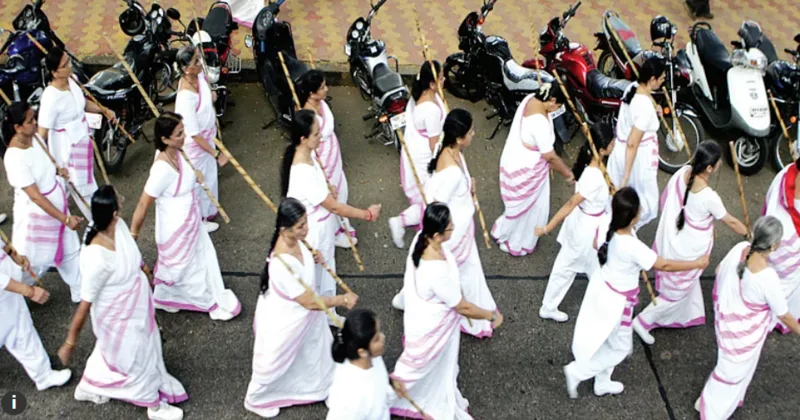
What many critics often ignore—or deliberately overlook—is that women have long had their own parallel organization: the Rashtra Sevika Samiti, founded in 1936. This women-led movement is rooted in the same cultural and nationalistic ethos as the RSS. It trains women in physical discipline, ideological education, and community service. It’s focus is on nurturing “nari shakti” (women power) in the context of Bharatiya traditions, family values, and national responsibility.
Just because women are not wearing “shorts” alongside men doesn’t mean they are excluded. The Samiti operates independently but shares the same foundational values—self-discipline, patriotism, and service. It provides leadership training, runs educational institutions, and engages in social outreach across the country. Thousands of women who are part of this movement take pride in their roles, without needing to mimic the male organizational framework.
Respecting Gender Roles v/s Promoting Inequality
The RSS worldview doesn’t promote gender inequality, rather, it believes in complementary roles. While modern liberal discourse often emphasizes identical roles for men and women, traditional Indian thought, which the RSS draws from, emphasizes equal worth with different responsibilities. This does not make women weaker or lesser. On the contrary, many women in the Sangh Parivar play powerful roles in ideological, educational, and service sectors.
People who are critical about RSS may not agree with this worldview, but mocking it based on clothing or outdated stereotypes only weakens serious political discourse.
Women in the Wider Sangh Parivar
Women are active in RSS-affiliated organizations like Akhil Bharatiya Vidyarthi Parishad (ABVP) which sees large participation of young women in student activism. Then there is Bharatiya Janata Mahila Morcha, the BJP’s women’s wing which has elevated many women to prominent political positions. Vivekananda Kendra, inspired by Swami Vivekananda and closely linked to Sangh ideology, trains women in yoga, leadership, and rural education. Vanvasi Kalyan Ashram works for the upliftment of tribal women, focusing on health and education.
And yes! In the recent years, the RSS has also acknowledged the need to modernize and include women’s voices in broader conversations. RSS chief Dr. Mohan Bhagwat has on several occasions stated that Indian women are not subservient but are “partners in nation-building.”
Empowerment Rooted in Culture
As a modern educated Indian woman, I feel that rather than adopting a Western feminist framework, the RSS and its women’s wings have often promoted a culturally rooted idea of women’s empowerment — one that respects tradition while encouraging education, self-reliance, and leadership. There have been different programs conducted by the Samiti which includes Balika Shivirs (girls’ camps) for confidence building and moral education, Mahila Sampark, which is a network of educated women from urban areas who reach out to rural women, offering literacy and health awareness. Then there are Sanskar Kendras, where cultural and moral trainings are imparted to young girls to instill self-respect and civic sense.
Young women who get trained in these environments often go on to lead schools, social welfare programs, and even enter politics. As everybody says change should always start from within us. Educating people correctly is all that is needed.
Challenges and Evolution
Despite the progress, the lack of direct representation of women in the RSS’s core leadership remains a concern. However, the RSS says that its impact must be seen in action, not in titles. Thousands of swayamsevaks and sevikas are working together across caste, class, and gender lines to build a better India — quietly, consistently, and without seeking public applause.
Let me say this proudly that women nurtured by RSS ideology are now lawyers, doctors, politicians, social workers, teachers, and entrepreneurs who blend modern ambition with cultural pride.
RSS does not admit males or ladies……..but it embraces the whole family!
Its women’s wings, once on the sidelines are now shaping future generations and proving that nation-building is not a male preserve, but a shared responsibility. As India marches into the future, the humanitarian and inclusive aspects of the Sangh — especially the rising participation of women will determine whether it can truly become the moral and social backbone of a just, strong, and united Bharat.
Rahul Gandhi’s comment reflects a superficial understanding of the RSS and its ecosystem. Instead of reducing complex institutions to soundbites and stereotypes, it’s important to acknowledge the depth of work done by both men and women within the Sangh Parivar. Criticism is healthy in any democracy, but it should be informed, respectful, and constructive—not dismissive or derisive.
In the end, empowering women does not always mean copying Western models or political correctness. Sometimes, it means respecting the power that comes from rootedness, cultural pride, and silent, consistent service—qualities that thousands of women in the RSS ecosystem embody every day, with or without “shorts.”














Comments