





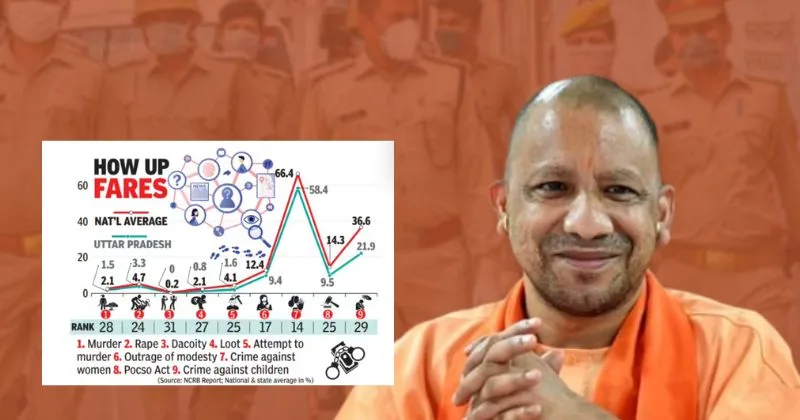
LUCKNOW: Uttar Pradesh, India’s most populous state with nearly 17 per cent of the country’s population, has recorded a remarkable improvement in law and order, emerging as one of the safer states in the country, according to the National Crime Records Bureau (NCRB) 2023 report. The state registered a crime rate of 181.3 per lakh population, considerably lower than the national average of 270.3, ranking 20th among 28 states and 8 Union Territories.
The findings are significant as Uttar Pradesh has long been associated with high crime figures, often dominating national headlines. However, officials point out that while the state may record a higher absolute number of cases due to its massive population, the crime rate per lakh population provides a more accurate and balanced picture. The NCRB data highlights that the state not only reported a lower overall crime rate but also outperformed the national average in several sensitive categories, including murder, attempt to murder, dacoity, robbery, rioting, and crimes against women and children.
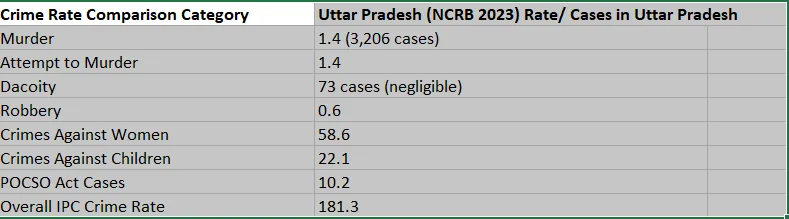
According to the NCRB 2023 report, Uttar Pradesh registered 3,206 murder cases, which equals a murder rate of 1.4 per lakh people. The attempt-to-murder rate was also 1.4. Serious crimes like dacoity and robbery were very low, with only 73 dacoity cases reported and a robbery rate of 0.6.
In terms of socially sensitive crimes, the state registered 58.6 cases of crimes against women per lakh population and 22.1 cases of crimes against children. Cases under the POCSO Act stood at 10.2 per lakh population, showing offences specifically against minors. At the broader level, Uttar Pradesh’s overall IPC crime rate was 181.3 per lakh population. Together, these figures present a comprehensive snapshot of the state’s crime landscape in 2023.
Director General of Police (DGP) Rajeev Krishna said the improvement is the result of systematic reforms, strategic policing, and technology-based monitoring under Chief Minister Yogi Adityanath. He added that the police have shifted from traditional methods to data-driven crime mapping at both large and local levels. This helps them identify crime-prone areas and deploy forces effectively, preventing incidents before they escalate.
One of the most transformative steps, according to the DGP, has been the large-scale deployment of Police Response Vehicles (PRVs) across districts. These vehicles, equipped with GPS and communication systems, are strategically stationed to ensure immediate intervention whenever a crime is reported. Complementing this system is the UP-112 emergency helpline, which has become a backbone of citizen safety.
Uttar Pradesh has also taken steps to integrate technology with ground policing. Security alarm systems installed in industrial hubs and urban residential complexes are now linked with the UP-112 command centre. This integration allows for instant alerts in case of a breach, enabling faster response and better coordination with private security agencies.
On the sensitive issue of women’s safety, which has often been at the centre of national debate regarding Uttar Pradesh, DGP Krishna underlined the role of Anti-Romeo Squads (ARS). Introduced to address harassment and stalking, these squads are deployed at colleges, markets, bus stands, and other vulnerable spots. Placing ARS teams at vulnerable locations has increased the confidence of women and made public areas safer.















Comments