





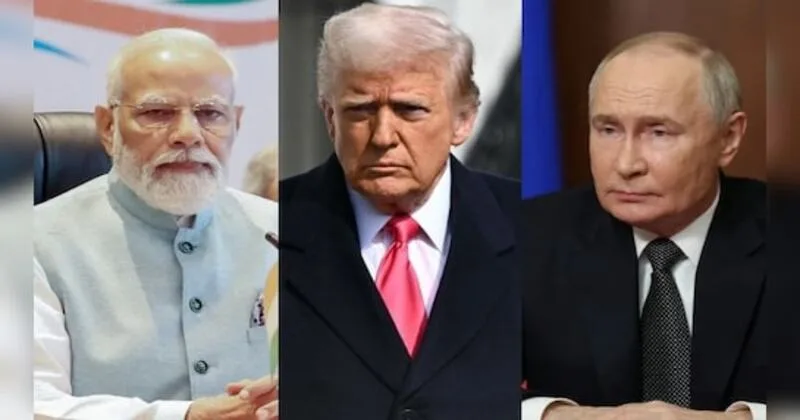
The war of words between US President Donald Trump and Russian President Vladimir Putin has escalated once again. Putin hit back strongly after Trump dismissed Russia as a “paper tiger.” “If Russia is a paper tiger, then who are you?” Putin asked, ridiculing NATO’s defense capabilities. He also warned that Washington’s decision to supply Ukraine with advanced Tomahawk missiles would carry serious consequences.
Turning to economic matters, Putin argued that neither India nor China should be intimidated by US tariffs. He said Trump’s decision to block Russian oil supplies and impose additional tariffs on India would ultimately backfire on the US. If Russian oil exports are cut, global crude prices would soar, he cautioned. This, according to Putin, would compel the US Federal Reserve to raise interest rates sharply, slowing American economic growth.
Putin stressed that India would not tolerate international humiliation, adding that Prime Minister Narendra Modi would not allow it. He warned that if India stopped buying Russian oil, the country would lose between nine to ten billion dollars annually. Even if Trump were to impose extra duties on Russian crude, the losses would remain similar. “Then why is India giving in to America’s politics and refusing to buy Russian oil?” he asked pointedly.
The Russian president also accused the US of double standards, arguing that while Washington pressures India and China over Russian oil, it remains the world’s largest user of nuclear power plants and continues to import uranium from Russia. Acknowledging persisting trade settlement issues between New Delhi and Moscow, Putin said these would be resolved at the BRICS level. He confirmed that he will visit India in December.
US Double Standard Raised as Taiwan Boosts Russian Trade
Oil imports from Russia have emerged as a key friction point in relations between India and the United States. President Donald Trump’s main charge is that the payments India makes for Russian crude are indirectly financing Moscow’s war in Ukraine. Western countries frequently bring India in these accusations. However, recent reports suggest that beyond India, Taiwan has also sharply increased its energy trade with Russia. In fact, Taiwan has now overtaken India in purchases of the petrochemical product naphtha, becoming Russia’s largest Asian buyer. This development is notable given Taiwan’s traditionally close ties with Washington.
When sanctions were imposed, Trump specifically targeted India, slapping an additional 25 percent tariff solely for buying Russian oil. The global community is now watching to see if the US administration will extend the same treatment to Taiwan. Data shows that Taiwan imported $1.3 billion worth of naphtha from Russia in the past six months, a 44 percent rise compared to the same period last year. Naphtha is critical in the production of plastics, fibers, and semiconductors, sectors central to Taiwan’s economy.
Markets Watch Closely Amid US Shutdown Fears
Meanwhile, concerns are mounting globally over Trump’s announcement of a US government shutdown following the failure to pass a funding bill. The impasse has unsettled international stock markets, although US indices have held firm at record highs.
In Asia, Hong Kong’s index slipped 0.48%, while Japan’s Nikkei surged 1.57%. In Europe, the FTSE dropped 0.20%, but Germany’s DAX rose 1.28%. On Wall Street, the S&P 500 edged up 0.06%, the Nasdaq climbed 0.39%, and the Dow Jones advanced 0.17%.
Despite warnings from Treasury Secretary Scott Bessant that the shutdown could dent US GDP growth, investors remained optimistic that the crisis would be resolved soon, giving a mild lift to the markets. Futures trading also showed small gains in the Dow, Nasdaq, and S&P. The shutdown is projected to last at least two weeks, during which time Trump is preparing to lay off a significant number of federal workers. Around 750,000 government employees have already been furloughed without pay.
Indian Markets Rally on RBI Policy Boost
In India, equity benchmarks posted robust gains, buoyed by a series of positive announcements from the Reserve Bank’s latest monetary policy review. The Sensex climbed 716 points (+0.89%) to close at 80,983, while the Nifty rose 225 points (+0.92%) to settle at 24,836. Falling global crude oil prices also supported market sentiment. International oil slipped to $60 per barrel on the back of increased production, a development viewed as favorable for India. The rupee strengthened by nine paise, closing at 88.71 against the US dollar. Automobile stocks are expected to remain in focus, with strong September sales figures likely to influence trading. Tata Motors, Mahindra & Mahindra, Hyundai Motor India, Maruti Suzuki, and Hero MotoCorp are among the companies drawing investor attention.
Gold Prices Volatile Amid Shutdown Uncertainty
Gold has been experiencing volatility in global markets. Prices had surged recently, but profit-booking triggered a mild pullback. Analysts attribute the renewed demand for gold to uncertainties over the US shutdown and speculation about potential cuts in interest rates. Prices slipped from $3,863 to $3,841 per ounce before recovering to $3,856. In India, only minor fluctuations in gold prices are expected today.












Comments