





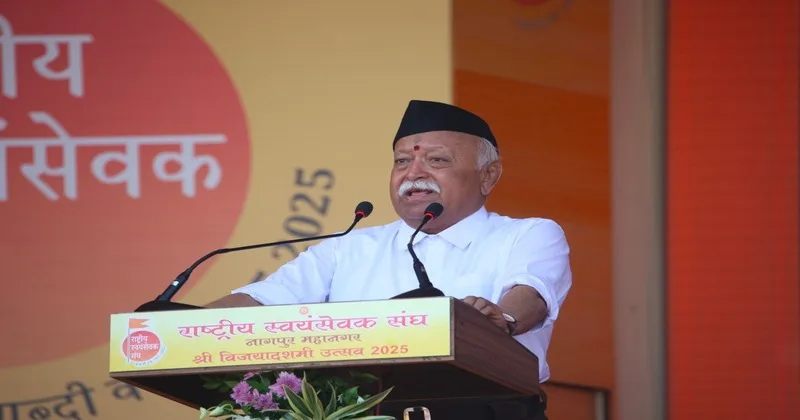
NAGPUR, RSS Vijayadashmi Utsav: The Rashtriya Swayamsevak Sangh today completed 100 years of its journey. In the last 100 years it has been relentlessly and tirelessly engaged in national service.
On this occasion, RSS Sarsanghchalak Dr Mohan Bhagwat addressed the Swayamsevaks at Reshim Bagh, Nagpur.
At the beginning of his speech, he paid tributes to Guru Teg Bahadur, Mahatma Gandhi and former Prime Minister Lal Bahadur Shastri. “We have gathered today on Vijayadashami. Today is the centenary of the initiation of Rashtriya Swayamsevak Sangh’s activities. Coincidentally, this year also marks the 350th anniversary of Shri Guru Teg Bahadur ji Maharaj’s martyrdom. He became a shield and sacrificed himself to protect the Hindu society from the atrocities of invaders from a foreign religion. According to the English calendar, today is the birth anniversary of Mahatma Gandhi. He was not only one of the foremost among those who fought for our freedom but also has a special place among those who envisioned a post-independence Bharat based on Bharat’s Swa (selfhood). Today is also the birth anniversary of former Prime Minister late Shri Lal Bahadur Shastri ji, an embodiment of simplicity, humility, integrity, and determination who sacrificed his life for the nation”, Dr Mohan Bhagwat said.
“They are exemplary icons of devotion, dedication and service to the nation for us. They teach us how a person can become human in the real sense and live life accordingly. The present national and global circumstances require Bharatiyas to lead a similar life enriched with personal and national character. This is evident in a review of our collective progress as an independent nation over the past year”, he further said.
While speaking on Maha Kumbh mela 2025, he said that, “The recent past has, on the one hand, strengthened our faith and hope, while on the other hand, presented us with both old and new challenges in greater clarity. It has also determined our future duties. The Maha Kumbh mela, held in Prayagraj earlier this year, set a new world record by breaking all past records of the number of pilgrims from across Bharat and surpassing all benchmarks of excellent management. It roused a wave of faith and unity across Bharat’.
“On April 22, in Pahalgam, cross-border terrorists killed 26 Bharatiya civilian tourists after asking them about their Hindu faith. The attack led to a wave of grief, sadness and anger across Bharat. After careful planning, the government of Bharat gave a fitting response to this attack in the month of May. During this entire period, we witnessed heartening scenes of the firmness of the country’s leadership, the valour and war-readiness of our armed forces, as well as the determination and unity of our society. However, at the same time, it has become evident to us that, while maintaining a policy and spirit of friendship with everyone, we must remain as vigilant as possible and further develop our security capabilities”, he further said.
The policy responses of other countries around the world to this entire episode, who our friends are in the global arena and to what extent they are willing to stand by us was also tested.
No substitute to Swadeshi and Swavalamban
Dr Mohan Bhagwat said that, there is no substitute for Swadeshi and Swavalamban. “In the economic sphere, one can say that our situation has been improving as per the prevailing indicators. The enthusiasm among ordinary citizens to make our nation a global leader is clearly visible in our industry, and especially among the younger generation. However, the flaws of the prevailing economic system, such as: the widening gap between rich and poor, the concentration of economic power, the strengthening of new mechanisms that enable easier exploitation by exploiters, degradation of the environment, and the rise of transactionalism and inhumanity instead of genuine interpersonal relationships, are globally exposed. We will need to reconsider our approach on some issues to ensure that these flaws and the tariff policy adopted by America, based solely on its self-interest, do not pose a challenge for us. The world operates through mutual interdependence. By becoming Aatmanirbhar (self-reliant) and being cognizant of global unity, we must ensure that this global interdependence does not become a compulsion for us, and we are able to act according to our own will. There is no substitute for Swadeshi and Swavalamban”, he said.
He said that, disasters in the Himalayas should be considered as a warning bell for Bharat. “The harmful consequences of the materialist and consumerist development model adopted worldwide, based on a materialist and compartmentalized approach, are increasingly becoming evident everywhere. In Bharat too, due to the same model, irregular and unpredictable rainfall, landslides, drying up of glaciers, and other similar effects have intensified over the last 3-4 years. The entire water supply of Southwest Asia originates in the Himalayas. The occurrence of these disasters in the Himalayas should be considered as a warning bell for Bharat and other countries of South Asia”, he said.
Dr Mohan Bhagwat on the prevailing situation in our neighbouring countries said, Peace, stability, prosperity, and ensuring comfort and wellbeing in our neighbouring countries is necessary. “In recent years, there has been considerable turmoil in our neighbouring countries. The regime change in Sri Lanka, Bangladesh, and more recently Nepal due to violent outburst of public anger is a concern for us. The forces wanting to create such disturbances in Bharat are active inside as well as outside our country. The natural and immediate causes for discontent are the disconnect between the government and the society and the lack of able and people-oriented administrators. However, violent outbursts do not have the power to bring about the desirable change. The society can achieve such transformation only through democratic means. Otherwise, in such violent circumstances, there is a possibility that dominant powers of the world try to find opportunities to play their own games. These neighbouring countries are linked with Bharat on the basis of both culture and long-standing ties between citizens. In one way, they are part of our own family. Peace, stability, prosperity, and ensuring comfort and wellbeing in these countries is necessity arising out of our natural affinity with these countries, going beyond the consideration for protection of our interests”, he said.
“Across the globe, scientific progress, the ability of technology to make many aspects of human life more convenient, and greater interconnectedness between countries due to communication and global trade present a positive picture. However, there is a considerable difference between the pace of scientific and technological progress and the pace at which humans adapt to these. Due to this, ordinary people may end up facing numerous problems. Similarly, we are also witnessing other problems, such as the ongoing wars and conflicts (both large and small) across the globe, the fury of nature due to environmental damage, weakening of social and family bonds, and growing misconduct and hostility towards others in everyday life. Efforts have been made to address all these problems, but they have failed in stopping their progression or providing a comprehensive solution. All countries are facing a threat from perverted and hostile forces that believe that the complete destruction of all bonds that unite, such as culture, faith, tradition and the like, is necessary for resolving these problems. These forces will aggravate the social ills, conflict and violence affecting humanity. In Bharat too, we are experiencing all these circumstances in various ways. The world is eagerly awaiting solutions that are based on Bharatiya philosophy”, he said.
“What strengthens our hope and reassures us is the consistent rise of the nationalist spirit and belief and confidence in cultural belonging across the country, especially in the younger generation. In addition to Swayamsevaks, various religious and social institutions, as well as individuals, are coming forward to selflessly serve underprivileged sections of society. Consequently, the society’s self-reliance, ability to solve problems encountered, and capacity to fulfil the deficiencies have improved. Swayamsevaks are observing an increased desire in society to engage directly in Sangh activities and social work. Among intellectuals, there is a growing reflection on exploring models of development and public administration that are based on our country’s worldview, nature, and needs, instead of following prevailing global models”, he further said.
Sanatan, integral approach has power to attain individual and collective wellbeing while ensuring sustainability
Dr Mohan Bhagwat said that, the modern worldview is not entirely misplaced, but it is incomplete. “All our modern thinkers – from Swami Vivekanand to Mahatma Gandhi ji, Deendayal Upadhyaya ji, Ram Manohar Lohia ji – and other greater leaders in our society, who have tried to reflect on Bharat and the world based on a Bharatiya worldview, have all pointed in the same direction while addressing all these problems. The modern worldview is not entirely misplaced, but it is incomplete. This is why some countries and classes have experienced an improvement in material development. This has not happened for all. Leave aside others, some researchers have observed that if Bharat were to live a so-called prosperous and advanced material life like that in America, it would require resources equivalent to five more Earths. This is why new problems are arising for humanity and nature alongside progress, which are becoming existential crises. The root cause of this is incompleteness of the prevailing approach”, he said.
He further said that, “Our Sanatan, spiritual, holistic and integral approach has the power to ensure the material wellbeing of an individual, alongside the development of the mind, intellect, and spirituality; maintain collective progress and environmental sustainability, alongside individual development; and nurture a sense of duty and a sense of belonging and oneness towards others while aspiring for economic wellbeing according to individual needs. This is because we have realized the principle that unites all. Through that, for thousands of years, we had evolved a beautiful, prosperous, and peaceful lifestyle, which recognizes the importance of interpersonal relations and respects the cooperative coexistence of humans and the nature”.
“The world requires a new model based on this holistic and integrated outlook, one that meets the needs of today’s world and provides a permanent solution for the problems which humanity is facing today. Destiny demands that Bharatiya citizens provide a model worthy of emulation through their own example”, he added.
Sarsanghchalak draws 7 key observations about Bharat based on collective experience of century
Dr Mohan Bhagwat said, The Rashtriya Swayamsevak Sangh has completed 100 years of its work. After imbibing the values and Samskaras of the Sangh, Swayamsevaks have actively engaged in various aspects of social life, as well as diverse organisations and institutions. This includes both local and national level organisations. Swayamsevaks continue to cooperate and engage in dialogue with numerous individuals who are actively working in society.
The Sangh has drawn 7 observations and conclusions based on its collective experience:
1. Resurgence of Bharat is gaining momentum. However, we are still operating within those policies and frameworks whose inadequacies have been exposed to us. It is also true that, alongside the world, we have moved ahead in those ways to such an extent that it won’t be possible to make sudden changes. In the long run, we will need to make gradual shifts. However, there is no other way to protect ourselves from the challenges that we and the world are currently encountering or will encounter in the future. We need to create a successful development model based on our holistic and integrated outlook and present it to the world. A world blindly running after material wellbeing and desires needs to be shown the path of Dharma, which transcends the paths of worship and customs and traditions, which connects all, which takes all together, and which ensures collective progress.
2) The task of creating an ideal model of the country for the world is not the sole responsibility of the system. This is because the systemic structures have a limited capacity and desire to bring about change. The inspiration and ability to do so ultimately come through the strong will of society. Thus, social awareness and change in societal conduct are necessary for bringing about social change. Changes in society’s behaviour do not come through speeches or texts. We need to create active social awareness, and those undertaking this need to become living examples of change. At every level, there should be persons who can become role models, who are devoted to society, who embody transparency and selflessness, and who consider the entire society as their own and conduct themselves with good behaviour towards it. We need local social leadership that can inspire society as role models while staying with them. This is why: social transformation through Character building (Vyakti Nirman) and systemic change through social transformation is the correct path for bringing about change in the world. This has been the collective experience of Swayamsevaks
3) In every society, the system for creating such individuals remains active in place. This system was destroyed in our society during the long period of foreign invasion. They must be re-established in a manner suited for the present time, within our homes, our education system, and various dimensions of society. We need to create individuals who can undertake this work. Even after mentally accepting this idea, actually bringing it into practice requires changing habits of mind, speech and action. A system is needed for this. The Sangh Shakha is such a system. For the past 100 years, Sangh Karyakartas have consistently sustained this system in all kinds of circumstances. We must continue to do so in the future as well. This is why Swayamsevaks must undertake the discipline of changing their own habits by actively participating in the daily Shakha activities. The Shakha exists to nurture individual and collective qualities and spirit to create a favourable atmosphere for better basic human values and solidarity within the society, while actively engaging and cooperating in social activities.
4) The most important factor in any nation’s progress is its social unity. Our country has immense diversity. Many languages, multiple religions, diverse lifestyles and a variety of cuisines due to geographic diversity, caste and sub-caste – all these diversities have existed since inception. Over the past thousand years, some foreign communities have also entered Bharat from outside our borders. While foreigners have left, our own brothers who accepted these religions and continue to follow them are still present in Bharat. According to Bharatiya traditions, all are welcome and accepted. We look at them as ours rather than as the ‘other’. We regard these diversities as specialities and understand the tendency to take pride in them. However, these distinct identities should not cause division. Despite all our distinct identities, we are all parts of a larger society. As a society, a country, a culture, and a nation, we are united. We must remember that this larger identity is above everything else for us. Because of this, our attitudes towards each other in society are required to be harmonious and respectful. Everyone has their own beliefs, icons and places of worship. We should be careful not to disrespect these in thought, word, or action. Awareness must be created for this. All of us should follow rules, maintain order, and demonstrate harmonious behaviour. Taking the law into one’s hands and coming out on the streets or engaging in hooliganism and violence, on a small matter or merely out of suspicion- this tendency is not correct. Show of strength is deliberately done to provoke a particular community. The consequences of falling into their trap are evil, both in the short and long term. It is necessary to curb such tendencies. The government should operate in accordance with the law, rather than being influenced by bias or undue pressure from anyone. However, the good people of the society (Sajjan Shakti) and the younger generation also needs to be vigilant and organized, they will also have to intervene if necessary.
5) Dr. Ambedkar Sahab referred to the foundation of this unity as ‘inherent cultural unity’. Bharatiya culture has been a special feature of Bharat since ancient times. It is completely inclusive. It teaches us to respect and embrace all forms of diversity as it is rooted in Bharat’s spiritual truth and qualities such as compassion, purity and discipline – that is, in Dharma. As this nation’s children, Hindu society has adopted this in their way of life as a tradition; which is why it is also called Hindu Sanskriti. It has originated through the penance of Rishis of Bharat. The prosperous and secure environment of ancient Bharat allowed them to do so. This Samskriti has flourished, remained unbroken and reached us today because of the perseverance, sacrifices and dedication of our ancestors. Rashtriyata (or nationalist spirit) is conducting ourselves according to our Bharatiya Sanskriti, cherishing the memory of our ancestors by having a sense of pride and following their conduct, and by devoting ourselves to our divine motherland which has enabled everything. This Hindu Rashtriyata always keeps us together while accepting and respecting all diversities. We don’t have a conception of ‘nation state’. States are formed and decline, while Rashtra remains eternal. We should never forget this foundation of our unity.
6) The strength, virtue and organized character of the Hindu society guarantee national unity, oneness and development. The Hindu society is accountable for Bharat. It is an inclusive society. It is free of and will remain free from a mentality ‘us and them’ which creates divisions on the basis of superficial differences of many names and forms. The Hindu society is upholder and guardian of the noble idea of ‘Vasudhaiva Kutumbakam’. This is why it is the duty of the Hindu society to make Bharat prosperous and a country that contributes immensely to the entire world. The Sangh has been working to organize the entire Hindu society which on the basis of its organised strength, safeguarding its Dharma, which can offer a new path to the world, will make Bharat prosperous. An organised society can fulfill all its duties on its own. No separate effort will be needed from outside.
7) If we need to fulfill this vision of the society, then both individual and national character will have to be strengthened, within Individuals and communities alike. Sangh Shakha provides a clear conception of our national identity and pride. Through the daily programmes conducted in the Shakha, Swayamsevaks develop their personality, capability, leadership, devotion and wisdom.
“Therefore during the Shatabdi Varsh (centenary year), the Sangh will attempt to ensure that its work of Vyakti Nirman spreads across the country and the Panch Parivartan programme, which aims to bring gradual changes in social conduct, is adopted by all sections of the society through the examples of Swayamsevaks. This is a programme for ensuring that individuals and families incorporate these five initiatives into their own conduct: social harmony, preservation of family values, environmental protection, selfhood and self-reliance, and adherence to legal, civic, and constitutional duties. Doing so will set the examples for the entire society. The expected actions in this programme are simple and easy to incorporate into daily life. These have been discussed in detail during various Sangh programmes in the last 2-3 years. Apart from Sangh Swayamsevaks, other organizations and individuals are also conducting similar programmes in the society. Sangh Swayamsevaks are trying to coordinate and assist with them”, he said.
He further said that, “From time to time in world history, Bharat has played a significant role – it has restored the lost balance of the world, providing a global Dharma that instills a sense of restraint and discipline in global life. Our ancient ancestors organised the diverse society living in Bharat as a Rashtra to fulfill this responsibility. This was the vision of the auspicious outcome of the prosperity and development of the capabilities of independent Bharat that stood was before the pioneers of our freedom struggle and national resurgence”.
Dr Mohan Bhagwat also recited, former Sanghchalak of Bengal Prant Late Keshab Chandra Chakraborty ji’s poem:–
बाली सिंघल जबद्वीपे
प्रांतर माझे उठे ।
कोतो मठ कोतो मन्दिर
कोतो प्रस्तरे फूल फोटे ।।
तादेर मुखेर मधुमय बानी
सुने थेमें जाय सब हानाहानी ।
अभ्युदयेर सभ्यता जागे
विश्वेर घरे-घरे ।।
He concluded, Bharatiya Sanskriti had spread as far as Sinhal (Sri Lanka) and Java. There were Mutts and temples everywhere, where fragrance of life was like flowers. Enemity and conflict in countries also used to get resolved after listening to Bharat’s sweet and wisdom-filled voice. Let us come together and once again establish this true identity of Bharat in the world, in tune with the present time, space and circumstances. To fulfill this duty given by our forefathers — a duty that is also the need of the world today — let us all unite, walk together, and proceed on our path of duty. On this auspicious occasion of Vijayadashami, let us perform Simollanghan with this resolve.
Former President Ram Nath Kovind takes part in centenary celebrations of RSS as chief guest
At the centenary celebrations of the Rashtriya Swayamsevak Sangh (RSS) on Vijayadashami, former President of Bharat, Ram Nath Kovind, reflected on the profound influence of Dr. Keshav Baliram Hedgewar and Dr. B.R. Ambedkar in shaping his life and vision. Paying homage to the Sangh’s founding figures and national icons, Kovind underscored how their ideas continue to guide his understanding of society, nation, and constitutional values.
Speaking on the occasion, which coincided with the birth anniversaries of Mahatma Gandhi and former Prime Minister Lal Bahadur Shastri, Kovind paid rich tributes to RSS founder Dr. Keshav Baliram Hedgewar, Babasaheb Ambedkar, and successive Sangh leaders including M.S. Golwalkar (Guruji), Balasaheb Deoras, Rajju Bhaiya, and K.S. Sudarshan. He said their collective vision shaped the RSS into “the world’s largest volunteer organisation carrying forward the world’s most ancient culture.”
#RSS100Years | “Two Doctors who are associated with Nagpur have played a critical role in shaping my life — Dr Keshav Baliram Hedgewar and Dr Bhimrao Ramji Ambedkar”
—The 14th President of India Shri Ram Nath Kovind at RSS Vijayadashami Utsav celebrating the Centenary Year of… pic.twitter.com/j6f49TYjY1
— Organiser Weekly (@eOrganiser) October 2, 2025
He stated that Dr. Hedgewar planted the seedling of RSS and Guruji expanded it and strengthened its roots
#RSS100Years | “Dr. Hedgewar planted the seedling of the organisation , Guruji expanded it and strengthened its roots.”
—The 14th President of India Shri Ram Nath Kovind at #RSS Vijayadashami Utsav celebrating the Centenary Year of the organisation in Nagpur, Maharashtra pic.twitter.com/WX49btPEjn
— Organiser Weekly (@eOrganiser) October 2, 2025
Ram Nath Kovind ji lauded the Sangh for working towards uniting the society. While addressing the gathering on the occasion of 100 years of Sangh, Kovind ji said that RSS has worked towards uniting all from farmers to students, from scientists to artists, from tribals to cities.
Reflecting on his personal journey, Kovind noted how the thoughts of Hedgewar and Ambedkar had deeply influenced his outlook towards society and the nation. He emphasized the Sangh’s resilience, recalling how it not only survived but grew stronger after bans in 1948, 1975, and 1992. “The Sangh has no formal membership, yet no one can match the dedication of its swayamsevaks,” he remarked.
Highlighting the organisation’s emphasis on equality and harmony, Kovind referred to initiatives like “one temple, one well, one cremation ground,” and reminded that Mahatma Gandhi himself had praised the Sangh’s casteless spirit. He also recalled historical moments when Babasaheb Ambedkar expressed solidarity with RSS volunteers, describing them with “a sense of belonging.”
The former President underlined the Sangh’s role in promoting self-reliance, indigenous economic models, and environmental conservation—particularly through its Panch-Parivartan program. He urged citizens to internalize the Ekatmata Stotra (Unity Hymn), which he said embodies India’s geography, history, and cultural inclusiveness.













Comments