





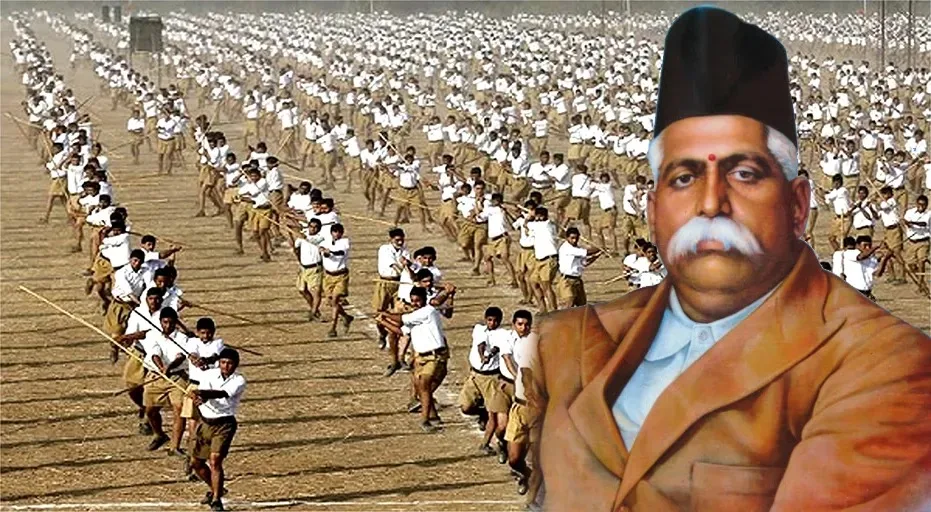
On October 2, 2025, the Rashtriya Swayamsevak Sangh will complete 100 years of its glorious journey. The journey is full of discipline, dedication, sacrifice and silent service. It is a journey of transforming ordinary people into extraordinary nation-builders.
But what went into the making of RSS? What were the thoughts, struggles, and inspirations behind its birth? To answer this, we must go back to the beginning, to the fire that burned in the heart of one boy from Nagpur, Keshav Baliram Hedgewar.
Early life of Keshav
On April 1, 1889, Keshav was born in Nagpur. A resident of Nagpur, Keshav was a born patriot. From his very childhood, he carried a strong desire to overthrow British rule from Bharat.
Interestingly, Keshav had deep roots in Kandakurthi village, located in Nizamabad, Telangana. His great-grandfather, Narahari Sastri, migrated from Kandakurthi to Nagpur at the behest of Bhosale Maharaj, the grandson of Chhatrapati Shivaji Maharaj, during a period of drought. Today, a museum has been built at the very same place.
At the tender age of 9–10, while studying in the third standard, his rebellious streak surfaced. On the occasion of Queen Victoria’s Diamond Jubilee celebrations, sweets were distributed in his school. Young Keshav, in quiet defiance, threw the sweets into the dustbin.
This trait of rejecting slavery only grew with time. While preparing for his matriculation, a school inspection was scheduled. Keshav decided to welcome the inspector not with bows of loyalty but with the thunderous cry of ‘Vande Mataram’, a slogan considered seditious by the British.
He gathered students of the school, explained his plan, and class after class rang with the chant of Vande Mataram. The inspector was furious and demanded the headmaster punish the culprit. But despite a thorough inquiry, no one betrayed Keshav. In frustration, the headmaster decided to rusticate all matriculation students. Parents pleaded, and finally, a compromise was offered: each boy had to nod in admission of ‘mistake’ to be readmitted. Every boy complied, except Keshav. This spirit of uncompromising nationalism defined his life.
Around the same time, stalwart Babasaheb Paranjape started a school for national education at Yavatmal. On the recommendation of Dr Munje, Keshav joined it. The British soon banned the school.
Then, Keshav went to Pune, enrolling in a school affiliated to the National University of Calcutta. Later, he opted for Amaravati as his exam centre and cleared it successfully. His certificate bore the signature of none other than Rash Behari Bose, the great revolutionary.
From the beginning, Keshav was naturally drawn towards revolutionary activities. In 1910, he deliberately chose Calcutta for his medical education, knowing it was the fortress of Indian revolutionaries. He eventually became an active member of the Anusheelan Samiti, the topmost body of the revolutionaries. In 1914, he completed his degree in medical called Licentiate in Medicine and Surgery (LMS). After spending one year in Calcutta for apprenticeship and he came back to Nagpur in 1916.
But Calcutta had changed his outlook. Keshav realised that protesting would not secure independence. The revolution needed mass awakening.
Therefore, departing from revolutionary path he started participating in Congress activities. Lokmanya Tilak with his slogan of “Swaraj is my birth right” was the tallest leader of Congress then and his action and conviction energised the youth.
Keshav threw himself into Congress activities, giving fiery speeches that soon drew the ire of the British. When bans could not silence him, the colonial rulers tried law.
On August 19, 1921, Dr Keshav Baliram Hedgewar was sentenced to one year rigorous imprisonment under sedition charges. He walked free on July 12, 1922. At his felicitation in Vyankatesh Theatre, leaders like Pt. Motilal Nehru and Hakim Ajmal Khan applauded his courage.
But Bharat was changing. Tilak was gone. Mahatma Gandhi had risen to lead the Congress. After World War I, Gandhi launched the Khilafat Movement, hoping to unite. But instead, it ignited communal violence. The Moplah revolt of Malabar saw Hindus slaughtered, converted, and women subjected to unspeakable horrors. Dr Hedgewar talked about this to Gandhiji, but received no convincing answers. This disillusionment sparked a new realisation, Bharat’s future lay in awakening, uniting, and organising the Hindu society itself.
And thus, was sown the seed of an organisation that would change the destiny of Bharat.
Birth Of RSS
On Vijayadashami, September 27, 1925, Keshav Baliram Hedgewar founded the Rashtriya Swayamsevak Sangh. The Sangh’s beginning was modest. Indeed the RSS of Vijayadashmi 1925 was as different from the RSS of later years as a mango kernel is from a mango tree. The whole thing was slow but organic growth. There were some experienced people with Dr Hedgewar. But he started with children from the age group of 12-14.
Their uniform for the occasion was the same as that of Nagpur Congress Session Volunteers in 1920—Khaki shirt, knee-long Khaki shorts and Khaki cap with two buttons. It was only five years later that the black cap came in. Every Thursday they met to hear a senior colleague on the state of the nation. After two years this talk came to be known as ‘bauddhik’, the name it bears to this day. As the numbers increased, Maharashtra Vyayamshala and Pratap Akhada also came up. But it was seen that rivalry among Vyayamshalas could hurt, and so daily shakhas came up to be held the following year. Now the Lathi was also introduced.
For months, the new organisation was nameless. On April 26, 1926, a meeting was called to decide on a name. Among the names suggested were Jari Patka Mandal (after Shivaji’s ‘golden bordered flag’), Bharat Udharak Mandal, Hindu Sevak Sangh and Rashtriya Swayamsevak Sangh. After some discussion, the last name was adopted.
The first shakha was held at Mahal, Mohite Wada, on May 28, 1926, which today is the RSS Headquarters.
This daily Shakha is the unique feature of RSS. This resulted into many miracles. There were many differences among Hindus. The daily Shakha eradicated all of them. Some of the social reformers tried to focus on differences to eradicate them. Doctorji deliberately decided to draw a bigger line of ‘Hindu’ to minimise them.
Unity Beyond Caste
RSS shakhas soon performed miracles. Hindus divided by caste began dining together. At the 1932 winter camp, when swayamsevaks hesitated to eat with so-called untouchables, Hedgewar simply said: “You may eat separately. I will eat with everyone.” His calm firmness transformed minds, and all ate as one.
The Sangh’s instruction “Ekashah Samapt”, Fall in Line, meant everyone stood shoulder to shoulder- rich and poor, literate and illiterate, high caste and low. This was silent social revolution.
Bhgawa Dhwaj – The Guru
It was only in 1934 that Doctorji bought Reshim Bagh as the permanent and central Sanghasthan, in the midst of a jungle on the outskirts of the city. But in 1944 Government tried to acquire even this particular patch of ground in the name of a cinema hall and stadium—though there was any amount of other land lying all around. It was only the unanimous protest of the leading citizens of Nagpur that saved the ground for RSS.
Flag Committee and Doctorji
There is an interesting story behind adopting bhagwa dhwaj as the guru in Sangh. The Karachi Session of Congress appointed a Flag Committee to finalise the National Flag since a variety of tricolours had been used over the decades. The Committee comprised of Sardar Patel (President), Maulana Azad, Pandit Nehru, Master Tara Singh, Kaka Kelkar, Dr Hardikar and Pattabhi Sitaramayya (Convener). Its unanimous report was that “The National Flag should be a Kesari or Saffron colour, having on it at the left top quarter the Charkha in blue”, since that colour is “non-communal” and “is associated with this ancient country by long tradition”.
Dr Hedgewar met Congress leaders in Delhi and Mumbai to urge acceptance of this report. But under communal pressures, Congress continued this old flag, only replacing the red strip by an orange one and moving it from bottom to top. Dr Hedgewar regretted that Congress did not understand the roots of Indian Nationalism.
Incidentally, only the ill-informed could object to Bhagwa or Kesaria—or think that the Green Flag is ‘Islamic’. So, dr hedgewar knew the importance of bhagwa so he adopted bhagwa dhwaj as the flag and guru for rss.
Guru-Dakshina
Even a small organisation needs some money. Dr Hedgewar would contribute personally and collect from his friends. But all of them felt that this was not a satisfactory arrangement. Somebody suggested organising a lottery. But others ruled that out. Somebody else suggested selling drama tickets. But, Hedgewar innovated the idea Guru-Dakshina.
Once a year, every swayamsevak would voluntarily contribute to the Guru—the Bhagwa Dhwaj.
The first Guru-Dakshina in 1928 collected just ₹84.
Today, lakhs contribute silently, and yet, no one outside a shakha office-bearer ever knows the amounts. This ensured RSS’s autonomy and self-reliance.
Prayer and Discipline
There was an RSS prayer too—half in Hindi (taken from the Arya Samaj prayer) and a half in Marathi, reflecting, perhaps, the bilingual composition. After deliberating for 8 hours a day, a Marathi structure of the Sanskrit prayer was prepared. All orders were also Sanskritised. Later Shri Narhari Narayan Bhide from Nagpur translated that prayer in Sanskrit, the mother of all Bhartiya Languages and that is how Sangh Prarthana started in 1940. you must have heard in nearby your playgournds and community halls, Namaste Sada Vatsale matribhume. Sangh decided to say “Bharat Mata Ki Jai” after the daily prayer in Shakha. This is the only slogan that is chanted in RSS Shakhas for the last 100 years.
Doctor Hedgewar breathed his last on June 21, 1940. Even after his poor health, he visited the camp on June 9, 1940. In a private closing ceremony, he said, “I can see a mini-Bharat in front of me”.
Shri Guruji takes Over
After the death of Doctor on June 21, 1940, Shri MS Golwalkar (Guruji), assumed the responsibility as the Sarsanghachalak, as per the wish of Doctor Hedgewar. A day before his death, on June 20, 1940. Shrri Guruji carried on this responsibility for the next 33 years.
Sangh had a firm belief that Gandhi would not accept partition at any cost. There were concrete reasons for the same. In 1946 elections for the Assembly, Congress fought with the slogan of ‘Akhand Bharat’ while for the Muslim League separate Pakistan was the sole agenda. Congress won in all the provinces except Bengal, even in Muslim majority provinces like North-West Frontier Province. Therefore, there was no reason to believe that Congress would accept partition.
Direct Action Day
Jinnah had called for a direct action on August 16, 1946 to pressurise the Congress for partition. Calcutta witnessed brutal killings of Hindus. The same trend continued in Noukhali. The same situation was there in Punjab and Sindh. Hindus were not ready to face the brutalities of Muslims. Gandhiji even went ahead and proposed Lord Mountbatten, “ to dissolve the Nehru led government and let there be government as per Jinnah’s wish.”
Even during the times of direct action, Hindus fought back with great valour in Muslim dominated Punjab. RSS activist from Nagpur was a Pracharak at Montgomery district (present day Sahiwal in Pakistan). He has written an 80 pages booklet on the bravery of Swayamsevaks during the tragedy of partition. In Muslim dominated areas, Sangh Swayamsevaks brought Hindus and Sikhs together
Acceptance of Partition
At last, Congress accepted the partition of the nation in the Congress session held on June 14-15, 1947. Then Gandhi only came forward and explained the necessity of accepting the resolution. To avoid further referendum on partition, the date was advanced to August 14, 1947. This led to further devastation. Thousands of dead bodies of Hindus started coming from Punjab. Lakhs of people started coming as refugees. Sangh started working for these people. Punjab Relief Committee was formed. Sangh became very popular and all the refugees started saying that we were saved by Swayamsevaks.
From a small gathering in Mohite Wada to a global movement, the Sangh has walked a century. It has served in times of partition, during calamities, in refugee camps, in national crises, from Assam floods to Emergency to COVID relief.
Today, RSS has lakhs of swayamsevaks, thousands of daily shakhas, and over 32 inspired organisations working across diverse fields, education, tribal welfare, border security, disaster relief, culture, health, economy, rural development and more.











Comments