




On Vijayadashami in 1925, Dr. Keshav Baliram Hedgewar founded the Rashtriya Swayamsevak Sangh (RSS) with the conviction that Bharat’s strength in the world depends first on internal unity and discipline. Hedgewar understood that a nation fragmented within could never command respect abroad, and that true sovereignty rests on cultural confidence as much as on political power. This insight was tested in Bharat’s first three great wars — the 1962 conflict with China and the 1965 and 1971 wars with Pakistan.
Each of these crises not only shaped Bharat’s military and diplomatic path but also revealed the RSS’s worldview — that civilisational clarity, social discipline, and unity are the real anchors of national defence.
1962: The Shock of China
Guruji’s Farsighted Warnings
M. S. Golwalkar (“Guruji”), the second Sarsanghchalak, was forthright about Communist China. In his book Bunch of Thoughts, section Fight to Win, he wrote:
“Firstly, we have to keep in mind that China has always been expansionist. It is in its blood. Over one hundred and fifty years ago Napoleon had forewarned not to rouse that yellow giant lest he should prove a grave peril to humanity. Seventy years ago Swami Vivekananda had specifically warned that China would invade Bharat soon after the Britishers quit.”
He added with biting clarity:
“Now, added to the expansionist blood of China is the intoxicant of Communism, which is an intensely aggressive, expansionist and imperialistic ideology. Thus in Communist China we have the explosive combination of two aggressive impulses. It is a case of – already a monkey, moreover drunk with wine.”
Guruji also dismissed illusions such as Panchsheel:
“The slogans and paper compromise like ‘peaceful co-existence’ and ‘Panchsheel’ that our leaders are indulging in only serve as a camouflage for the self-seeking predatory countries of the world to pursue their own ulterior motives against our country. China, as we know, was most vociferous in its expression of faith in Panchsheel. China was extolled as our great neighbour and friend for the last two thousand years or more from the day it accepted Buddhism. Our leaders declared that they were determined to stick to China’s friendship ‘at all costs’. Once, we had similarly resolved to win the friendship of Muslims in this land ‘at all costs’. How much it has cost us in terms of our national integrity and honour is all too well known. The same history has been repeated in this case also.”
RSS’s Service and Recognition
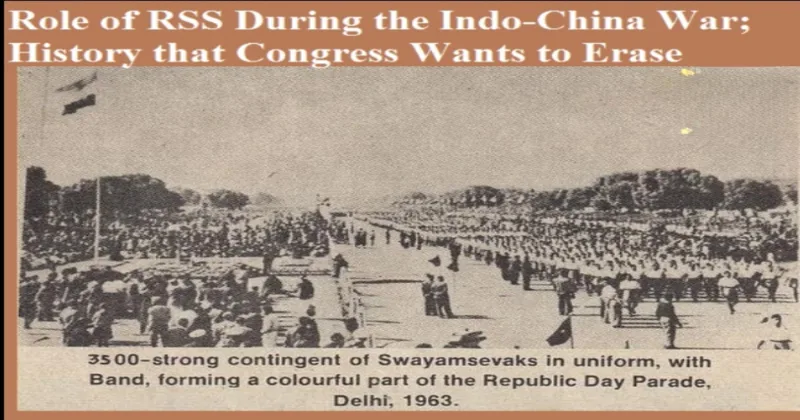
When war broke out, swayamsevaks stepped forward across the nation: managing traffic, assisting civil defence, donating blood, and helping families of soldiers. Their discipline was so striking that even Pandit Nehru, despite his deep political hostility towards the RSS, had to bow before their spirit of service. In a gesture that surprised many, he invited RSS swayamsevaks to march in the 1963 Republic Day Parade. It was an extraordinary moment in independent Bharat’s history — the state compelled to recognise the very organisation it often kept at the margins.
A century later, the memory of that moment still resonates. As part of the centenary celebrations — 100 Years of RSS — Prime Minister Narendra Modi is set to unveil a commemorative postal stamp depicting Sangh swayamsevaks marching in the 1963 Republic Day Parade. This symbolic act is more than just nostalgia; it affirms how the Sangh’s disciplined patriotism, once reluctantly acknowledged, is now celebrated as integral to Bharat’s national story.
1965: Pakistan’s Aggression
RSS Relief Efforts
When Pakistan launched “Operation Gibraltar” in 1965, sending infiltrators into Kashmir, the Indian Army responded with courage. The Sangh again mobilised swayamsevaks in Punjab, Delhi, and other regions for relief work, evacuations, and support to soldiers’ families.
Guruji on Pakistan
Golwalkar interpreted Pakistan’s hostility in civilisational terms. In Bunch of Thoughts he observed:
“Pakistan was born of the mentality opposed to Bharat’s culture and unity. That mentality of aggression and hatred is not extinguished by partition. It continues to express itself in attacks across our borders.”
He further noted that appeasement had encouraged aggression, “The rulers of Pakistan have no faith in peaceful coexistence. Theirs is the logic of the sword. Unless we stand united and strong, we invite repeated assaults.”
For Guruji, Pakistan was not just a neighbour with territorial disputes but the product of a mindset shaped by the Two-Nation Theory, inherently opposed to Bharat’s civilisational unity.
1971: Liberation of Bangladesh
Refugee Relief
By 1971, Pakistan’s repression in East Bengal had created a humanitarian disaster, forcing millions into Bharat. The RSS, now under the emerging leadership of Balasaheb Deoras (who formally became the third Sarsanghchalak in 1973), played a critical role in refugee relief. Camps run by swayamsevaks in West Bengal, Assam, and Tripura provided food, shelter, and medical aid to lakhs of displaced families.
Deoras’s Reflections
Deoras hailed the liberation of Bangladesh as historic justice, “Pakistan was created by breaking Bharat. Now Pakistan itself has broken. This is history’s justice.” (Speech, 1972)
At the same time, he warned against complacency, “Even after the victory, we must not lose sight of the fact that the mentality that created Pakistan still exists on our borders and within.”
For Deoras, the 1971 war was not just a military triumph but a reminder that vigilance must continue until the deeper mindset of separatism and hatred is defeated.
The Sangh’s Enduring Lessons
From these three wars, the Sangh distilled lessons that remain relevant:
- Unity is Security — Hedgewar and Guruji insisted that a united society is the best defence. A fragmented Bharat invites aggression; a united Bharat deters it.
- Civilisational Clarity — China was seen as expansionist by nature, intensified by Communism; Pakistan as the embodiment of the divisive Two-Nation mindset. Both required realism, not illusions.
- Service as Patriotism — Whether in 1962, 1965, or 1971, swayamsevaks proved that service at home is as much national defence as the soldier’s duty at the front.
- Strength before Diplomacy — Panchsheel and “Hindi-Chini Bhai-Bhai” collapsed under the weight of aggression. For the Sangh, diplomacy without strength is empty.
- Dharma as Compass — Even in war, the Sangh’s outlook was guided by Dharma: justice, duty, and civilisation, not conquest or hatred.
From Reluctant Recognition to National Honour
The wars of 1962, 1965, and 1971 tested Bharat’s resilience and revealed the Sangh’s core convictions. Golwalkar’s words about China being “expansionist in its blood” and Pakistan embodying a “mentality opposed to Bharat’s culture” were not mere polemics but civilisational diagnoses. Deoras’s reflection that Pakistan’s break-up was “history’s justice” showed how the Sangh read geopolitics as history’s unfolding of Dharma.
In all three wars, the swayamsevaks’ discipline and relief work won national recognition. Most famously, after the 1962 conflict, Pandit Nehru — despite his hostility to the Sangh — was compelled to acknowledge their patriotism and allow them to march in the 1963 Republic Day Parade. What began as reluctant recognition has, in a hundred years, blossomed into open honour.
As part of the Sangh’s centenary, Prime Minister Narendra Modi will unveil a postal stamp showing swayamsevaks marching in that very parade of 1963. This gesture is more than symbolic; it marks how the RSS, once seen from the margins, is today celebrated as central to Bharat’s national life. It tells the story of a movement whose strength lay not in political office but in discipline, service, and unwavering faith in Dharma.
As the Sangh enters its hundredth year, its wartime lessons remain relevant: unity is strength, clarity is protection, and service is patriotism. From Nehru’s reluctant bow in 1963 to Modi’s proud salute in 2025, the journey of the RSS is the journey of Bharat itself — from hesitation to self-confidence, from fragmentation to unity, from silence to civilisational assertion.













Comments