





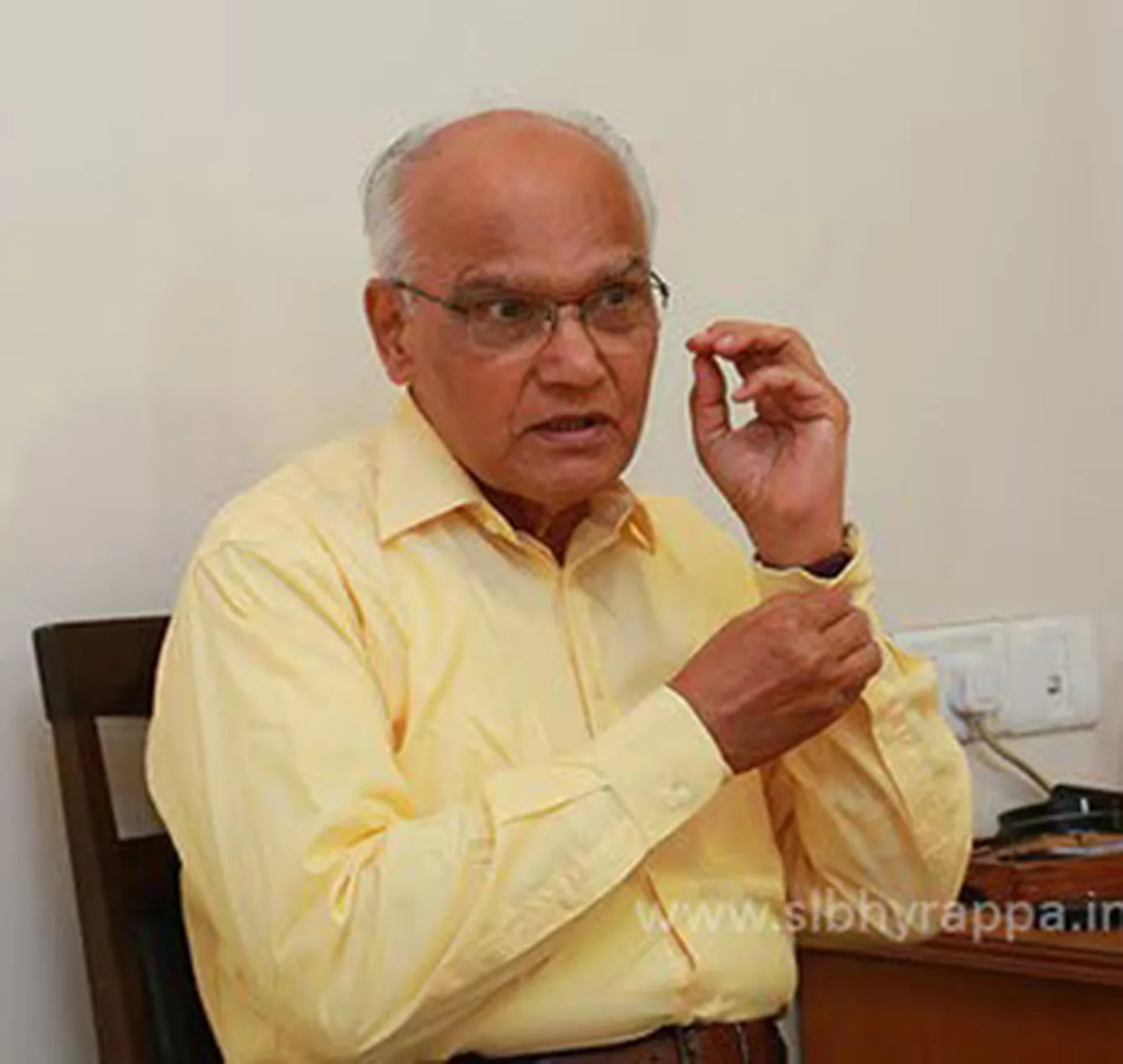
Even the hostile critics of the renowned Kannada novelist Dr S L Bhyrappa, who passed away in Bengaluru on September 24, have grudgingly acknowledged his contributions to Kannada literature. In particular, they have noted his success in widening the reader base for Kannada books. A parallel to such attacks on a writer can be traced back to the 1950s, when another famed Kannada novelist, A N Krishna Rao, faced criticism for his portrayal of the realities of prostitution. Like Bhyrappa, Krishna Rao stood firm against pseudo-leftism and the socialists who were prominent in Nehruvian Bharat. Santheshivara Lingannaiah Bhyrappa was a towering figure in Kannada literature. It could be said that few educated Kannadigas have not heard of him or read his works. Many of his critics, still rooted in the mindset of Indira Gandhi’s era and reluctant to accept the new order in the country, labeled him conservative, male chauvinist, and a supporter of Hindutva politics.
The hallmark of Bhyrappa’s writings is his forthrightness in narrating the atrocities committed against Hindus during centuries of Islamic rule. Such accounts were long concealed by so-called centrist or moderate historians, not to mention leftists who dominated public discourse after Independence. Few heard of great historians such as Radha Kumud Mookerji, Sir Jadunath Sarkar, or R C Majumdar, as history-writing came to be controlled by the likes of Tara Chand, Nurul Hasan, Bipin Chandra, and R S Sharma. For instance, I had not known that the slave king Iltutmish destroyed the original Mahakali temple at Ujjain. Instead, I admired him for nominating his daughter Razia Sultana as successor, influenced by works such as Dr Rafiq Zakaria’s book on her. Our textbooks for decades clouded history through selective omissions. While obituaries have hailed Bhyrappa’s classics Vamshavriksha, Grihabhanga, and Parva, I consider his 2007 novel Aavarana especially noteworthy. The book chronicles the role of Islamic invaders in seeking to annihilate Hinduism—not only through the destruction of temples, but also through forced conversions and assaults on livelihoods. It is often assumed that Aurangzeb was the most notorious destroyer of temples, such as the original Kashi Vishwanath in Varanasi and Krishna temple in Mathura. Yet, much before him, rulers like Balban, the Khiljis, the Tughlaqs, and Sikandar Lodi committed similar acts. The Ram Janmabhoomi movement highlighted how Babur’s general Mir Baqi demolished the Ram Mandir at Ayodhya. One wonders how Babur, who ruled only four years and was preoccupied with consolidating power, found the time both for conquest and to pen his autobiography. Karnataka remembers how Alauddin Khilji’s general Malik Kafur plundered Halebeedu, and how the Bahamani rulers razed the grand city of Hampi in 1565. Less widely known is that Tipu Sultan converted the Hanuman Temple at Srirangapatna into a mosque. Yet the standard narrative for years was that nameless miscreants, not rulers, desecrated temples—or that Hindus themselves demolished shrines of Buddhists, Jains, and rival sects. Even today, acts of sacrilege continue. Meanwhile, Congress leaders who celebrate Tipu Sultan’s birthday point to his support for the Sringeri Matha after Marathas raided it.
Another striking revelation in Aavarana is how Islamic rulers deliberately sought to weaken Hindus by denying them access to healthy food. This, Bhyrappa suggests, is why claims persist that Muslims have stronger physiques and better looks than Hindus. Though not a professional historian, Bhyrappa supported this novel with extensive citations from scholars and historians. By addressing issues ignored by mainstream academia, he left behind a body of work that challenged the political and intellectual orthodoxies of his time.










Comments