





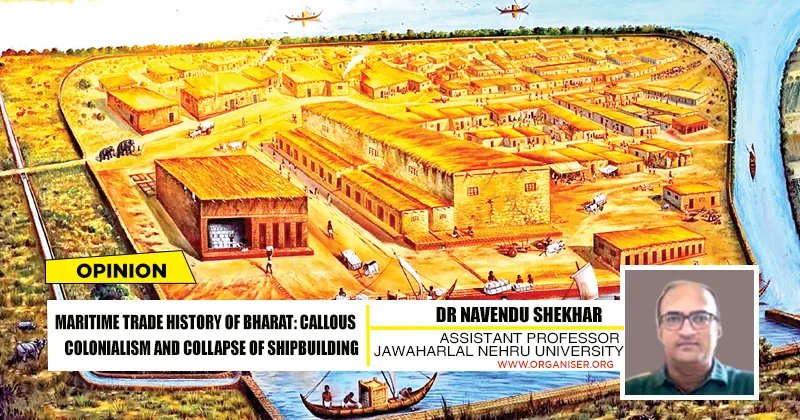
Maritime history of India paints a vivid picture of a country deeply connected to the sea for over three millennia, a story that challenges the notion of India as a landlocked civilisation focused solely on its internal affairs.
Hub of Global Commercial World
India is a land of paradoxes. Geographically, its mountain ranges and vast coastline might suggest a natural inclination towards isolation. Yet, its history reveals a continuous and vibrant record of interaction with the world. For more than 3,000 years, India was a central hub of the global commercial world, sustaining trade relationships with a succession of empires and cultures, from the Phoenicians and Romans to the Turks and the British. Indian maritime activity was also a powerful force that shaped its economic, cultural, and political landscape.
Clinching Evidence of Overseas Exchange
Early evidence of overseas exchange appears in archaeological and literary records from the third millennium BCE. For instance, Indian teak wood was discovered in the ruins of Ur in Mesopotamia, dating back to 3000 B.C., suggesting that Indian maritime trade with Babylon was active even in that ancient era. Lothal was a Harappan-era port and dockyard on the Gulf of Khambhat. Coastal Dravidian and Indus Valley urban populations engaged in shipbuilding and trade.
Rig Veda Corroborates Sea Voyages
Continuing to Vedic times, the Rig Veda, one of the oldest human texts, contains several passages referencing sea voyages undertaken for trade and exploration. These ancient hymns speak of merchants embarking on journeys for wealth and of ships navigating the vast, open ocean. Findings, such as Indian cedar in the palace of Nebuchadnezzar, the Babylonian King (604-562 B.C.), further solidify this connection. Jataka Tales, a collection of Buddhist literature, also provide invaluable, albeit indirect, evidence. Baveru-Jataka, for example, recounts how Indian merchants exported peacocks to Babylon (Baveru), which indicates that trading voyages to the Persian Gulf were a common practice as early as the 6th century B.C.
Dravidian words of articles of merchandise have even been found in Hebrew texts from the time of King Solomon. The word for “peacock ” in the Hebrew text is tuki, while the Tamil-Malayalam name of the peacock is tokei. This era saw the rise of important ports like Supara and Bharukaccha (Broach) on the Western Coast, which served as crucial hubs for trade with the West.
Flourishing Shipbuilding Industry
The Maurya period (321-184 B.C.) marks a significant leap in India’s maritime capabilities. Alexander the Great’s campaign in India revealed a flourishing shipbuilding industry, as his forces utilised a vast number of locally built boats to navigate the Indus and Hydaspes rivers. This industry was so well-developed that it operated as a state-controlled monopoly under the Mauryan Empire. As the Greek ambassador Megasthenes recorded, shipbuilders were salaried public servants who worked exclusively for the king, and the state-owned ships were leased to merchants and voyagers. The Arthashastra of Kautilya from this period details a highly organised Naval Department, headed by a Superintendent of Ships. This official was responsible for everything from river navigation and fishing licenses to collecting port taxes and managing distressed vessels. The regulations were comprehensive, including strict rules against nocturnal travel on rivers and policies for assisting ships damaged by storms, reflecting a sophisticated understanding of maritime administration. A fascinating story from the Bodhisattvavadana Kalpalata recounts how Emperor Ashoka had to issue a “Marine Edict” to deal with Naga pirates, highlighting the challenges of protecting trade routes in that era.
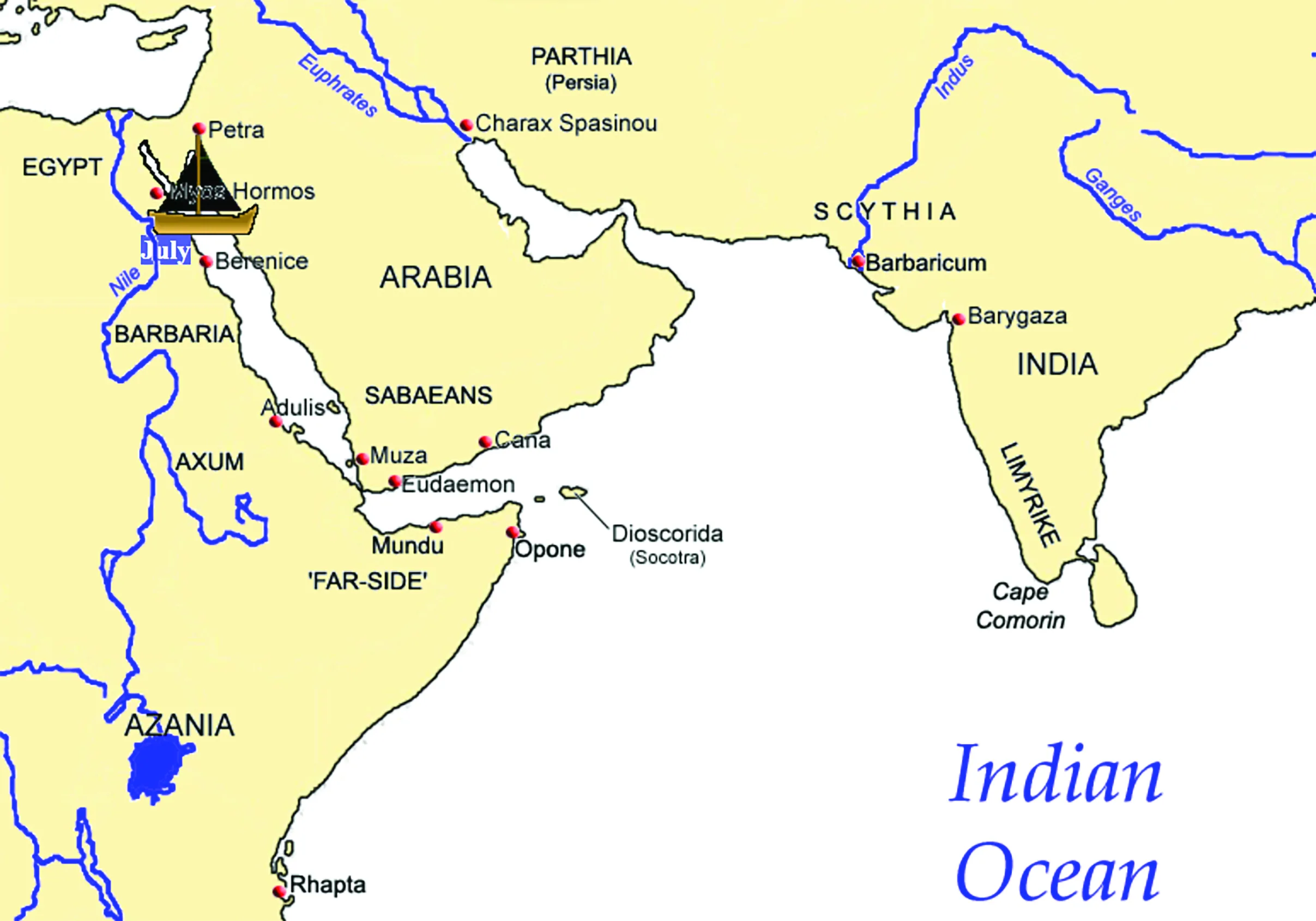
Following the Mauryas, the Andhra-Kushan period (200 B.C.–250 A.D.) is particularly notable for its robust trade with the Roman Empire. Roman gold flowed into India in exchange for luxuries like spices, silks, and gems. The sheer volume of this trade is attested to by the discovery of numerous Roman coins, particularly in the south Indian states of Tamilakam and Andhra. One can visualise the extent of Indian maritime trade through Pliny’s complaint that there was “no year in which India did not drain the Roman Empire of a hundred million sesterces (an ancient Roman silver coin). Andhra kings even minted their own coins featuring the image of a two-masted ship, a clear symbol of their naval power and a testament to their deep involvement in sea-borne commerce. The Periplus of the Erythraean Sea, a Greek sailing guide from around 100 A.D., gives us a detailed look at the bustling ports of this time. It also mentions Barygaza (Broach) as the principal trading hub for Western India, with inland towns like Paithan and Tagara supplying it with goods for export. On the Malabar coast, the port of Muziris (Muyirikodu) was a key centre for the pepper trade, visited by large “Yavana” (Greek and Roman) ships bringing gold, wine, and other goods. Another significant port was Kaviripaddinam (Pukar) on the Eastern Coast, described in ancient Tamil poems as a thriving town with warehouses for foreign goods and settlements for foreign traders who spoke various languages. Tamil merchant communities like Aruvakar, Ilam Tiruvittan and the wider Tamilakam mercantile networks were active in the Tamil-Chola and Chera region. Tamils were known for their pearl fishing industry in the Gulf of Mannar, which they called “Salabham,” meaning “the sea of gain”. Western Indian merchants from Gujarat and Saurashtra (early Gujaratis) who specialised in trade with West Asia. Coastal Bengali mariners and Tamraliptika merchants moving eastward. Jewish and Parsi trading settlements began appearing later; earlier diasporas of Indian traders were also present in the Persian Gulf.
Sea-borne trade between India and China began as early as the start of the Christian era, predating Chinese voyages to the Indian Ocean by several centuries. During the age of the Guptas and Harshavardhana, an enthusiastic group of Bengali and other Indian missionaries, fuelled by a proselytising zeal, travelled to China, Korea, and Japan to spread Buddhism. The Chinese pilgrim Fa Hien successfully completed a sea journey from Ceylon to China, with the help of Indian ships. The Kwai-Yuen Catalogue records a series of Indian Buddhist priests who sailed between Southern India and China. The whole coast of Further India, including modern-day Burma, as well as the islands of the Malay Archipelago, was dotted with prosperous Indian colonies and naval stations. These served as important halting places for ships plying between India and China. Along with these places, cities like Gaur were prominent cities and trade centres from the time of the Pala and Sena kings. It was known for its shipbuilding industry and was a hub for Arab merchants. Satgaon, Sonargaon, and Sripur were other important trade centres in Bengal, noted for their cotton and silk cloths, and rice trade with places like Ceylon, Pegu, and Sumatra. Indian influence also extended to Japan, with Japanese tradition recording the names of Indian evangelists like Bodhidharma and Bodhisena who visited the country. Furthermore, Indian traders are credited with introducing cotton to Japan in the 8th and 9th centuries.
The period between the 4th and 11th centuries saw “Greater India” cultural diffusion through trade, colonisation, and religious missions. Indian merchants, sailors, and religious emissaries established enduring ties with the Malay world. The colonisation of Java by Indians is one of the most significant events in Indian maritime history. This effort was largely initiated by navigators from the kingdom of Kalinga, located on India’s eastern coast. In 75 A.D., a group of Hindu navigators sailed from Kalinga to Java, where they established a colony, built towns and cities, and developed a long-lasting trade with their homeland. Javanese history confirms this narrative, noting that the colonisation led to the establishment of an era that still exists today. The colonisation resulted in the construction of magnificent temples like Prambanam and Borobudur, which are a testament to the transplanted Indian art and civilisation.
The arrival of the Muslims introduced new elements of conflict and organisation. The coasts were often plagued by pirates, such as the Meds and Jats of Sindh, who had harassed Sultan Mahmud’s army. He had to construct a fleet of 1,400 ships armed with iron spikes to counter the Jats in a naval battle on the Indus. The coasts of Gujarat and Malabar were key trading centres, exporting sugar, spices, and other goods, while Malabar was a hub for trade with China and other countries. Marco Polo described the Gujarat coast as a centre of piracy and noted that Calicut was a major hub for ships from the West. He also left detailed descriptions of Indian shipbuilding, including large ships with multiple bulkheads to prevent sinking. Arab and Persian merchant communities operating in tandem with Indian partners often settled in port towns. Gujarati Muslim and Hindu merchant groups like Bohra, Khoja, and Baniyas were dominating trade across the Arabian Sea. Marakkayar and Labbai Muslim groups in the Coromandel and Malabar coasts were deeply involved in the spice and textile trade.
The chief centres of shipbuilding were Bengal, Kashmir, and Tata. The Admiralty also regulated river tolls and provided a detailed hierarchy of maritime personnel, from the captain (Nakhoda) to common sailors (Kherwah).
Hindu Landlords Control Naval Activity
There was also a remarkable outburst of Hindu naval activity under independent landlords like Kedar Roy and Protapaditya. Kedar Roy, with his men-of-war, fought against both the King of Arrakan and Raja Man Singh of Jaipur. The Indian merchant was the most important figure in India’s overseas trade from the 16th to the 18th centuries. Indian maritime trade, particularly in the Indian Ocean, was characterised by the dominance of Gujarati Muslim merchants and the importance of trade in coarser textiles and bulk goods like rice, pulses, and oil. Indian imports were largely limited to bullion, spices, and horses. Indian shipping remained vital because of its lower freight rates and the preference of Indian merchants to trade within their own communities. However, investment in ship ownership was not popular as it was a low-profit venture with high risks. Indian trade was based on family firms and social networks rather than impersonal corporate structures, and it was highly competitive yet constrained by social customs.
Portuguese arrival (late 15th century) disrupted existing networks with attempts to control spice routes and key ports. A key aspect of their policy was the cartaze system, where Indian ships had to purchase passes from the Portuguese Viceroy of Goa to avoid seizure and confiscation of their goods. While the Portuguese asserted their dominance through force and a policy of “redistributive enterprises” (extracting revenue from trade through coercion), their efforts to completely monopolise the spice trade and divert it from the Red Sea and Mediterranean routes were ultimately unsuccessful in the long run. European sea power transformed regional trade, displacing indigenous control of certain routes while also integrating Indian shipping into emerging global commerce. Surat, which became a pre-eminent Mughal port, also became a major node for the English and Dutch East India Companies later. Masulipatnam (Machilipatnam), Madras (Chennai), and Calicut became focal points on the Coromandel and Malabar coasts. Bengal’s Hooghly river ports—Sutanuti, Calcutta (later development under the British)—gained commercial-military importance. Gujaratis, Parsis, Marwari and Bania trading groups were prominent groups involved in mercantile activities. Coromandel trading communities included Chettiar financiers, Komati traders, and Tamil merchant families. While the Portuguese and later the Dutch and English companies brought periods of disruption and competition, Indian merchants adapted. They redirected their shipping, for example, away from Malacca after its capture by the Portuguese, towards the Red Sea, which became a primary market for Indian textiles. Despite the increasing European presence and organisation, Indian trade remained dominant in the Indian Ocean until the political collapse of the Mughal Empire in the 18th century.
The rise of the British in India marked the beginning of the end for the indigenous shipbuilding industry. However, for a period, the British East India Company utilised Indian shipbuilding capabilities. We see the emergence of Indian shipbuilders employed by European companies, which were run by local master shipwrights and Parsi contractors. Bombay and Surat dockyards produced vessels for European navies. Colonial rule, steam technology, and imperial trade policies reshaped maritime economies. Indian seafaring partially declined while Indian merchant communities repositioned themselves in new roles. Transition from sail to steam undermined indigenous shipbuilding traditions but also created opportunities in coal, coaling stations, and dockyard employment. Large-scale Indian diasporas developed: merchants and coolie labour formed networks in East Africa, Southeast Asia, and the Caribbean. Regulatory constraints and imperial tariffs limited indigenous entrepreneurship, but community capital and networks persisted.















Comments