





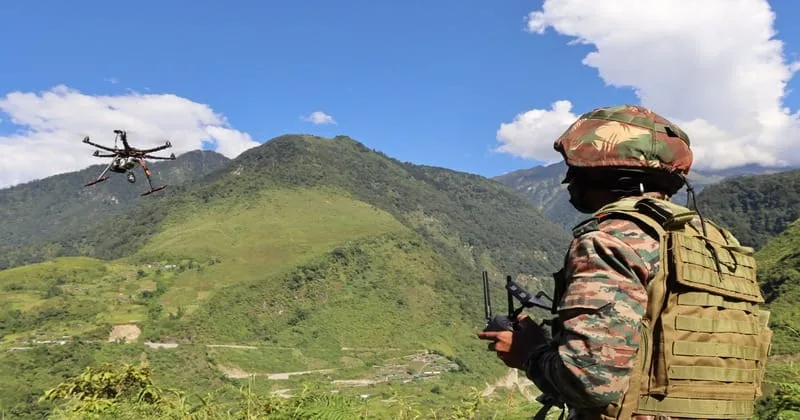
Attack drones, advanced stealth missiles, and air defence systems are the future of warfare and security for a nation. The Operation Sindoors showed us the power of missiles like Brahmos and attack drones of the Indian armed forces against the enemy nation, Pakistan. The success in Operation Sindoor is mostly attributed to the modern weapons of the Indian armed forces. To continue the winning momentum, the Indian Army is conducting a series of battlefield drone exercises to prepare the army for future war-like situations.
The Spear Corps under Eastern Command conducted Exercise DRONE KAVACH in the forward areas of Eastern Arunachal Pradesh from September 25 to 28, 2025. The exercise showcased the Indian Army’s combat readiness for the next generation of drone warfare, besides validating state-of-the-art drone technologies and counter-drone systems.
Exercise DRONE KAVACH was spread over a period of four days and was also attended by personnel of Indo-Tibetan Border Police (ITBP) deployed in forward areas. As part of the exercise, a series of tactical manoeuvres and combat situations were exercised to validate the Indian Army’s preparedness for operating in a multi-domain technological-infused battlefield scenario. Tactics, Techniques and Procedures pertaining to target acquisition, active/ passive counter drone measures and target neutralisation with assured success were rehearsed under simulated conditions. Newly raised structures at the unit level were also exercised for developing tactics, techniques and procedures in consonance with the overall employment philosophy and mandated operational tasks.
Valuable insights gained through the exercise would assist the Indian Army in achieving a comprehensive understanding of the future operational environment, besides preparing for fighting a successful drone battle.
Exercise DRONE KAVACH represents a significant step in the Indian Army’s commitment towards modernisation while striving for technology absorption to achieve operational excellence.
It should be mentioned that the Indian armed forces are equally conducting these exercises in the relatively calm eastern borders. Starting from Sikkim to Arunachal Pradesh, the Indian army is preparing its men for the modern-day battle. Recently, in his visit to the advanced drone centre in Likabali in Arunachal Pradesh, Chief of the Army Staff General Upendra Dwivedi said that every man and officer of the army should be capable of operating a drone, just as he carries his weapon. Depending on the task of the unit or soldier, drones will be employed for combat, surveillance, logistics, or even medical evacuation.
Counter-drone measures are also being inducted in parallel, creating a layered system to both exploit and neutralise unmanned platforms. He had announced that every infantry battalion will have a drone platoon, artillery regiments will be equipped with counter-drone systems and loiter munitions, and composite *Divyastra* batteries will be created to enhance precision and survivability. This dual thrust, arming soldiers with drones while strengthening counter-drone defences, reflects the Indian Army’s recognition that unmanned systems are no longer niche but *essential elements of the battlefield*. By institutionalising training, operationalising units, and aligning force structures, the Indian Army is ensuring that the “soldier of tomorrow” will not only carry a weapon but also an eagle, a drone that extends his vision, reach, and power on the battlefield.














Comments