





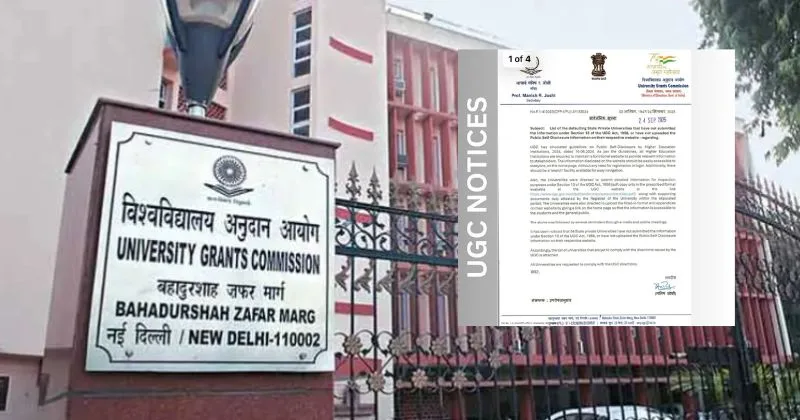
The University Grants Commission (UGC), India’s apex higher education regulator, has pulled up 54 state private universities across the country for failing to comply with mandatory disclosure norms. In a strict notice, the UGC has highlighted that these institutions either did not submit information under Section 13 of the UGC Act, 1956, or failed to upload Public Self-Disclosure details on their official websites as per the new regulatory guidelines.
This action comes against the backdrop of the Public Self-Disclosure Guidelines for Higher Education Institutions (HEIs), 2024, which were circulated last year on June 10, 2024. The guidelines mandate all higher education institutions to maintain a functional and transparent website where stakeholders, including students, parents, employers, and the general public, can access relevant information easily.
📢 UGC Updates
UGC has issued a notice to 54 State Private Universities that have not submitted information under Section 13 of the UGC Act, 1956, or failed to upload Public Self-Disclosure details on their official websites.
👉 Check the list of defaulting universities here:… pic.twitter.com/x59t3ea3JV
— UGC INDIA (@ugc_india) September 26, 2025
The UGC revealed that multiple reminders through e-mails and online meetings were issued to these universities before resorting to the public notice. Despite repeated opportunities, the institutions failed to comply with the directives, forcing the Commission to name them publicly.
The Commission has warned that such non-compliance undermines the credibility of the institutions and destroys the confidence of students, parents, and other stakeholders who depend on verified information for decision-making.
UGC Guidelines on Public Self-Disclosure
According to the notification, the Public Self-Disclosure Guidelines, 2024 were issued to enhance transparency, accountability, and trust in the higher education sector. The guidelines require universities to:
- Maintain a functional official website with updated and verified information
- Ensure that all the disclosures are easily accessible on the homepage without any requirement for login or any kind of registration
- Provide a search facility on the website to help in navigation and quick access to information
- Upload prescribed formats and appendices, along with supporting documents attested by the Registrar, ensuring that students and the public have reliable data regarding institutional operations.
The UGC clarified that these measures are critical for improving governance and public confidence in higher education institutions, especially in the rapidly expanding private university sector.
Section 13 of the UGC Act, 1956
The notice has invoked Section 13 of the UGC Act, 1956, which empowers the Commission to require universities to furnish information for inspection purposes. This provision ensures that the UGC can monitor the functioning of universities, assess compliance with regulations, and safeguard the interests of students.
By not submitting the requested details or refusing to upload self-disclosure information, the 54 universities have violated not only the spirit of transparency but also the statutory obligations mandated by the UGC Act.
List of Defaulters
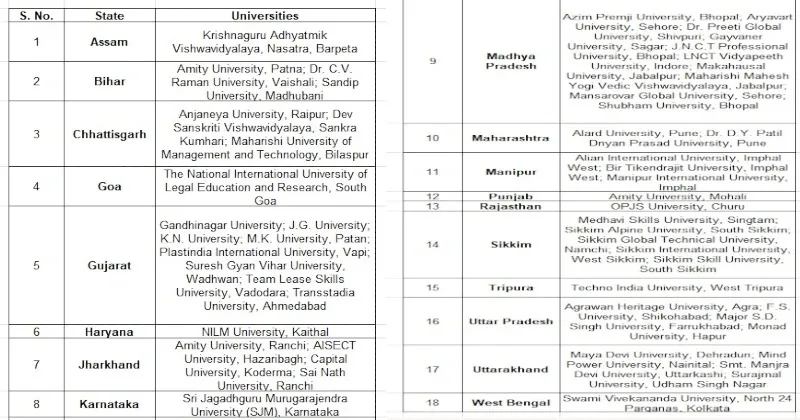
The list of 54 non-compliant state private universities spans 16 states across India, covering institutions from Assam in the east to Goa in the west, and from Punjab in the north to Karnataka in the south. The defaulting universities include well-known names such as Amity University (Ranchi and Patna campuses), Azim Premji University (Bhopal), and several others across Bihar, Chhattisgarh, Gujarat, Madhya Pradesh, Maharashtra, Manipur, Sikkim, Uttar Pradesh, Uttarakhand, and West Bengal.
Higher education is one of the most critical sectors that shapes the future of India’s youth. With the rapid growth of private universities, questions about their quality, recognition, infrastructure, and legitimacy often come to the forefront. Transparency in operations becomes essential in this context, as it enables students and parents to verify whether a university is recognized, whether its courses have the necessary approvals, and whether the degrees it offers carry validity.
A transparent governance structure will ensure accountability from the management, and this will reduce the chances of malpractices. It will help curb the rise of so-called “degree shops” or fraudulent institutions.
UGC’s notice is advisory at present. The Commission could issue show-cause notices, launch detailed inquiries into the operations of defaulting universities, or recommend the withdrawal of recognition and approval of new courses. Public warnings may also be issued, which could severely damage the reputation of these institutions and discourage prospective students from enrolling. In more severe cases, the issue could even be referred to the concerned state governments for disciplinary or corrective action.
The UGC has made it clear that it will continue monitoring the situation closely, and universities that ignore the directives risk facing greater scrutiny and consequences in the near future.
The notice to 54 universities is a crucial wake-up call for the entire private higher education sector. In addition, the ongoing digital transformation has made online information the first point of reference for most students and parents. Institutions that fail to provide accessible, verified, and updated information on their official websites may find themselves at a disadvantage, losing both trust and talent to more transparent competitors.
















Comments