





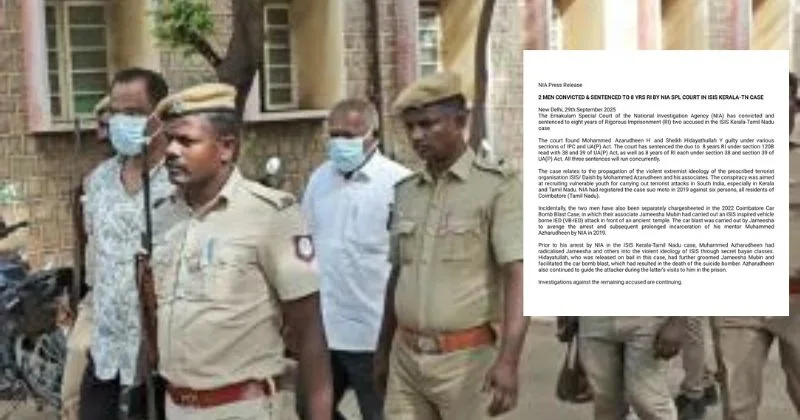
CHENNAI: In an important verdict against the spread of radicalisation in South India, a special court of the National Investigation Agency (NIA) in Kochi on September 29 sentenced two residents of Coimbatore, Tamil Nadu, to eight years of rigorous imprisonment (RI) in the Kerala-Tamil Nadu Islamic State (IS) recruitment and conspiracy case.
The two convicts, H Mohammed Azarudeen and Y Sheik Hidayathullah, both hailing from Ukkadam, Coimbatore, were found guilty of actively recruiting vulnerable youth and propagating the violent extremist ideology of the banned terror organisation, the Islamic State of Iraq and Syria (ISIS) or Daish.
Special Judge N. Sesharinathan pronounced the sentence, which will run concurrently for both men. The NIA detailed the convictions, stating that the duo was found guilty of offences punishable under Sections 38 (membership of a terrorist organisation) and 39 (supporting a terrorist organisation) of the Unlawful Activities Prevention Act (UAPA), along with Section 120B (criminal conspiracy) of the Indian Penal Code (IPC).
The case, which the NIA registered suo motu in 2019, unveiled a dangerous conspiracy aimed at establishing a terror network in the Southern states. The NIA investigation revealed that the accused were plotting to recruit susceptible young individuals for carrying out terrorist attacks, particularly in major cities across Kerala and Tamil Nadu.
According to the prosecution, Azarudeen and Hidayathullah became active members of ISIS, leveraging technology and secrecy to further their goals. They utilised social media, including a private WhatsApp group, and conducted secret ‘Bayan’ classes to attract and indoctrinate youth into the IS fold.
Forensic examination of their seized digital devices and social media accounts exposed the extent of their radicalisation efforts. The NIA recovered voluminous IS-related propaganda materials, including posters, videos, and links displaying extreme violence, instructions on manufacturing bombs, killing of hostages, and tutorials on securing their social media communications from surveillance. They also downloaded videos and speeches of notorious Islamic radical leaders, including those of Zahran Hashim, the mastermind behind the 2019 Easter Sunday bomb blasts in Sri Lanka, which were recovered from their devices.
The NIA noted that the accused had been advancing ISIS activities since 2017, which included travelling to various locations in Kerala to meet with associates and convey their support for the terror outfit.
2 Men Convicted & Sentenced to 8 Yrs RI by NIA Spl Court in ISIS Kerala TN Case pic.twitter.com/oitBlNW57E
— NIA India (@NIA_India) September 29, 2025
The sentencing further highlights the deep-rooted nature of this terror module, as both Azarudeen and Sheik Hidayathullah have also been named in a separate charge sheet connected to the 2022 Coimbatore car bomb case. This high-profile case involved their associate, Jameesha Mubin, who died while carrying out an ISIS-inspired Vehicle-Borne Improvised Explosive Device (VB-IED) attack in front of the ancient Kottai Sangameshwarar Thirukovil temple in Coimbatore.
The NIA probe established a direct link, revealing that the car blast was carried out by Mubin as an act of revenge. His primary motivation was to avenge the 2019 arrest and subsequent prolonged incarceration of his mentor, Mohammed Azharudheen, in the very ISIS recruitment case for which he has now been sentenced.
Prior to his arrest in 2019, Azharudheen was instrumental in radicalising Mubin and others through his secret Bayan classes. Crucially, even after his arrest, Azharudheen continued to guide Mubin during the latter’s visits to him in prison, demonstrating his continued influence from behind bars.
The NIA investigation further revealed the role of Sheik Hidayathullah, who was on bail in the recruitment case. He is accused of further grooming Jameesha Mubin and actively facilitating the execution of the car bomb attack, which ultimately resulted in the suicide bomber’s death.
















Comments