





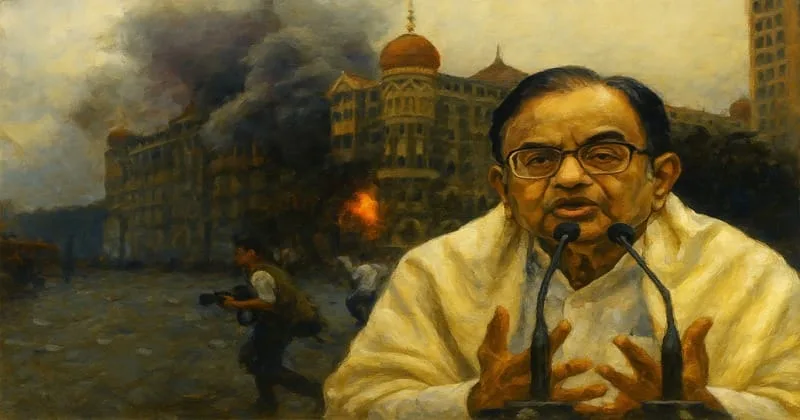
The terrorist attack on Mumbai on November 26, 2008, is something India can never forget. It was an assault that shook the very soul of the nation. For three days, Mumbai remained under the shadow of terror. One hundred sixty-six innocent citizens and security personnel lost their lives, hundreds were injured, and the entire country watched helplessly as the horrifying face of terrorism unfolded. The expectation was that the then-union government would take decisive action, ensuring Pakistan paid the price for its crime. Instead, the Congress government in power chose to preach restraint and dialogue.
Today, when the then Home Minister P. Chidambaram himself admits that he wanted retaliatory action against Pakistan but was stopped by the Ministry of External Affairs, the questions only deepen. Was this merely the opinion of a few bureaucrats, or was it the product of Congress’s larger political mindset and vote-bank compulsions? Chidambaram’s confession exposes Congress’s long-standing weakness: a double-faced approach toward national interest and security. Whenever faced with the choice between the nation and Muslim appeasement, the party consistently chose the latter.
In reality, the Mumbai attack was nothing less than a direct assault on India by a Pakistan-sponsored terror network. Lashkar-e-Taiba terrorists infiltrated India via the sea and struck iconic landmarks like the Taj Hotel, Oberoi Hotel, Nariman House, and the Chhatrapati Shivaji Terminus. The entire world was stunned. At that moment, there was an expectation that India would respond with the same severity as the United States did after 9/11 in Afghanistan. Yet, the Congress government did nothing of the sort. Then Prime Minister Manmohan Singh and his cabinet rejected military action and instead began the farcical exercise of sending dossiers.
Chidambaram says he favoured retaliatory strikes but was persuaded by the Ministry of External Affairs to pursue talks. But when the country suffers an attack akin to war, can dialogue really be the only option? Or was this decision a reflection of Congress’s fear of losing its vote-bank, dictated by the mindset of the Sonia Gandhi–led high command? The truth is, Congress’s attitude toward terrorism has always been questionable. Its inaction after 26/11 was not an isolated case.
Even after the 1993 Mumbai bomb blasts, Congress failed to take decisive steps against Pakistan and Dawood Ibrahim. The execution of Afzal Guru, convicted for the Parliament attack, was delayed for years, with Congress leaders even showing sympathy toward him. Between 2004 and 2014, under the UPA government, terrorist incidents became routine; in Delhi, Hyderabad, Varanasi, Pune, Ahmedabad, and Mumbai; bombings occurred almost every month. The government’s response was confined to rhetoric and commissions of inquiry.
Adding to this perception were statements from senior Congress leaders that openly suggested a soft corner for extremists. Digvijaya Singh addressed Osama bin Laden as “Osama Ji.” At the time of Yakub Memon’s hanging, several Congress leaders questioned the judicial process. These acts reinforced the view that for Congress, political arithmetic mattered more than national security.
It is also worth noting that real power during the UPA era lay in the hands of Sonia Gandhi. Her foreign-influenced perspective, shaped by international pressures, had little space for Indian national sentiment or public outrage. Chidambaram’s admission only confirms that even after 26/11, Congress’s agenda was not the defence of the nation but the preservation of power through vote-bank politics. In sharp contrast, since 2014, under the leadership of Narendra Modi, India’s policy has fundamentally changed. The message is clear: terrorism will not be tolerated, and terrorists and their sponsors will be punished, even if it means striking across the border.
In 2016, after the Uri attack, the Indian Army conducted surgical strikes. For the first time, the world saw India carry out direct assaults on Pakistani positions. In 2019, following the Pulwama attack, the Indian Air Force bombed terror camps inside Pakistan’s Balakot. Recently, Operation Sindhur has once again demonstrated that India now adopts a decisive posture against terrorists and will not bow to international pressure. This is not just a change in action but a policy shift. The people now have the assurance that their security is the government’s highest priority. It is for this reason that whenever terrorism is discussed, Congress stands in the dock, while the BJP is credited for decisive responses.
It must be said that Chidambaram’s statement today is not just a personal explanation. It is a window into the Congress government of that era. If the Home Minister himself admits that he wanted retaliatory strikes against Pakistan but was stopped, it directly implies that at the highest levels of power, there was no will to show firmness against terrorism. This confession has unmasked the hypocrisy of Congress, a hypocrisy the people of India have long sensed. Congress has always hesitated on the issue of terrorism, always shown leniency toward Pakistan, and always placed vote-bank politics above national interest.
Chidambaram’s admission today is not merely a statement; it is proof of Congress’s betrayal of Bharat. The memory of the martyrs of 26/11 reminds us of one thing: if power rests in the hands that prioritise votes over security, the nation is bound to remain vulnerable. When a government compromises the safety of its citizens, avoids decisive action against terrorists, and gives the enemy state open protection, it is not just failure; it is betrayal of the nation itself. That is exactly what Congress did after 26/11. This is why, even today, when the tragedy is remembered, the sacrifice of the martyrs is recalled alongside Congress’s helplessness and appeasement.
















Comments