





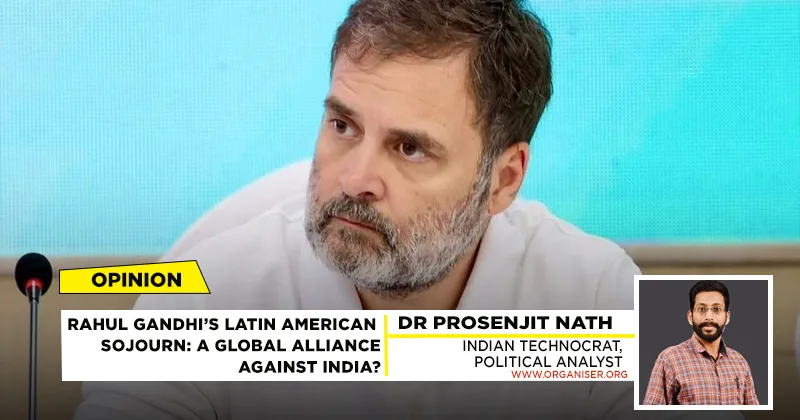
The latest controversy surrounding Congress leader Rahul Gandhi’s foreign travels has reignited a debate about his political priorities and his approach to India’s internal affairs. On Saturday, the Bharatiya Janata Party (BJP) launched a sharp attack on the Leader of the Opposition after it was revealed that he had embarked on a tour of four South American countries. According to Congress spokesperson Pawan Khera, Rahul Gandhi is scheduled to meet political leaders, university students, and members of the business community during his visit to countries such as Brazil and Colombia.
On the surface, this may appear like a routine diplomatic engagement, a politician seeking to engage with global stakeholders and explore new trade opportunities. However, the BJP sees something far more sinister. BJP spokesperson Pradeep Bhandari alleged that Rahul Gandhi’s trip is not merely a diplomatic outreach but part of a larger conspiracy to “build a global alliance” against India. In a strongly worded post on X, Bhandari claimed, “Rahul Gandhi departs to South America! Wonder who will be the next anti-India element that Rahul will meet behind closed doors! Rahul wants to fight the Indian state and Indian democracy. He is building a global alliance for it. George Soros, his mentor, might be directing him!”
Rahul Gandhi goes on yet another foreign visit!
Rahul Gandhi departs to South America!
Wonder who will be the next anti-India element that Rahul will meet behind closed doors!
Rahul wants to fight the Indian state and Indian democracy!
He is building a global alliance for it.… pic.twitter.com/tti3v2qQ3U
— Pradeep Bhandari(प्रदीप भंडारी)🇮🇳 (@pradip103) September 27, 2025
This statement has sparked a fresh wave of political mudslinging, with the BJP drawing attention to the timing of the visit. Just a day before Rahul Gandhi’s departure, well-known activist Sonam Wangchuk was arrested under the National Security Act (NSA). Wangchuk, who has been increasingly critical of the government’s policies in Ladakh, has been accused of fomenting unrest in the strategically sensitive region. Bhandari suggested that Rahul’s departure immediately after Wangchuk’s arrest is no coincidence, implying coordination between domestic dissenters and international players.
The BJP’s allegations gain weight when viewed against Rahul Gandhi’s past actions on the global stage. He has previously met figures like U.S. Congresswoman Ilhan Omar, who has been vocal in her criticism of India, particularly on issues related to Kashmir. Rahul has also, on several occasions, urged foreign governments to intervene in what he calls the “erosion of democracy” in India. Such statements, the BJP argues, amount to inviting external interference in India’s sovereign matters, a red line no responsible national leader should cross.
Bhandari further reminded the public that Gurpatwant Singh Pannu, a Khalistani separatist and a declared terrorist, has publicly endorsed Rahul Gandhi in the past. Though Rahul has not reciprocated or directly engaged with Pannu, the very fact that a known anti-India figure views Rahul as a potential ally adds to the suspicion surrounding his foreign engagements. The BJP narrative suggests that Rahul’s visits to foreign nations often involve closed-door meetings that are never fully disclosed to the public, raising questions about transparency and intent.
From the Congress party’s perspective, however, this trip is being projected as a legitimate effort to strengthen India’s global standing. According to their official statement, Rahul Gandhi will be engaging with political and business leaders to explore opportunities in the wake of U.S. tariffs on certain Indian goods. He is expected to discuss trade diversification, academic collaborations, and democratic values with counterparts in Brazil, Colombia, and other countries. By framing the visit as a platform for dialogue with the next generation of global leaders, the Congress hopes to portray Rahul as a statesman with international stature.
Yet, the underlying question remains: Why does Rahul Gandhi consistently choose to raise sensitive domestic issues on foreign soil rather than within India’s democratic institutions? This has been a recurring criticism leveled at him by the BJP and its supporters. The perception that he is undermining India’s image abroad for short-term political gains has been damaging not just to Rahul personally but also to the Congress party’s credibility.
Moreover, invoking the name of George Soros adds another layer of complexity. Soros, a billionaire known for funding liberal and progressive causes worldwide, has openly criticized the Modi government, even predicting that Prime Minister Narendra Modi would face a political “reckoning.” For the BJP, Soros represents a symbol of external meddling in India’s affairs. By linking Rahul to Soros, Bhandari is suggesting that there is a coordinated international effort to destabilize India through ideological and financial networks.
While Congress leaders dismiss these allegations as paranoid conspiracy theories, the timing and optics of Rahul Gandhi’s trip leave room for skepticism. In an era where global perception matters immensely, political leaders must tread carefully. When a leader of the opposition appears to be seeking validation abroad, it inevitably raises concerns about loyalty and accountability.
As India navigates complex geopolitical challenges, managing border tensions with China to forging trade alliances amid shifting global power dynamics, the last thing the country needs is its political opposition projecting internal discord to the world. Whether Rahul Gandhi’s Latin American tour is a genuine attempt at diplomacy or, as the BJP claims, part of a “global alliance” against India, the episode underscores a deeper question: should India’s leaders air the nation’s internal disputes on foreign soil, or should such debates remain firmly within the boundaries of its democracy?












Comments