





India is often described as a subcontinent, but a closer gaze reveals something more profound. Bharat is, in essence, a maritime civilisation. Bounded by the Indus to the West, the Brahmaputra to the East, the Himalayas to the North, and the Indian Ocean embracing its peninsular expanse, India is a “unique island.” The very geology of the land tells a seafaring tale as Gondwana drifted Northwards, India “sailed” into Asia, carrying with it an intrinsic maritime destiny.
Why Bharat Lost its Independence
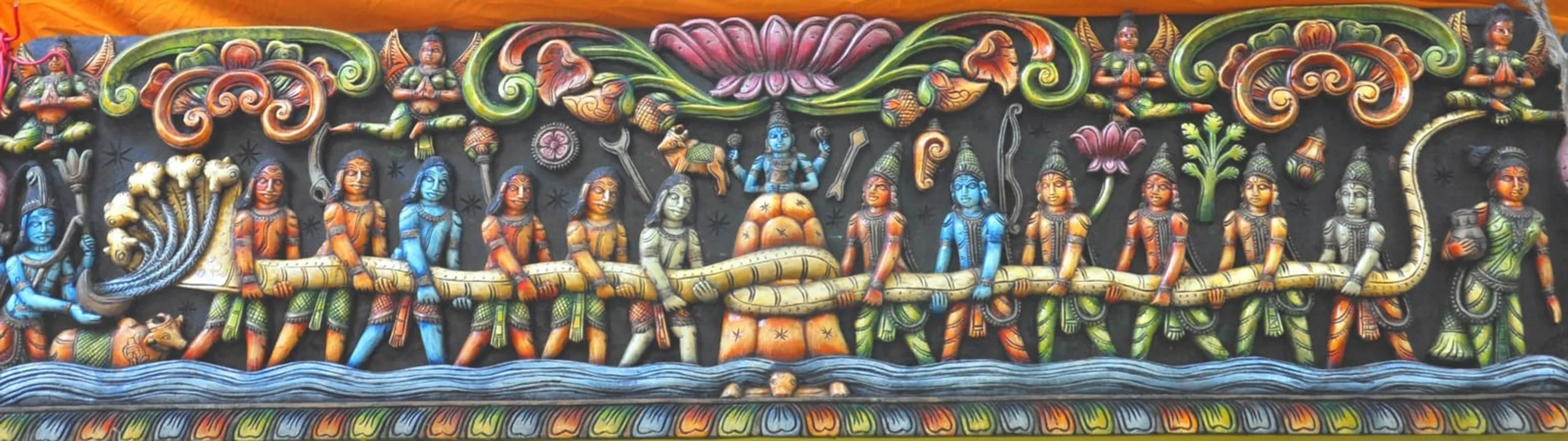
For millennia, the seas have been the crucible of India’s prosperity, its cultural outreach and its strategic relevance. The saga of Samudra Manthan captures this truth in allegorical form. The ocean, churned by Gods and demons, yields not just treasures but the knowledge itself. The sea is thus not merely a frontier but a source of wisdom, wealth, and survival. Interestingly, the departure terminal of the Suvarnabhumi Airport Departure Terminal depicts a vivid rendering of Samudra Manthan.
Panikkar’s Cogent Argument
KM Panikkar, pioneering maritime thinker, argued that India lost its Independence not on land but because it ceded command of the seas to colonial powers. That lesson underpins the central thesis: maritime power was Bharat’s original civilisational necessity, diminished in medieval and colonial centuries, yet revived in our time as the strategic spine of a resurgent nation.
Knowledge, Monsoons & Connectivity
From the earliest times, Indians looked outward to the sea. Harappan dockyards at Lothal reveal trade with Mesopotamia; seals discovered abroad testify to maritime commerce stretching across thousands of nautical miles. Mastery of the monsoons gave Indian sailors a unique advantage. Harnessing predictable seasonal winds, they blended astronomy with navigation, turning the Indian Ocean into a highway of connectivity long before Europe’s “Age of Discovery.”
“Bharat’s coastlines will become gateways to the nation’s prosperity”
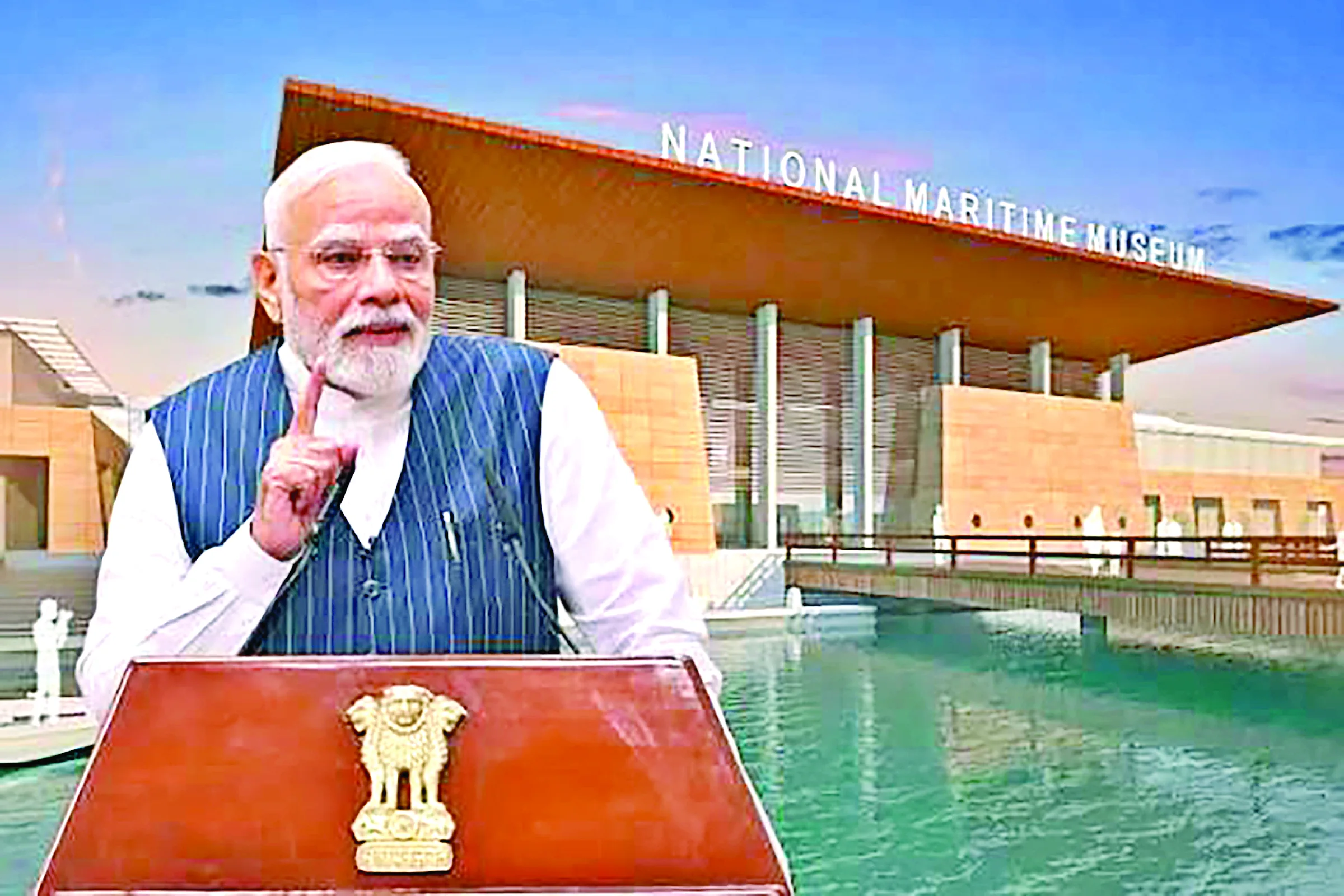
On September 20, while addressing the ‘Samudra se Samriddhi’ event, PM Modi said, “Bharat is moving forward with the spirit of global brotherhood and Bharat has no major enemy in the world today, but in true terms, Bharat’s biggest adversary is dependence on other nations”. He reiterated that greater foreign dependence leads to greater national failure. For global peace, stability, and prosperity, the world’s most populous country must become self-reliant. He cautioned that reliance on others compromises national self-respect. Modi asserted that the future of 140 crore Bharatiya cannot be left to external forces, nor can the resolve for national development be based on foreign dependency. He stressed that the future of coming generations must not be put at risk. He declared that the solution to a hundred problems is one—building an Atmanirbhar Bharat. To achieve this, Bharat must confront challenges, reduce external
Citing Bharat’s shipping sector as a major example of the damage caused by flawed policies, PM Modi remarked that Bharat was historically a leading maritime power and one of the world’s largest shipbuilding hubs. Ships built in Bharat’s coastal states once powered domestic and global trade. Even fifty years ago, Bharat used domestically built ships, with over 40 percent of import-export conducted through them. The Prime Minister criticised the current opposition party stating that the shipping sector later fell victim to their misguided policies and instead of strengthening domestic shipbuilding, they preferred paying freight to foreign vessels. This led to the collapse of Bharat’s shipbuilding ecosystem and forced dependence on foreign ships. As a result, the share of Bharatiya ships in trade dropped from 40 per cent to just 5 per cent. The Prime Minister emphasised that today, 95 per cent of Bharat’s trade relies on foreign ships—a dependency that has caused significant loss to the nation.
“If Bharat is to become a developed nation by 2047, it must become self-reliant, there is no alternative to self-reliance and that all 140 crore citizens must commit to the same resolve—whether it is chips or ships, they must be made in Bharat”, emphasised the Prime Minister, remarking that with this vision, Bharat’s maritime sector is now moving towards next-generation reforms.
Maritime Spirit of Indigenous Fests
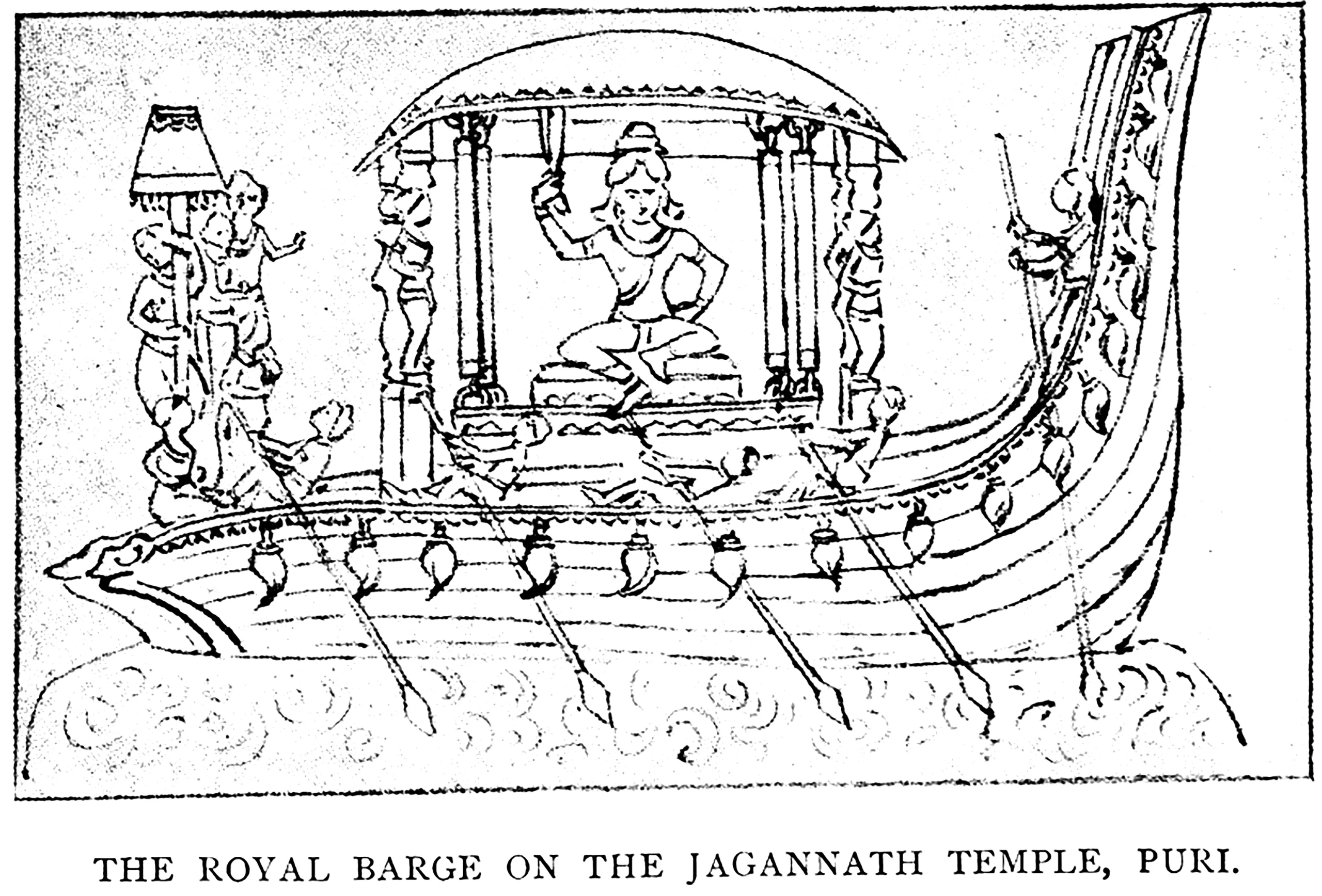
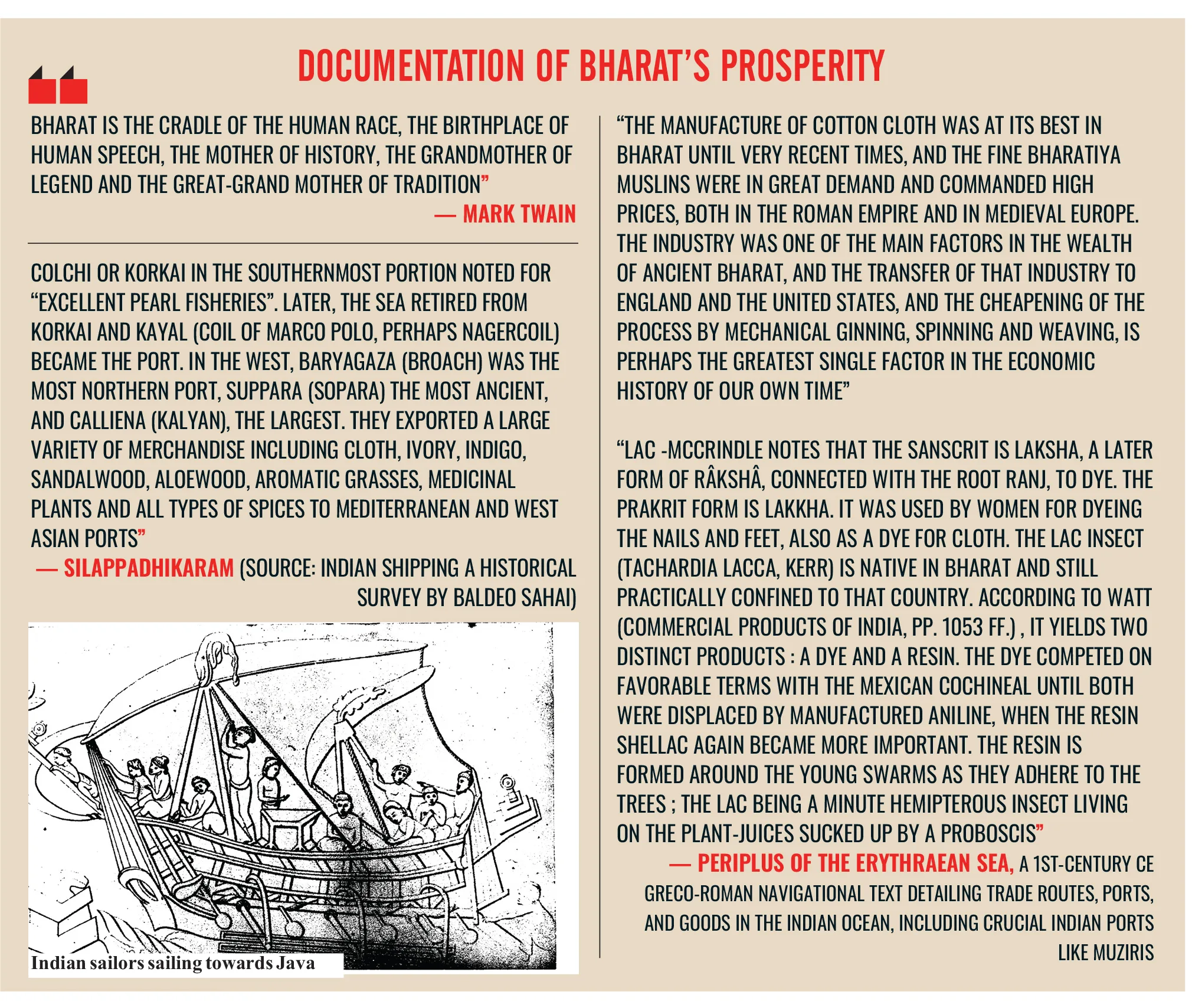
Cultural memory preserves this maritime spirit. The festival of Bali Yatra, still celebrated in Odisha, recalls Kalingan voyages across the Bay of Bengal to Sumatra and Bali. Young girls release miniature boats to honour their seafaring ancestors. The Malabar Coast was connected to the Red Sea, Gujarat to Oman and East Africa, while Buddhist monks carried philosophy and scripts to South East Asia. By the 12th century, India’s prosperity (commanding an estimated quarter of the global GDP) was inseparable from maritime trade. The oceans were not peripheral. They were the very arteries through which wealth, culture, and ideas pulsed across Bharat’s civilisational body.
Today, Bharat has reclaimed its role as a maritime pillar in the world. With over 11,000 km of coastline and geographic command over critical chokepoints, India sits astride the lifelines of global commerce
Naval Prowess in Ancient Times
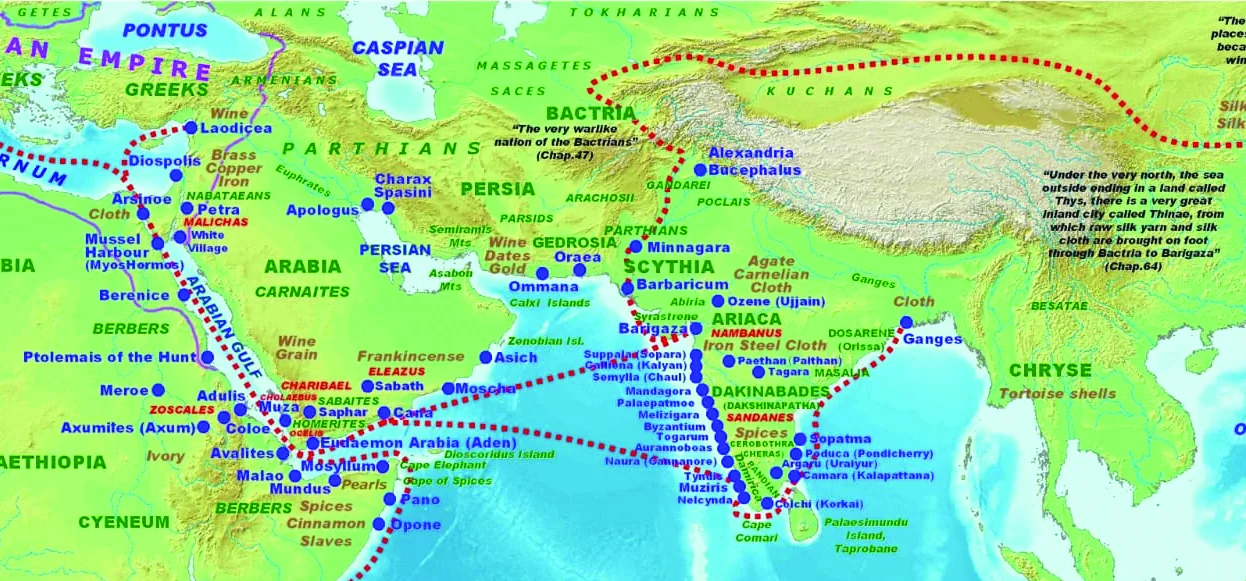
India’s maritime might was not only commercial but strategic. The Satavahanas of the Deccan thrived on the Indo-Roman trade through Malabar ports. The discovery of a figure of the Hindu Goddess Lakshmi at Pompeii, in erstwhile Rome, is a striking reminder that Indian goods and iconography travelled as far as Roman cities, underscoring the depth of Indo-Roman maritime exchange.
Strengthening maritime ecosystem
- The Union Cabinet, chaired by PM Narendra Modi in September 2025, approved a ₹69,725 crore package to revitalise Bharat’s shipbuilding and maritime ecosystem
- The initiative will run for 10 years and is based on a four-pillar strategy: Strengthening domestic shipbuilding capacity, providing long-term financing solutions, promoting greenfield and brownfield shipyard development and enhancing skills, technical capabilities, and policy reforms
- The Shipbuilding Financial Assistance Scheme (SBFAS) has been extended till March 31, 2036 with a total corpus of ₹24,736 crore
- A Shipbreaking Credit Note allocation of ₹4,001 crore has been announced to incentivise domestic shipbuilding
- A new National Shipbuilding Mission will be set up to oversee and coordinate all initiatives
- The Maritime Development Fund (MDF) with a corpus of ₹25,000 crore has been approved, comprising:
- Maritime Investment Fund of ₹20,000 crore (49% government participation)
- Interest Incentivisation Fund of ₹5,000 crore to lower debt costs and improve project bankability
- The Shipbuilding Development Scheme (SbDS) with an outlay of ₹19,989 crore will:
- Expand Bharat’s shipbuilding capacity to 4.5 million Gross Tonnage (GT) annually
- Support creation of mega shipbuilding clusters and infrastructure expansion
- Establish the Bharat Ship Technology Centre under the Indian Maritime University
- Provide risk coverage and insurance support for shipbuilding projects
- Recently the government passed Bills related to maritime. The new Bills are the Bills of Lading 2025, the Carriage of Goods by Sea Bill 2025, the Coastal Shipping Bill 2025, the Merchant Shipping Bill 2025, and the Indian Ports Bill 2025
- The Bills of Lading, 2025, focuses on simplifying legal documents to reduce disputes and improve the ease of doing business. The Carriage of Goods by Sea Bill, 2025, replaced a 1925 Act, adopting Hague-Visby Rules for reduced litigation and stronger international ties
- The Coastal Shipping Bill, 2025, targets reviving Bharat’s 6 per cent modal share, saving around Rs 10,000 crore annually in logistics costs, and also reducing pollution and road congestion
The Cholas, at their zenith, built naval forces numbering hundreds of ships. Rajendra Chola’s 11th-century expedition against Srivijaya in South East Asia was not conquest for territory but a campaign to suppress piracy that threatened maritime commerce. Indian naval power was thus exercised to secure order, not to dominate. The Cholas complemented naval expeditions with diplomacy. This could be exemplified through the Song Dynasty chronicles mentioning embassies from the ‘Chulian’ kings, a testament to the recognition India’s maritime rulers commanded in East Asia.
On the Malabar coast, the Kunjali Marakkars resisted Portuguese fleets for a century. Using shallow-draft vessels against heavily armed carracks, they exploited geography with audacity, demonstrating asymmetrical maritime resilience. In the West, Chhatrapati Shivaji Maharaj was guided by the strategic principle that “he who is victorious over the oceans is almighty,” a truth that underscored his efforts to secure maritime supremacy. His forts along the Konkan, later fortified by Sarkhel Kanhoji Angre, became thorns in the side of European naval powers.
From Rani Abbakka of Ullal, who defied Portuguese armadas, to Marthanda Varma’s consolidation of Travancore’s naval power, Bharat’s coastlines were guarded by warriors who understood the sea not as a boundary, but as a theatre of sovereignty. This view was not only restricted to the seas. On the Brahmaputra, Lachit Borphukan of the Ahom kingdom led the 1671 Battle of Saraighat, where the use of agile war canoes and tactical ingenuity enabled the Ahoms to prevail over the Mughal fleet. His riverine campaigns highlight that control of waterways, both maritime and inland, has long been integral to Bharat’s sovereignty.
Decline & Colonial Eclipse
Yet, after centuries of prominence, decline had set in. By the 13th century, India’s maritime vision dimmed. Risk-taking declined, religious taboos such as samudra ulangan stigmatised overseas travel, and “sea blindness” set in. Arab and Chinese traders filled the vacuum.
The great turning point came in 1498, when Vasco da Gama landed at Calicut. Enabled by a Papal bull that divided the world between Spain and Portugal, European powers entered the Indian Ocean with new maritime technologies and imperial ambitions. Resistance was fierce, be it the Kunjalis, the Angres, regional dynasties, but betrayals and fragmentation weakened India’s position.
Panikkar’s warning resonates: India’s subjugation was not from land defeats, but maritime vulnerability. Colonial control systematically curtailed indigenous shipbuilding, dismantled maritime institutions, and relegated India to the status of a subject people in its own ocean.
World War II and the Post-Independence Revival
World War II provided a strange opportunity for revival. Thousands of Indians served across theatres from Madagascar to Singapore, gaining modern naval exposure. Visionary leaders anticipated that self-rule would demand maritime strength. The Scindia Steam Navigation Company’s Loyalty voyage from Bombay to London in 1919 symbolised mercantile assertion, and April 5 is now commemorated as National Maritime Day in its honour.
After Independence, institutions such as Hindustan Shipyard and the Shipping Corporation of India, with strong contributions from the Sindhi community, sustained shipping resilience. By the 1960s and 70s, India was among the few developing nations with its own shipbuilding base and merchant fleet. The seeds of modern revival had been planted.
Slump of 1970s-80s
Yet progress faltered. The oil crises and global shipping recessions hit India hard. Strategic thinking returned to a land-centric focus after the 1962 and 1971 wars. Maritime consciousness remained shallow, confined to coastal communities and specialists. Though naval performance in 1971 demonstrated capability, doctrine lagged, and shipping declined. This was not a collapse, but a lull, a subdued tide before the surge.
The 1990s liberalisation reopened India to the world, and the seas again beckoned. The Vajpayee era and Prime Minister Manmohan Singh’s 2004 Naval Commanders’ Conference recognised the need for maritime doctrine. A watershed came with the 2004 tsunami: India’s Navy emerged as a first responder, projecting humanitarian power across the region.
PM Modi’s Will to Make Bharat Maritime Power
Maritime strategy gained international salience through Prime Minister Narendra Modi’s resurgent “Sagar Sampann Bharat”, the Ensuring Secure Seas doctrine of 2015, the articulation of SAGAR (Security and Growth for All in the Region), and the subsequent Mahasagar vision. This has expanded India’s maritime horizon from the Indian Ocean to the broader Indo-Pacific.
Today, Bharat has reclaimed its role as a maritime pillar in the world. With over 11,000 km of coastline and geographic command over critical chokepoints, India sits astride the lifelines of global commerce.

The Navy fields aircraft carriers like INS Vikrant, nuclear submarines under Project 75 Alpha, and advanced destroyers of Project 15B. Surveillance assets such as P-8I aircraft and coastal radar chains extend maritime domain awareness. India leads in counter-piracy patrols, anti-trafficking operations, and cyber protection of offshore infrastructure.
Compassionate Approach
As Panikkar anticipated, the Navy is now military, diplomatic, constabulary, and benign in its reach. It defends, deters, builds trust, upholds law, and delivers humanitarian relief. Exercises such as Malabar, MILAN, and Varuna deepen interoperability and signal shared responsibility. Operations like Samudra Setu during the COVID-19 pandemic and support to Sri Lanka in its economic crisis showcase compassion at sea.
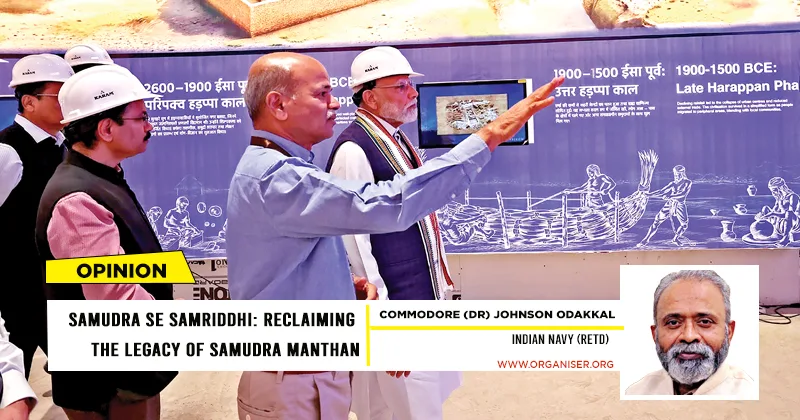
Lothal: Showcasing rich heritage of Maritime
- Bharat with a 7,520-km long coastline is home to the oldest known civilisation in the world, the Indus Valley Civilisation (IVC). Excavations over the last 100 years have led to more and more evidences of the once thriving IVC
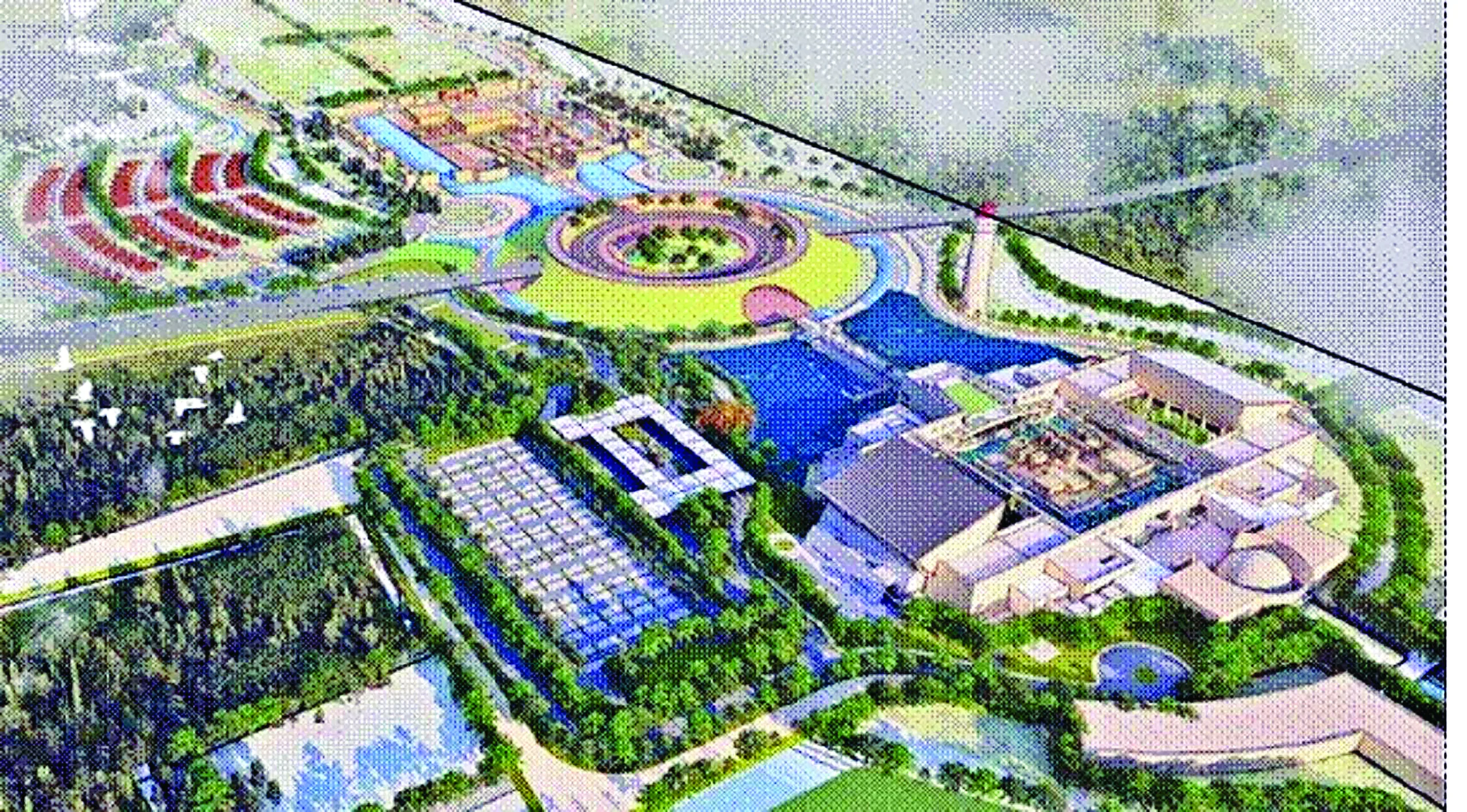
- The NMHC is being built in Lothal, Gujarat, a historic Indus Valley civilization(IVC) site, under the Ministry of Ports, Shipping, and Waterways.
- The NMHC project aims to become one of the world’s largest maritime complexes, integrating past, present, and future maritime activities into a world-class facility
- The NMHC project will feature a museum with 14 galleries, Lothal Town, an Open Aquatic Gallery, Lighthouse Museum, Coastal State Pavilions, eco resorts, theme parks, and a maritime research institute
- Bharat Maritime History
Ancient Bharat:
- Indus Valley Civilization (IVC) : The origins of Bharat’s maritime activities can be traced to the IVC
- Lothal’s dry-dock (2400 BC) is the world’s first known dry-dock, reflecting advanced nautical knowledge
- Evidence indicates robust trade between the Indus Valley and Mesopotamia
- The discovery of Harappan seals and jewelry in Mesopotamia underscores this extensive exchange between the two ancient civilizations
- Vedic Era (1500 – 600 BC): Vedic literature, including the Rig Veda, mentions boats and sea voyages, with Varuna, the Lord of the Sea, guiding maritime routes
- The Ramayana and Mahabharata describe shipbuilding and sea travel
- Nandas and Mauryas (500 – 200 BC): The Magadh kingdom’s navy is the first ever recorded instance of a navy anywhere in the world.
- Chanakya, the advisor to the first Mauryan emperor, Chandragupta Maurya, detailed a waterways department led by a Navadhyaksha (Superintendent of Ships) in his Arthashastra
- Emperor Ashoka used maritime routes to spread Buddhism to Southeast Asia and Sri Lanka, further enriching India’s cultural and religious influence
- Satavahana Dynasty (200 BC-220 AD): The Satavahanas controlled Bharat’s East coast, trading with the Roman Empire
- Gupta Empire (320-550 AD): The Gupta Dynasty marked Bharat’s Golden Age, with prosperity, cultural growth, and advancements in astronomy and navigation, as noted by Chinese travelers Fa-Hien and Huein Tsang
Southern Dynasties:
- Cholas (3rd–13th century): Extensive maritime trade with Sumatra, Java, Thailand, China. Built harbors, shipyards, lighthouses
- Pandyas: Controlled pearl farming and traded with Rome and Egypt
- Cheras (12th Century): They traded with the Greeks and Romans, using monsoon winds to sail from Tyndis (near Kochi) and Muziris (near Kochi) to Arabian ports
Pre- Independence:
- Shivaji Naval Resistance: Shivaji Maharaj built a strong navy to counter European and Mughal influence along the western coast. Coastal forts like Sindhudurg and Vijaydurg strengthened maritime defenses
Status of Bharat’s Maritime Sector:
- Bharat ranks as the 16th largest maritime country globally
- Bharat is the world’s 3rd largest ship recycler by tonnage, holding a 30 per cent global market share in ship-breaking with the world’s largest ship-breaking facility located in Alang, Gujarat
- Economic Importance: Bharat’s maritime sector serves as the backbone of its trade and commerce, handling around 95 per cent of the country’s trade by volume and 70 per cent by value
- Bharatiya ports handle approximately 1,200 million tonnes of cargo annually, underscoring the sector’s economic significance
- According to the World Bank’s 2023 Logistic Performance Index (LPI) Report, Bharat ranks 22nd globally in the “International Shipments” category, a significant rise from 44th in 2014
- This improvement underscores the performance of Bharatiya ports, which have outperformed global peers on operational parameters such as container turnaround time and dwell time
- With the global blue economy expected to reach USD 6 trillion by 2030, Bharat’s maritime sector is set to significantly contribute to the country’s rise as the world’s third-largest economy
Projects like Sagarmala integrate ports, coastal communities and sustainable growth with research in green fuels and autonomous shipping prove that India’s maritime vision is not merely about fleet strength, but stewardship of oceans as global commons. In Panikkar’s words, maritime power is once again India’s “lifeline.” But today it is anchored in confidence, not vulnerability.
Samudra Manthan to Mahasagar
India’s maritime journey is a saga of rise, eclipse and resurgence. From Harappan dockyards to Chola expeditions, from the defiance of the Marakkars and Angres to the humiliation of colonial eclipse, from wartime revival to post-Independence resilience, from the slump of the 1970s to the resurgent decades of the 21st century, this is a story of continuity and renewal.
The imagery of Samudra Manthan returns to guide us: churning the ocean yields wisdom and strength, not merely treasure. India’s modern doctrine of Mahasagar carries the same essence. It is not about dominance, but about stewardship, collaboration, and balance.
Bharat’s maritime destiny is its civilisational essence and its strategic future. The oceans, once the theatre of our neglect, are now the compass of our resurgence. As India sails into the Amrit Kaal, it does so with pride in its heritage, confidence in its capability, and commitment to a rules-based, responsible maritime order.












Comments