





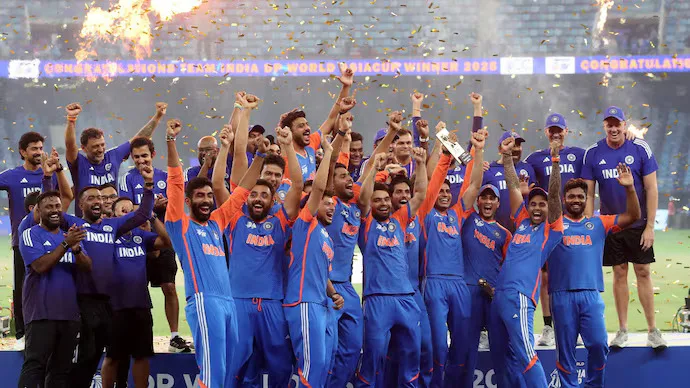
India’s emphatic victory over Pakistan in the Asia Cup final on September 28, turned into more than just a cricketing triumph. Securing their ninth Asia Cup title with a five-wicket win in Dubai, Team India drew praise from Prime Minister Narendra Modi, who invoked the spirit of Operation Sindoor, a recent military strike against Pakistan, to highlight the nature of the win.
“Operation Sindoor on the games field. The outcome is the same – India wins! Congrats to our cricketers,” PM Modi wrote on X, linking the battlefield and the cricket pitch with one clear message: whether in sports or security, India prevails over Pakistan.
PM Modi’s remark carried heavy symbolism. Earlier this year, Operation Sindoor had devastated Pakistan’s terror infrastructure through targeted Indian airstrikes, leaving Pakistan’s airspace exposed and forcing a senior Pakistani military officer to seek a ceasefire. By equating India’s cricketing triumph with the operation, Modi underlined a continuity of dominance across fields.
On the field, Tilak Varma emerged as India’s hero with a composed half-century, backed by Sanju Samson and Shivam Dube’s crucial partnerships. Their efforts helped India chase down Pakistan’s total with ease. This marked India’s second T20I Asia Cup crown and the ninth overall, including ODI editions.
Under captain Suryakumar Yadav, India has been in unstoppable form, winning 18 T20 internationals, losing only two, and tying two since he took over the leadership mantle.
However, the post-match ceremony saw unprecedented tussle. The Indian team refused to receive the Asia Cup trophy from Pakistan Cricket Board (PCB) chief Mohsin Naqvi, who also serves as president of the Asian Cricket Council (ACC). Naqvi, a senior Pakistani government minister, had earlier sparked controversy with a provocative post during the tournament.
Captain Suryakumar Yadav confirmed the team’s stand: “We as a team decided not to take the trophy from Mohsin Naqvi. Nobody told us to do so, but I feel a team that wins the tournament deserves the trophy. Yet, it was denied to us,” he told reporters.
The players accepted their medals but avoided wearing them on stage. Neither did Suryakumar hold the trophy. In a bizarre turn, an ACC official was seen quietly removing the trophy from the presentation area after India’s refusal.
According to reports, the team had informed officials that they were willing to accept the trophy from Emirates Cricket Board vice-chairman Khalid Al Zarooni, who was present on stage alongside Naqvi. However, Naqvi allegedly refused to allow this arrangement.
“This is one thing I have never seen since I started playing cricket, that a champion team is denied a trophy. We played back-to-back tough games and I felt we deserved it,” Suryakumar lamented.
Despite the snub, he emphasized the spirit of the team: “If you ask me about trophies, I have 14 in my dressing room. But the real trophies are my teammates and the support staff. That’s what I’m taking back from this Asia Cup,” he said.
While the trophy row overshadowed the celebrations, individual brilliance was acknowledged. Abhishek Sharma received the Player of the Series, and Tilak Varma was named Player of the Tournament. Pakistani players collected their runners-up medals without incident.
For many, the match was not just about runs and wickets but a symbolic continuation of national assertion. With PM Modi branding the win as “Operation Sindoor on field,” the Asia Cup final has now entered the annals of India-Pakistan sporting history as a game charged with symbolism, pride, and defiance.











Comments