





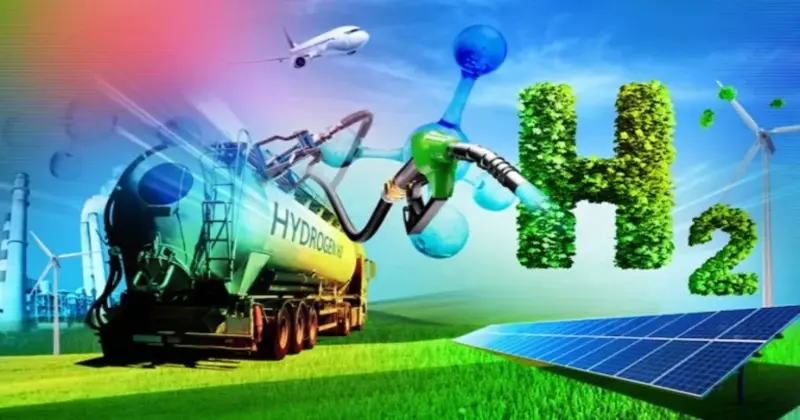
The Indian Government’s mission to achieve a targeted production capacity of 5 million tonnes per annum of Green Hydrogen by 2030 is now supported by ISRO. Chairman Dr. V. Narayanan spoke at the Alliance University Bengaluru during a national workshop on hydrogen fuel technologies. His message marked the tone for what might be India’s next technology and energy great leap.
“Hydrogen is one of the cleanest and greenest fuels, which is a ray of hope for sustainable development,” he said to students and scientists. He also mentioned that “It is at the core of ISRO’s advancement and will define India’s aspiration in space, clean energy and greener transport.”
The journey of hydrogen, from road to rocket
India’s focus on hydrogen is not recent. Its space programme is a living testament. Back in February, the GSLV Mk III rocket, the 100th successful mission by ISRO, took to the sky was fuelled by a cryogenic stage powered by liquid hydrogen and oxygen. It was a moment of pride for the agency and country as well. This technology was once denied to India by the world order, now India has mastered its own technology and has become self-reliant.
Dr. Narayanan also remembered another milestone and said “We had tested a 100-watt oxygen-based fuel cell in space last year and we now have a 20-kilowatt version under test”. This breakthrough indicates the extent to which hydrogen is not only rocket fuel but a wide-ranging energy source with limitless uses.
Indeed, the presence of hydrogen has been quietly growing across industries. In 2010–11 ISRO and Tata Motors constructed a bus that was powered by a hydrogen fuel cell. While tested in safety and public concerns kept such experiments on hold. But the times have changed now, in June 2025 five buses powered by hydrogen were rolled out to commercial operations, taking a step towards cleaner transportation in cities. Industry players like BHEL and NTPC are racing ahead by constructing hydrogen systems and even gas turbine engines.
Hydrogen, as promising as it is, has to be handled with care. “We should never overlook safety hazards,” cautioned Dr. Narayanan. He went on to note that large-scale hydrogen plants present possible hazards, underlining the necessity for quick response sensors. In present time sensors respond within three to four seconds, but in the future millisecond response detection could create the difference between danger and safety.
His emphasis was on the safety issue and also focused that technology is never about invention alone, but also responsibility. If hydrogen is to be used to fuel cars, industries and even homes, it needs to be used with the utmost care.
A new era of cryogenic achievements
India’s cryogenic engine journey has been nothing but spectacular. Dr. Narayanan clarified that ISRO currently has three cryogenic propulsion systems operational, with India leading the world in three of the most important parameters. “We achieved a first flight with three engines alone, achieved engine development in 25 months and conducted a stage test in just 34 days,” he said.
With the success of the NASA-ISRO NISAR satellite, which carries a precious Indian-made payload, India had arrived from the modest launch of its first tiny rocket in 1963 which was made possible with support of the USSR.
Although the space industry provides evidence of the power of hydrogen, its real potential exists in in daily application. Hydrogen is being adopted in aircraft, trains and automobiles. Its potential to produce no carbon emissions at the point of use means it is among the most efficient way to decarbonisation. For a nation like India which is seeking to grow while being environmentally conscious this technology may prove revolutionary.
It was perfectly put by Abhay G. Chebbi, Pro-Chancellor of Alliance University, during the workshop that “Hydrogen is developing fast as a clean, efficient and multifaceted energy carrier. With less than 1% of the world’s hydrogen originating from renewable resources, workshops and experiments are imperative to fill the gap between potential and reality.”
His call to students was straightforward: the future of energy transitions is not just in the hands of policy and industry but also in the minds of those young adults eager to innovate and risk.
The National Green Hydrogen Mission
India’s vision is well-defined to emerge as a world leader in hydrogen production, utilization and export. The National Green Hydrogen Mission is the catalyst for this vision. It seeks not just to enhance energy security but also to create future industries.
This mission is a response to the twin world pressures: growing energy demands and the need to reduce greenhouse emissions. However, for India, the stakes are even higher. A fast-growing population, a rapidly widening economy and accelerating urbanization place enormous strain on conventional sources of energy. Hydrogen provides an answer to these demands without copying the carbon-intensive model of development.
Students and the future of innovation
Maybe the most moving segment of the workshop was the appeal to students. “The future is now,” they were reminded by Dr. Narayanan. Hydrogen is no longer a vision for the future; it is already hard at work in rockets, buses and power cells. But to scale it up will take innovation, new ideas and nerve to tackle challenges such as cost, storage and safety.
The students were also reminded that India’s scientific tale has always been that of endurance and vision. From achieving excellence in cryogenic technology despite the international sanctions as well as creating one of the world’s most ambitious space programs, India as a nation has demonstrated that persistence always bears fruit. Hydrogen could well be the next instalment in this saga, one that will be written by the current generation of engineers, scientists and entrepreneurs.
A global race, with India in the lead
The world is racing ahead on hydrogen. Developed countries are already pouring billions into research, infrastructure and commercialization. But India, with its proven track record of innovating on a shoestring, has a chance to not only emulate but lead.
Dr. Narayanan’s enumeration of ISRO’s success was not merely a technical update; it was also an announcement of what India is capable of, when it applies itself. From launching satellites to going green on roads with buses, hydrogen is not only defining India’s dreams, it is adding wings to them.
Hydrogen, once a distant scientific curiosity, is today a practical tool for change. It can fuel rockets, run buses, power homes and cut emissions. But more than that, it represents India’s determination to define its own path towards progress one that is cleaner, safer and sustainable.
For a nation that launched its first rocket from a small fishing town in 1963, the hydrogen tale is yet another story of how vision, supported by determination, can turn obstacles into achievements. The fuel of the future is already here and India is poised to be the beneficiary of its promise from the skies above to the streets below.
















Comments