





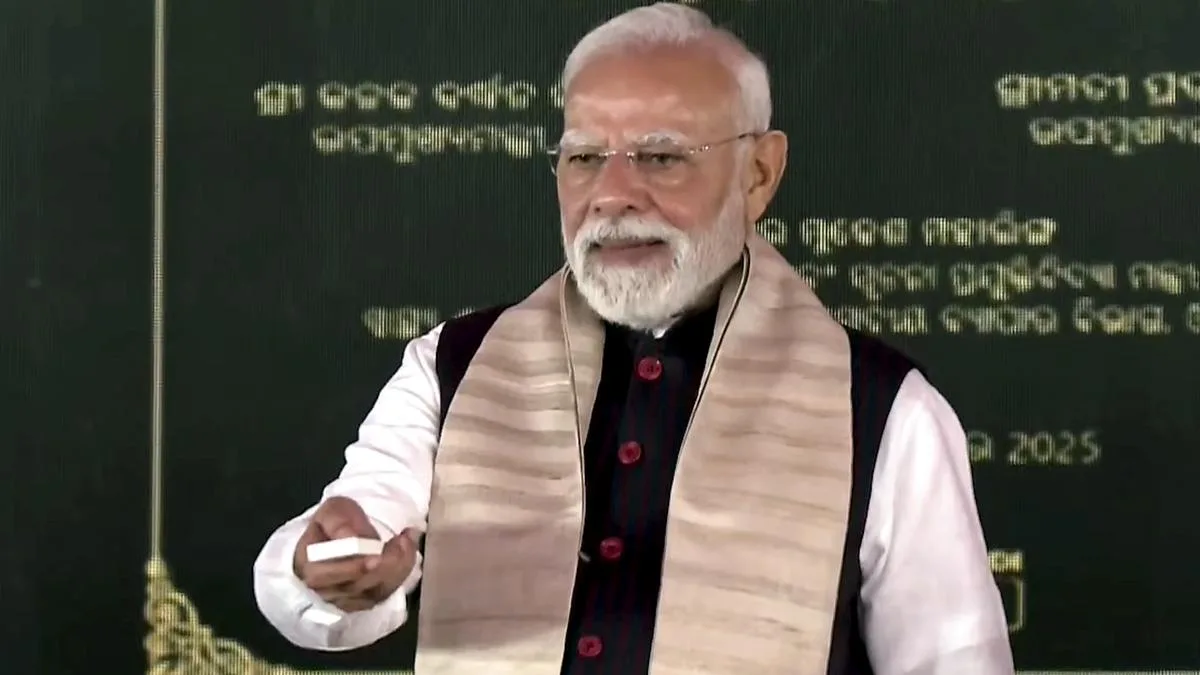
On BSNL’s silver jubilee, Prime Minister Narendra Modi stood before a gathering of telecom engineers, policymakers, and industry leaders and pressed the button that marked the formal launch of India’s first fully Swadeshi 4G network in Odisha.
It was not just another infrastructure project. It was a statement. A statement that India, a country of 1.4 billion people long dependent on imported telecom equipment, had now built its own complete network system from scratch. With this launch, India joined a small and powerful club, alongside Denmark, Sweden, South Korea, and China, of nations that can design, develop, and run their own telecom backbone.
And the numbers were equally staggering. 97,500 new BSNL 4G towers were simultaneously commissioned, built at an investment of Rs 37,000 crore, including advanced solar-powered towers in the remotest corners of the country.
Over 26,700 unconnected villages, including 2,472 of Odisha, in remote, border and left-wing extremism-affected areas will receive connection with this launch. This will serve over 20 lakh new subscribers, the statement said.
As the Prime Minister put it: “The Bharat Telecom Stack is not just about faster data. It is about India having complete control over its digital backbone. It is about Atmanirbhar Bharat.”
What makes the Bharat Telecom stack special?
For decades, India’s telecom story has been driven by imports. Almost 90 percent of the equipment, from core networks to towers, came from abroad. That dependency came with risks: inflated costs, vulnerability to cyber threats, and the constant fear of being left behind in technology races.
The Bharat Telecom Stack breaks that cycle. It is an end-to-end Indian system, designed, developed, manufactured, and deployed within the country. Unlike conventional networks that piece together parts from various foreign vendors, this is a full-stack solution that covers every layer:
1. C-DOT built the core network technology.
2. Tejas Networks provided the radios and transmission gear.
3. Tata Consultancy Services (TCS) set up the data centres and handled integration.
4. BSNL led the deployment on the ground.
Together, they created a cloud-based, 5G-ready system that can be monitored around the clock by an AI-driven Cognitive Network Operations (CNOPS) platform.
In plain words, this means India does not just have a 4G network; it has the ability to upgrade to 5G and beyond without ripping the system apart.
From blueprint to rollout in two years
One of the most remarkable aspects of the project is its speed. In just two years, the entire system went from design to deployment, one of the fastest 4G rollouts anywhere in the world.
The investment did not just target cities. Under the Digital Bharat Nidhi scheme, nearly 18,900 towers have been put up in rural, border, and insurgency-affected regions. These towers will connect 26,700 villages that had no reliable internet access until now.
Think about that: villages that had to climb hills or travel miles just to make a phone call will now have high-speed connectivity at their doorstep. For students, farmers, and small businesses in these areas, this is nothing short of transformational.
Why it matters: Beyond speed and towers
1. Securing India’s Digital Borders: In today’s world, telecom networks are as critical as military bases. A single vulnerability can open doors to espionage, data theft, or sabotage. By building its own telecom stack, India ensures that its most sensitive communications, in defence, governance, and critical infrastructure, remain secure and sovereign.
As Modi reminded the audience: “From data privacy to defence communication, India’s lifeline will now remain in India’s hands.”
This parallels the success of the India Stack, the homegrown ecosystem that gave us Aadhaar, UPI, DigiLocker, and FASTag, and revolutionised how Indians access digital services.
2. Boosting Jobs and Exports: The economic benefits are equally large. Instead of spending billions on imported technology, India can now invest in its own companies. That means thousands of new jobs in manufacturing, R&D, and telecom services.
And the opportunity does not stop at home. Many developing countries in Asia, Africa, and Latin America need affordable telecom solutions. With the Bharat Telecom Stack, India can step in as a global supplier, just as it has already become the second-largest mobile phone manufacturer in the world.
If executed well, India could transform into a global telecom hub, exporting not just handsets but the very networks that power them.
3. Bridging the Digital Divide: At its heart, the Bharat Telecom Stack is about inclusion. Millions of Indians in remote villages have been left out of the digital revolution. Now, with solar-powered towers and Swadeshi infrastructure, those communities will finally be connected.
Imagine a farmer in a tribal village using a smartphone to check crop prices in real time, or a student in a border district joining an online classroom. For them, this is not just about faster internet, it is about opportunity, dignity, and empowerment.
This directly feeds into the government’s vision of “Viksit Bharat @ 2047” a developed India where no citizen is left behind.
4. Ready for the Future: 5G and 6G: While the current rollout is 4G, the system is 5G-ready. BSNL has already announced plans to switch on 5G services by the end of the year, using the same Swadeshi backbone.
And looking further, India is already pushing into 6G research. With its own telecom stack in place, the country is no longer a passive consumer of global technology, it can lead the next wave.
The challenges ahead
Of course, challenges remain. BSNL has often been criticised for being slow to adapt. Entering the 4G market at a time when private players are well into 5G may look like playing catch-up.
But many argue the bigger picture matters. As telecom analyst quoted in media said: “This is not about who launched 4G first. It is about who controls the backbone of their telecom future. On that front, India has taken a decisive step.”
The tougher challenge will be competing globally against giants like Huawei, Ericsson, and Nokia. To succeed, India will need strong trade diplomacy, aggressive marketing, and strategic partnerships with countries looking for affordable and secure alternatives.
Symbol of Atmanirbharta
The Bharat Telecom Stack is not just about technology. It is about confidence. It is India saying to the world that it can build and innovate at the highest level and do it on its own terms.
Just as India once depended heavily on imported defence systems but now produces its own fighter jets and missiles, telecom too is moving towards self-reliance and strength.
As PM Modi summed it up in his address: “Bharat Telecom Stack is not just about connecting towers and signals. It is about connecting India’s future to India’s innovation.”
More than faster internet
The launch of BSNL’s Swadeshi 4G stack is a turning point. It is not just about better connectivity for consumers. It is about national security, economic independence, digital inclusion, and global leadership.
For a villager, it means access to the internet. For the government, it means secure communication. For the economy, it means jobs and exports. For the world, it means a new alternative to expensive and monopolised global telecom systems.
In many ways, the Bharat Telecom Stack is India’s declaration of digital independence, built in India, powered by Indian minds, and ready to serve both the nation and the world.













Comments