





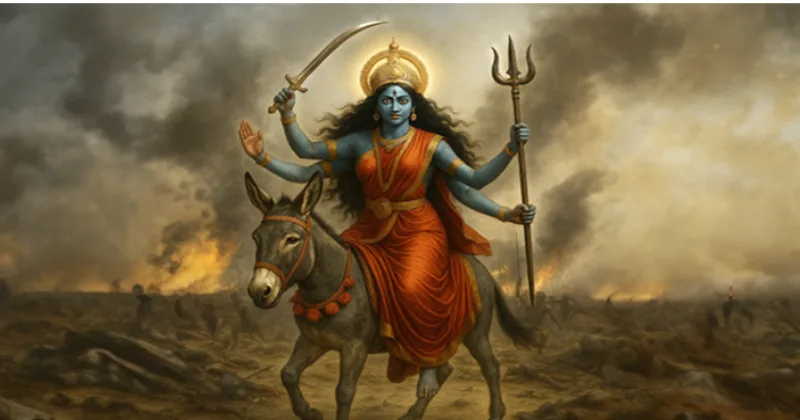
On the seventh day of Navratri, devotees across India worship Ma Kalaratri, one of the fiercest and most awe-inspiring forms of Durga Ma. Called the “destroyer of darkness,” she is honored not for her fierce appearance but for the courage and wisdom she grants her devotees. Worshiping her carries profound spiritual meaning, representing the removal of fear, ignorance, and negative energies that overshadow human life.
Goddess Kalaratri is often depicted with a dark complexion, disheveled hair, and a fearless stance. She rides a donkey, carries a sword and iron hook, and radiates a powerful aura that signifies fearlessness. Despite her fierce form, scriptures describe her as immensely compassionate, protecting her devotees from evil influences, nightmares, and inner weaknesses. Her very image is a reminder that darkness, whether external or internal, can only be overcome through courage and faith.
The word Kalaratri itself translates to “the dark night of time,” a metaphor for the most difficult and testing phases of human life. Worshipping her is believed to give devotees the strength to confront challenges, face adversaries, and rise above insecurities. Just as night ends with the dawn, her blessings symbolize the assurance that no struggle lasts forever and that courage leads to liberation.
Spiritual teachers often highlight that fear is the root cause of human suffering. By surrendering to Kalaratri, devotees find the mental and emotional strength to overcome irrational fears, whether of failure, loss, or death.
Beyond fear, Goddess Kalaratri is also celebrated as the destroyer of ignorance. In Hindu philosophy, ignorance (avidya) is considered a major barrier that prevents individuals from realizing truth and self-awareness. Darkness here is not just physical but intellectual and spiritual.
Her worship is believed to ignite inner wisdom that helps the devotees to differentiate between illusion and reality. By removing the veil of ignorance, she paves the way toward enlightenment and self-realization. Thus, her fierce energy is not destructive in a negative sense but transformative, enabling growth and clarity of thought.
Texts like the Markandeya Purana and Devi Mahatmya describe Kalaratri as a warrior who annihilates demons, including Shumbha and Nishumbha, who represent arrogance and delusion. In doing so, she becomes a symbol of victory over inner vices that trap the human spirit.
According to tradition, offering prayers to her during Navratri brings protection from evil spirits, accidents, and obstacles. Her mantra, chanted with devotion, is said to create a shield of positive energy, driving away negativity from the devotee’s surroundings.
In today’s fast-paced and stressful world, the worship of Goddess Kalaratri carries strong relevance. Fear of uncertainty, failures in career, relationship challenges, and social pressures continue to affect individuals deeply. Similarly, ignorance in the form of misinformation and narrow-mindedness creates division and unrest in society.
By invoking the power of Kalaratri, devotees are reminded of the importance of courage, resilience, and clarity of thought. Her worship inspires people to embrace truth, challenge injustice, and free themselves from self-doubt.
On the seventh day of Navratri, temples and households perform special prayers in her honor. Devotees light oil lamps, offer jaggery, and recite her mantras to seek protection and blessings. The rituals emphasize purification of the mind and environment, creating a sacred space for inner reflection.
Many also observe fasts on this day, symbolizing discipline and surrender. In certain regions, the worship of Kalaratri is considered especially important for students and seekers of knowledge, as she is believed to clear mental blockages and enhance learning.
Goddess Kalaratri may appear fearsome, but her essence lies in compassion and guidance. She is the embodiment of courage against fear and knowledge against ignorance. Her worship during Navratri is not just about venerating a divine force but also about recognizing and overcoming the darkness within.














Comments