





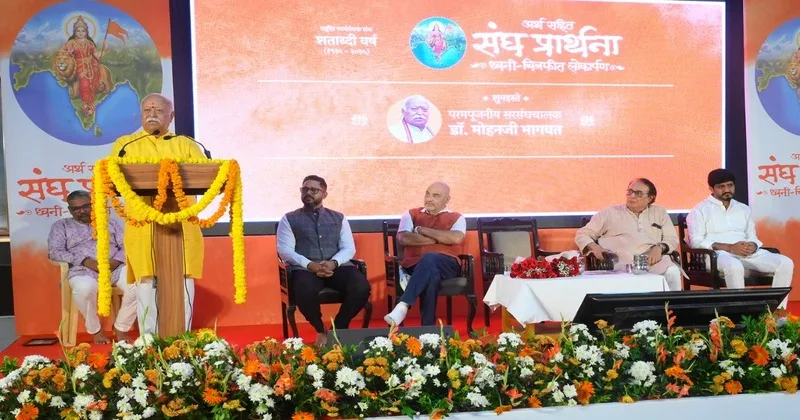
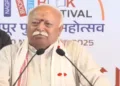
“Sangh’s Prarthana is the collective resolve of the organisation. Since 1939, swayamsevaks have been reciting this resolve through the prarthana in the daily shakha. With years of such sadhana, the prarthana has attained the strength of a mantra, and this is not just something to be told but something to be directly experienced”, said RSS Sarsanghchalak Dr Mohan Bhagwat at the inauguration ceremony of an innovative audio-visual presentation of the Sangh Prarthana, orchestrated with state-of-the-art music arrangement and translations of its meaning in various Bharatiya languages in Nagpur on September 27.
The ceremony was held at the Maharshi Vyas Auditorium in the Reshambagh Smriti Bhavan premises, attended by many distinguished personalities. On this occasion, the Dr Mohan Bhagwat elaborated on the history and impact of the Sangh prarthana.
He said that the Sangh prarthana expresses the goal to be collectively fulfilled by the entire Hindu society. It is a prarthana to Bharat Mata. The first salutation in it is to Bharat Mata, and only later to Ishwar. Nothing is sought from Bharat Mata; rather, it is a declaration of what has to be offered to her. What is to be asked for is sought from Ishwar. The prarthana is not just word, but an expression of feelings for Bharat Mata. The prarthana strengthens the swayamsevak.
Dr Mohan Bhagwat further said that there are also baal swayamsevaks in the Sangh. One might wonder, how much of the prarthana’s meaning do they understand? It is not true that they do not understand. They may not grasp the words and their meaning, but prarthana is a feeling. Even the most mischievous child swayamsevak, who troubles the teachers in the shakha, stands firm in the daksha and pranam posture during the prarthana. If a mosquito bites his right leg, he still keeps his left hand in pranam posture and uses the right hand for relief.
The first form of the prarthana is feeling. It carries the firmness of resolve and devotion and love towards the motherland. To understand feelings, no scholarship is needed, he further said.
Dr Mohan Bhagwat said that the Sangh believes that only when the collective energy of the entire Hindu society contributes, Bharat Mata will attain supreme glory. If this is to happen, then first comes feeling, then meaning, and then the flow of words. But if speed is to be increased, the path can also go from words to meaning, and from meaning to feeling.
Referring to an example he said, a Sanskrit teacher from a primary school was passing by when some sounds fell upon his ears. He was deeply impressed by its words and meaning. Out of curiosity, he asked the children about the sound, the children replied, “We are swayamsewaks of Sangh, and this is our prarthana.” Because of the impact of the prarthana, he began attending the Sangh shakha and later went on to become the Prant Sanghachalak of Bengal. He was Keshavchandra Chakravarti.
“Therefore, this flow must also begin, and this initiative is a medium to start such a flow. The combination of word, meaning, and feeling with music rarely occurs. When I first heard this track, I immediately realised that it elevates the prarthana into that atmosphere. Its preparation on the soil of England is a bonus. The more it spreads, the more new people will connect with the Sangh. Music has its own power, it enters directly into the mind through the ears”, he said.
Harish Bhimani said that today’s moment is unimaginable for us. The most important deity is Bharat Mata herself. She has no temple anywhere. This work was entrusted to me. For me, it is not just a ritual but an offering.
Rahul Ranade, Project lead & music director said, that the idea was first put before him by Bhimani himself.
During the ceremony, the audio-visual presentation of the Prarthana’s Hindi and Marathi translations was showcased. This Prarthana has been orchestrated with the collaboration of the Royal Philharmonic Orchestra of London. Renowned singer Shankar Mahadevan has given his voice to the prarthana, while Harish Bhimani voiced its Hindi translation and famous actor Sachin Khedekar voiced its Marathi translation. The presentation will also include translations of the prarthana in about 14 Indian languages, including Gujarati and Telugu.










Comments