





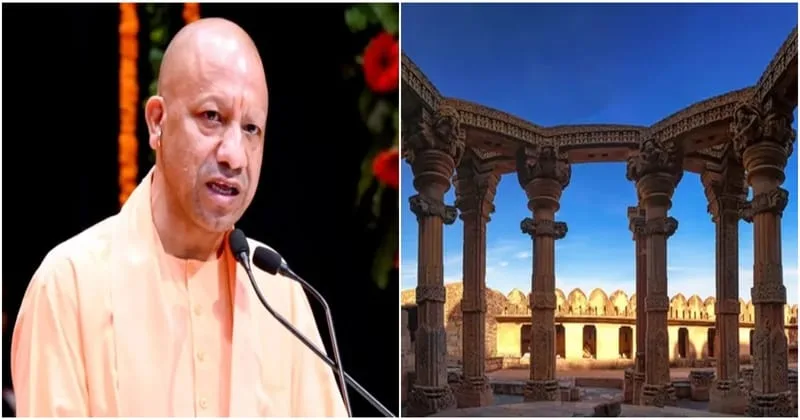
In a significant step towards cultural preservation and tourism-led development, Uttar Pradesh Chief Minister Yogi Adityanath has written to Prime Minister Narendra Modi, seeking the transfer of four heritage monuments protected by the Archaeological Survey of India (ASI) to the state government. The monuments include Talbehat Fort (Lalitpur), Kalinjar Fort (Banda), Madfa Fort (Chitrakoot), and the steps at Barua Sagar Ghats (Jhansi). According to the Chief Minister, state stewardship of these sites would not only strengthen conservation efforts but also enable modern tourism infrastructure, thereby boosting the economic prospects of Bundelkhand, a region he described as “the heart of India.”
Bundelkhand: A land of valour and heritage
Bundelkhand, spread across parts of Uttar Pradesh and Madhya Pradesh, has long been celebrated for its cultural depth, historic battles, and architectural grandeur. It is a land that has witnessed bravery, spiritual devotion, and artistic excellence. CM Yogi Adityanath, in his letter to the Prime Minister, stressed that the region has remained a centre of civilisation since the Stone Age and flourished prominently under the Gupta and Chandela dynasties.
The rulers of Bundelkhand left behind magnificent temples, palaces, and forts, each narrating tales of courage and resilience. However, despite its invaluable contribution to Indian civilisation, the region’s historical treasures have often remained underutilised from a tourism perspective.
The four sites under focus
Talbehat Fort (Lalitpur)
Talbehat Fort is a silent witness to centuries of warfare and royal rule. Built during the medieval era, the fort is known for its massive ramparts, gateways, and remnants of palatial structures. Historically, it was a strategic military base during the 1857 uprising, when Rani Lakshmibai and her allies used it in their resistance against British forces. Tourism experts believe that with proper illumination, guided tours, and amenities, Talbehat could emerge as a key destination for history enthusiasts and adventure tourists.
Kalinjar Fort (Banda)
Among Bundelkhand’s most iconic landmarks, Kalinjar Fort stands tall on the Vindhyan ranges, with its origins tracing back over a thousand years. The fort was a prized possession for dynasties including the Chandelas, Mughals, and Marathas. It was here that Sher Shah Suri met his end in 1545 due to an accidental explosion during a battle.
The fort is renowned not only for its strategic importance but also for its spiritual significance, with the Neelkanth Mahadev Temple inside its premises attracting devotees. Its walls bear intricate carvings, and the panoramic view from the fort adds to its allure. Under state stewardship, Kalinjar could be developed into a world-class heritage tourism site with sound-and-light shows, trekking trails, and better connectivity.
Madfa Fort (Chitrakoot)
Though relatively lesser-known, Madfa Fort in Chitrakoot carries immense historical and cultural value. Chitrakoot itself holds a sacred place in Hindu mythology, believed to be the site where Lord Rama, Sita, and Lakshmana spent a significant part of their exile. Madfa Fort, built in this spiritually charged region, adds to Bundelkhand’s heritage richness. By integrating the fort into pilgrimage tourism circuits, the site could attract not just history lovers but also religious tourists visiting Chitrakoot.
Steps at Barua Sagar Ghats (Jhansi)
Barua Sagar, located near Jhansi, is famous for its large lake and the historical steps leading to the water. The ghats have seen fierce battles, including conflicts during the 18th century and the 1857 revolt. The adjoining Barua Sagar Fort, overlooking the ghats, adds to the site’s significance. With proper development, Barua Sagar could be transformed into a heritage-cum-eco-tourism site, offering boat rides, cultural festivals, and light shows highlighting the region’s history.
Why transfer to the state government?
At present, the four sites are under the protection of the Archaeological Survey of India, which ensures their preservation but often with limited scope for tourism-related facilities. UP CM Yogi has argued that handing over the monuments to the state government would make them more accessible, visitor-friendly, and globally relevant.
He pointed out that under Section 35 of the Ancient Monuments and Archaeological Sites and Remains Act, 1958, such a transfer is legally possible. State control, he added, would allow the construction of visitor centres, sanitation facilities, illumination, and other tourist amenities without compromising cultural integrity.
A recent study by Ahmedabad-based CEPT University (Centre for Environmental Planning and Technology) identified 31 sites of importance in Bundelkhand, of which these four are currently ASI-protected. The report emphasised the urgent need for better infrastructure to unlock Bundelkhand’s tourism potential.
Tourism and Culture Minister Jaiveer Singh supported the Chief Minister’s request, stating that transferring these sites would help protect heritage while creating new jobs. He added that the development of Talbehat, Kalinjar, Madfa, and Barua Sagar Ghats would position Bundelkhand as a major attraction on the global tourism map. Experts believe that heritage tourism benefits local economies by generating employment in sectors such as hospitality, transport, handicrafts, and cultural activities. For Bundelkhand, which has long faced challenges like drought and limited livelihood opportunities, tourism could open up a sustainable path for growth.
CM Yogi also recalled that during the inauguration of the Bundelkhand Expressway, Prime Minister Modi himself had emphasised the importance of showcasing the region’s palaces, forts, and monuments as symbols of India’s global cultural identity. The new expressway has already improved connectivity to the region, laying the foundation for heritage tourism circuits. By integrating these monuments into structured tourism plans, the state government hopes to attract not only domestic travellers but also international visitors who are increasingly seeking cultural and experiential tourism.
One of the key concerns in transferring ASI-protected sites to state governments is maintaining the balance between development and preservation. UP CM Yogi Adityanath assured that the state’s focus would remain on conservation first, with modernisation aimed only at enhancing visitor experience.
This includes adopting best practices such as eco-friendly lighting, digital guides, augmented reality experiences, and community-led tourism models. The government also plans to involve local artisans and cultural performers in tourism programs, ensuring that development is inclusive and community-driven.
The proposal to transfer Talbehat Fort, Kalinjar Fort, Madfa Fort, and Barua Sagar Ghats to the Uttar Pradesh government is more than a matter of administrative control. It represents a vision to transform Bundelkhand from a historically rich but economically challenged region into a vibrant cultural and tourism hub.
With improved infrastructure, global promotion, and local participation, Bundelkhand has the potential to stand alongside Rajasthan, Madhya Pradesh, and Kerala as one of India’s premier heritage tourism destinations. If approved by PM, this could be the beginning of a new chapter for Bundelkhand, where its legendary tales of courage, devotion, and architectural grandeur find their rightful place on the world tourism map.
















Comments